
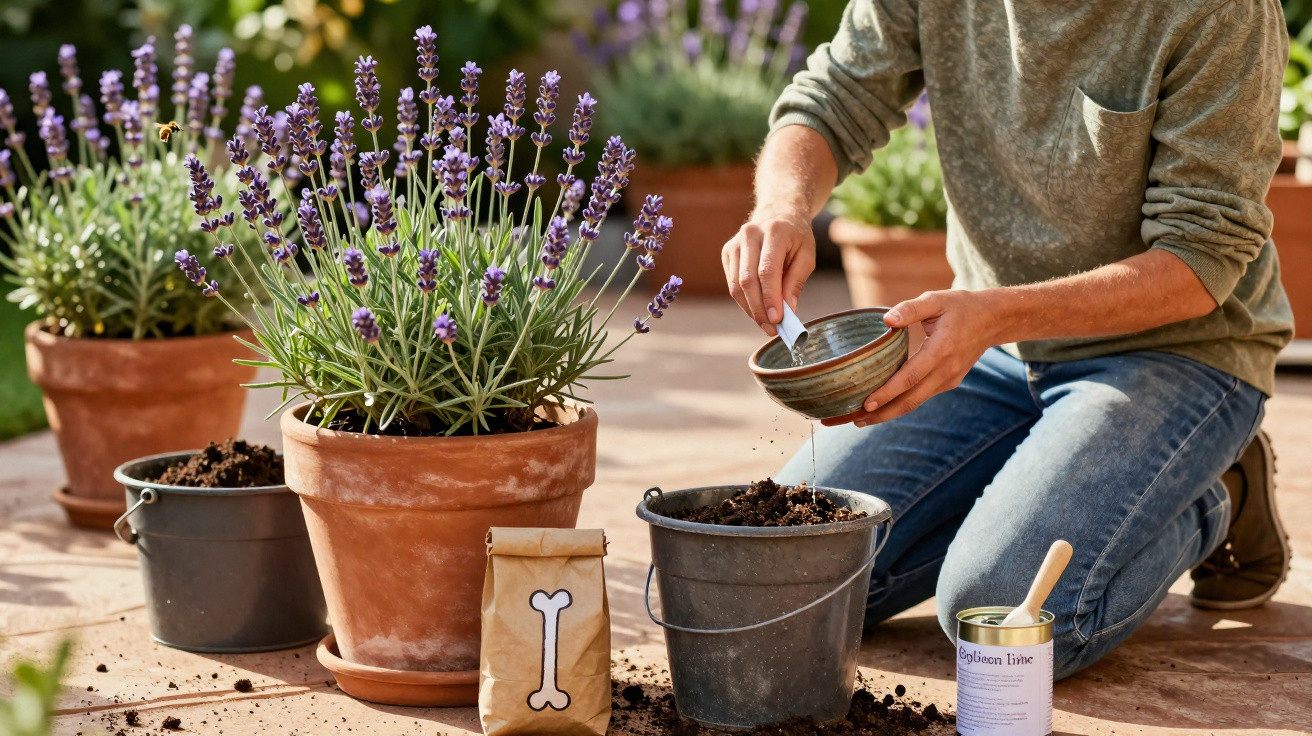
Many keen gardeners spend the summer watering and encouraging their plants, yet still wonder why their lavender produces hardly any flowers. The decisive step actually happens months earlier: in early spring, down in the soil, with a highly targeted and entirely natural nutrient blend.
Why lavender disappoints in July despite sunshine and watering
Lavender originates in the sparse, stony landscapes around the Mediterranean. There, it thrives in lean, free-draining ground, bakes in full sunshine and rarely receives much water. Those are precisely the conditions it prefers.
In the average home garden, the reverse is often true: plenty of compost, a thick layer of bark mulch, heavy potting compost and regular watering. While this may suit tomatoes perfectly, it is close to a nightmare for lavender.
“Lavender needs more light than feed – too many nutrients produce leaves rather than flowers.”
The effects of overly rich soil are familiar to many gardeners by July:
- lots of soft, green shoots
- few, short flower spikes
- the plant quickly flops open and looks “aged”
- greater susceptibility to wet conditions and frost
The encouraging part is that this can be corrected with a single, carefully applied spring feed. Rather than masking lavender’s natural habitat, it recreates it.
The three-part natural booster: compost, bone meal and lime
Garden professionals use a simple yet effective three-ingredient blend for lavender. Each ingredient is inexpensive, readily available and, crucially, works gradually and gently.
The recommended blend uses equal quantities of:
- mature compost
- bone meal
- garden lime or carbonate of lime
Each element has a distinct role:
| Ingredient | Effect on lavender |
|---|---|
| Mature compost | improves soil structure and provides small but broad-ranging amounts of nutrients |
| Bone meal | supplies plenty of phosphorus and calcium, supporting roots and flower production |
| Lime | raises the pH level and makes soil more calcareous – exactly what lavender enjoys |
“The clever part is that the blend does not feed heavily; it directs energy into roots and flowers rather than foliage.”
How to mix and apply lavender fertiliser correctly
Applying it is straightforward, but timing matters. Once a year is entirely sufficient; more frequent feeding is more likely to harm the plant.
Step 1: Prepare the blend
Use a small bucket or bowl and add:
- 1 part mature, sieved compost
- 1 part bone meal
- 1 part garden lime
Combine everything thoroughly until the mixture is even and slightly crumbly. Exact gram measurements are unnecessary, provided the proportions are roughly right.
Step 2: Feed at the right time
In central European conditions, the appropriate window is:
- Timing: roughly March to April
- once the hardest frosts have passed
- before fresh growth begins and buds become visible
At this stage, lavender is producing new roots and preparing to flower. This is when the blend has its strongest effect.
Step 3: Adjust the amount and placement
Keep the application deliberately modest:
- young plants in beds: around one small handful around each plant
- established plants in beds: up to two small handfuls
- lavender in pots: considerably less, around one to two tablespoons depending on pot size
Do not place the blend directly against the stem. Instead, spread it in a ring around the plant, approximately where the outer shoot tips reach. Then use a small rake or hand cultivator to work it lightly into the top few centimetres of soil.
“Important: do not dig deeply; simply work it in loosely – lavender does not like its roots being disturbed.”
Finally, water lightly so that the nutrients are carried towards the roots. Avoid waterlogging: the soil should be evenly moist, never wet.
Common mistakes that ruin every lavender flower
Many setbacks in a lavender bed are caused less by frost than by well-intentioned but unsuitable care. Several common traps are easy to avoid:
- too much nutrient: nitrogen-rich fertilisers, lawn feed or fresh manure mainly encourage leafy growth.
- too much moisture: thick mulch layers retain water in the soil, causing roots to rot more easily.
- the wrong position: partial shade, heavy clay soil and places where water collects are disastrous for lavender.
- repeated feeding: several applications a year make shoots soft and vulnerable.
Anyone seeking truly abundant flowers should keep lavender somewhat lean: full sun, poor soil, little water and just one targeted nutrient application in spring.
Drainage, pruning and pot size: the quiet partners behind July lavender flowers
Natural fertiliser can only work properly if the surrounding conditions are right. Three factors are particularly important:
Soil must be able to dry out
For plants in beds, a layer of gravel or grit in the upper few centimetres around the root area is helpful. In gardens with more clay-heavy ground, it is worth mixing coarse sand or grit into the soil when planting, allowing rainwater to drain away more quickly.
Annual shaping prune
Immediately after flowering, usually in late summer, cut the shoots back by around one-third to one-half – but never into the old, woody growth. This keeps the shrub compact and encourages dense, flower-rich growth again in spring.
Managing lavender in containers
Lavender has less room for error in a pot. Here, the essentials are:
- always create a thick drainage layer at the base using expanded clay or gravel
- use a lean, open growing medium, such as herb compost mixed with sand
- apply the natural blend only very sparingly
- keep the pot relatively dry during winter
With this combination, even balcony plants can carry a remarkably dense crown of flowers in July, along with the characteristic scent of a summer day in southern France right in the city.
Why the spring blend also benefits bees and the garden environment
The natural trio of compost, bone meal and lime brings further welcome benefits. Lavender’s flower spikes are among the most popular food sources for wild bees and bumblebees in high summer. The denser and longer-lasting the flowering, the more appealing the garden becomes as an “insect filling station”.
At the same time, the blend helps stabilise the soil: compost supports soil life and humus formation, while lime buffers acidity and helps prevent nutrients from being washed away. Applying the mixture locally around other sun-loving perennials with comparable needs – such as thyme, rosemary or sage – can extend this effect across an entire fragrant planting bed.
If you are unsure whether your soil is suitable for lavender, take a simple trial-and-observe approach: first test a plant in a pot filled with lean soil, apply the natural blend in spring and watch how it responds through the summer. If it flowers noticeably more generously than plants in the bed, this indicates that the garden’s site and soil need adjusting – not the lavender.



Comments
No comments yet. Be the first to comment!
Leave a Comment