
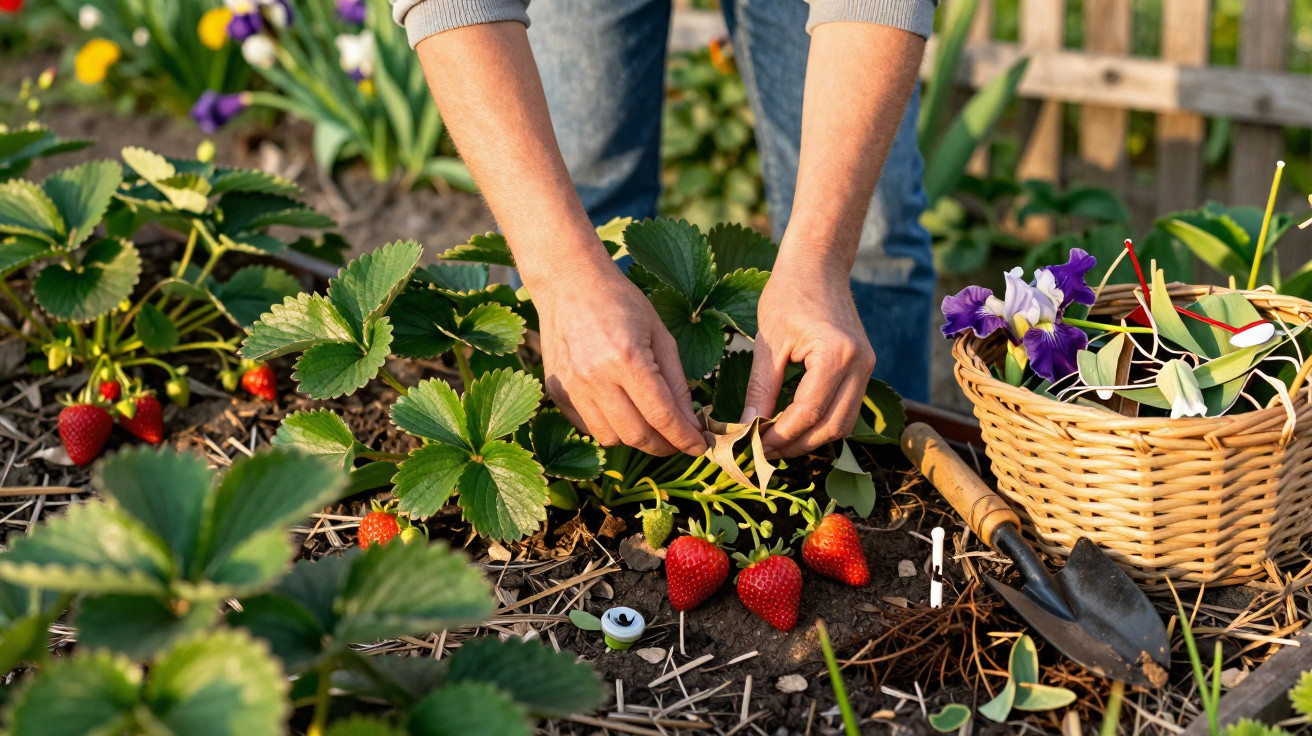
Across the country, amateur gardeners are now pulling faded leaves from borders, cutting back spring-flowering plants and carrying bags of garden cuttings to collection points. Few realise that some of this apparent waste is a free turbocharger for the strawberry bed – offering extra warmth, protection from disease and a noticeably earlier harvest.
Why spring border clear-ups can be a hidden mistake
Dried iris and tulip leaves are not waste
Once flowering has finished, irises, tulips, daffodils and other bulb plants can soon look rather forlorn: their leaves droop, turn brown and rustle like paper. At this stage, many gardeners cut everything back ruthlessly and put the whole pile into garden-waste bins or on the compost heap.
Yet this means discarding an exceptionally useful raw material. The long, fibrous leaves that have dried fully over winter are ideal for a job of real value in vegetable and berry beds: creating a protective, warming layer directly over the soil.
What appears to be a useless leftover is actually a tailor-made specialist plant material for your strawberries.
Unlike fresh lawn clippings, which can rot quickly, clump together and smell unpleasant, these dry leaves stay airy, firm and flexible. Those qualities make them an excellent lightweight, breathable mulch.
Their distinctive structure is what matters
Dried leaves from irises, tulips and similar plants have several important characteristics:
- Fibrous and flexible – they can be woven together easily
- Lightweight and air-permeable – allowing the soil to breathe
- Water-conducting – rain drains through rather than sitting on top
- Relatively durable – they break down more slowly than soft material
Anyone committed to sustainable gardening will already aim to keep as many nutrients and useful materials as possible within their own garden cycle. These leaves fit perfectly into that approach: they move straight from the spent ornamental border to the strawberry bed, with no shopping trip, packaging or cost involved.
How strawberries benefit directly from this “waste”
A natural hot-water bottle for sensitive strawberry roots
Strawberry plants enjoy warmth but do not cope well with dramatic temperature swings. This is particularly challenging in spring, when sunny daytime weather may be followed by single-digit temperatures overnight. The soil then cools rapidly, slowing both growth and flowering.
Spreading a thin layer of dry leaves around the plants creates a kind of natural heat store:
- During the day, the pale, dry material absorbs warmth from the sun and releases it gradually downwards.
- At night, the layer insulates the upper soil zone against sharp cooling.
As a result, strawberries behave as though spring were already slightly more advanced. They get going sooner, produce flowers earlier and set fruit earlier.
Red fruit sooner – often up to five days earlier
Studies in organic growing and observations from trial gardens repeatedly report comparable effects: mulch raises soil temperature slightly and keeps it more stable. For strawberries, this can mean that the first berries ripen on average up to five days earlier than those growing on uncovered ground.
For amateur gardeners, this head start can feel like a little eternity – after all, the first home-grown strawberry of the season is something special.
Gardeners who treat their beds consistently in this way soon notice that plants grow more evenly, cope more calmly with cold snaps and are less affected by a wet May.
A protective shield against rot and disease
No direct contact between fruit and wet soil
The second major advantage of this leafy covering concerns strawberry health. Damp soil and rain splash are among the biggest problems in spring. Every shower throws soil onto ripening berries, and fungal spores can reach their delicate skins along with it.
On bare ground, many strawberries sit directly on wet soil. These are ideal conditions for rot, especially the notorious grey mould. A dry mulch layer prevents this by ensuring that:
- Fruit rests on a dry, clean “bed”.
- Muddy splashes are caught in the material.
- The proportion of each berry touching soil is substantially reduced.
Trials using organic mulch layers have shown that the proportion of rotting fruit can be reduced significantly. The less direct contact there is with the soil, the lower the risk of fungal infection.
Research support: organic mulch reduces sprays
Specialist institutes working in agroecology have recommended organic mulching materials in berry production for years. The reason is that they reduce moisture exposure on the fruit surface, dry more quickly after rain and make it harder for fungi to spread.
Those who mulch deliberately can often dispense with some of the usual fungicide treatments – a benefit for the environment, the wallet and beneficial organisms in the soil.
The fibrous leaves of bulb plants are especially suitable because rain passes through them quickly. Hardly any water remains on the surface, and the top layer usually dries again shortly after a shower.
How to prepare the material correctly
Use only thoroughly dry, healthy leaves
When clearing spring flower borders, it pays to inspect the material closely. Not every plant remnant is equally suitable. Look for the following when collecting leaves:
- Leaves should be completely dry, more like hay than leather.
- They should bend without snapping immediately.
- Long, flat straps, such as iris leaves, are preferable.
- There should be no visible spots, coatings or signs of mould.
It is best to use two containers: put material suitable for compost into one bucket, and selected strawberry mulch into a second basket. Separating it while cutting saves sorting later.
Remove unsuitable material without compromise
The following definitely does not belong in the strawberry bed:
- Leaves with dark spots or grey, white or green coatings
- Very hard, thick stems that barely bend
- Remains showing obvious fungal or bacterial damage
Thicker, almost woody pieces take an extremely long time to decompose. They make spreading more difficult, leave gaps in the mulch covering and may scratch delicate shoots. It is better to shred these pieces and reserve them for long-term composting.
The right technique for the strawberry bed
Apply a thin layer rather than wrapping the plants
Getting the quantity right is crucial. Many gardeners tend to apply mulch too thickly and smother the plants. With strawberries, however, less is more.
Proceed as follows:
- Remove old foliage and obvious weeds around the plants.
- Take a small handful of dry leaves.
- Spread them loosely around each plant without compacting them.
- Press the layer down only very lightly at the end, so it cannot blow away.
The recommended depth is only one to two centimetres. This thin layer is entirely sufficient as both a heat store and a resting place for the fruit. A thicker covering increases the risk of waterlogging and insufficient air in the upper soil zone.
Leave space around the plant crown
Most importantly, keep the centre of the strawberry plant, known as the crown, clear. New leaves and flowers emerge around this point. If it is covered, it may rot during prolonged damp conditions.
Leave a small ring of bare soil around the crown of every plant – roughly the size of a 2p coin.
This small open space keeps the most sensitive part of the plant well ventilated. It also allows rainwater or watering to soak directly into the soil without lingering in the mulch.
Saving money and conserving resources
No expensive garden-centre mulch required
Anyone who has covered a larger strawberry patch with bought mulch will know the cost: bags of hemp shives, flax straw or coconut fibre can be expensive, while also bringing plastic packaging and long transport distances.
Using your own garden leftovers avoids all of this. You produce the mulch almost automatically during the usual spring clear-up. Every trip to the garden-waste collection point that is no longer needed saves time, fuel and frustration.
Three key effects at a glance
| Effect | Impact in the strawberry bed |
|---|---|
| Warmth | More stable soil temperatures, a quicker start and earlier ripening |
| Hygiene | Less contact with wet soil and a lower risk of rot |
| Resources | Less waste, no need to buy mulch and reduced use of plant protection products |
Practical advice and everyday combinations
Combine it with other measures
Using dry leaves works particularly well alongside other straightforward practices:
- Position rows so that they receive plenty of sun.
- Water only in the morning, allowing leaves and fruit to dry quickly.
- Remove large old leaves regularly to improve air circulation.
- Replace strawberry plants every three to four years to reduce disease pressure.
In areas with very wet weather, gardeners can also use small rain shelters made from transparent material. Combined with the dry mulch layer, this creates a particularly robust system.
Potential risks and easy ways to avoid them
There are a few points to keep in mind:
- Mulch applied too thickly can provide good hiding places for slugs.
- Material that is too damp or not fully dry will begin to go mouldy more quickly.
- If mulch is pressed directly against stems, the plant crown can rot.
All of these issues can be avoided easily by keeping layers carefully thin, selecting leaves thoroughly and checking the bed regularly.
Anyone who tries this simple, almost cost-free method will no longer see dried iris and tulip leaves as a burden, but as a valuable resource. It closes a small but effective cycle in the home garden – and strawberries repay the effort with an earlier, cleaner and more abundant harvest.


Comments
No comments yet. Be the first to comment!
Leave a Comment