
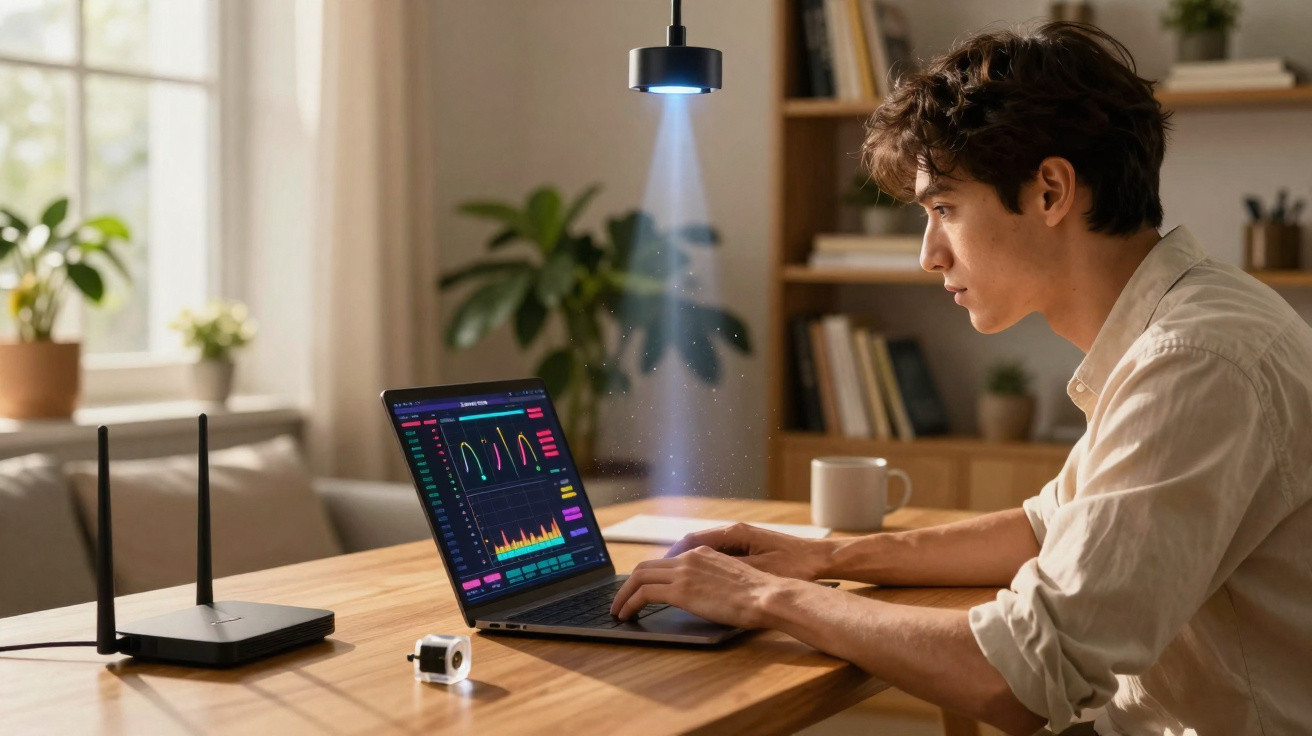
Rather than relying on conventional radio waves, researchers are using concentrated light to fire data through space in rapid bursts. The result is a wireless system capable of up to 362.7 Gbit/s - thousands of times faster than many household routers. It may sound like science fiction, yet parts of the underlying technology are already used in data centres today.
Lasers rather than antennas: the technology behind the record
The system under test was developed by a research team in the United Kingdom. Instead of Wi-Fi antennas, it uses a VCSEL array: lasers with a vertical light output that are already found in data centres and smartphone 3D sensors.
For the experiment, the engineers created a 5 × 5 grid of lasers, giving a total of 25 light sources. Each source carries part of the data stream. Together, they achieve a transmission rate of 362.7 Gbit/s across a distance of around two metres.
At more than 360 Gbit/s, the system is currently among the fastest known approaches to short-range optical wireless links.
For comparison, many residential fibre connections offer 500 Mbit/s to 1 Gbit/s. Even gigabit cable connections look rather dated beside this laboratory setup.
How the researchers achieve the data boost
The record-breaking result depends not only on the lasers themselves, but also on how data is “modulated” onto them. The team uses a technique known as frequency multiplexing. Put simply, the available bandwidth is split into several closely spaced channels that transmit data at the same time.
This enabled each individual laser to deliver between 13 and 19 Gbit/s. That figure is already impressive on its own, but combined it produces the headline rate of more than 300 Gbit/s.
Energy consumption is another notable aspect. The researchers report an energy requirement of just 1.4 nanojoules per bit. This is substantially lower than the requirement of many current Wi-Fi chips. The findings suggest that light-based communication can be highly efficient as well as fast.
- Maximum rate in the test: 362.7 Gbit/s over two metres
- Number of lasers: 25 VCSEL lasers in an array
- Data rate per laser: 13–19 Gbit/s
- Energy consumption: approximately 1.4 nJ per bit
- Application type: short-range optical wireless transmission
Where optical wireless communication could ease pressure on Wi-Fi
Despite the records, the aim is not to replace Wi-Fi altogether. Instead, the system is intended to supplement wireless networks and reduce the burden at particularly demanding points. Possible locations include indoor environments with exceptionally high data density, such as open-plan offices, industrial facilities and server rooms.
Conventional wireless systems in these settings often face interference, congested channels and high energy costs. Light-based technologies such as Li-Fi (Light Fidelity) and VLC (Visible Light Communication) avoid many of these issues because they operate in an entirely different frequency range.
The usable visible-light range is around 10,000 times wider than the usual radio-frequency spectrum - leaving room for vast quantities of data.
This makes it possible to establish several parallel links within a small area without all of them interfering with one another. In theory, such a setup could download 20 HD films in a second in a living room. Even if real-world performance ultimately falls well below that level, the figure demonstrates the potential.
Li-Fi, VLC and 6G: how they are connected
Li-Fi and VLC have long been considered promising additions to Wi-Fi, 4G, 5G and Bluetooth. The laser arrangement now tested builds directly on these approaches. Many of its technical principles come from traditional radio technology, but are applied to light waves instead.
While 5G currently focuses primarily on faster mobile data links, researchers are already looking towards the next generation, 6G. Optical wireless connections have an important role in this area. Light offers extremely high bandwidth and can be tightly focused. This allows highly directional, high-performance links - ideal for data centres, factory floors and data-hungry AR and VR applications.
Fast and precise - but unable to pass through walls
There is one limitation: light cannot travel through solid, opaque walls. However, this apparent drawback also brings an interesting benefit: improved security and less interference.
Anyone using a light-based connection in a room does not share the “channel” with neighbours or the rest of an apartment building. This lowers the risk of unauthorised access and makes interception attempts considerably more difficult.
Because visible light cannot penetrate concrete walls, many Li-Fi networks remain effectively confined to the room in which they are created.
That can be a significant advantage in sensitive settings such as meeting rooms, medical facilities, research departments and government offices. A potential attacker would need to be physically within the illuminated area of the light beam to have any chance of gaining access.
Where such speeds would make sense
The obvious question is: who genuinely needs 362 Gbit/s in everyday life? Current trends provide a fairly clear answer. Modern applications consume volumes of data that would have seemed like calculation errors ten years ago.
Typical situations in which a light network with extreme bandwidth could excel include:
- Data centres: Faster, flexible links between server racks without extra cable runs.
- Industry 4.0: Connected machinery, sensors and robots exchanging huge data packets in real time.
- AR/VR: High-resolution headsets receiving visual data from the “cloud in the room” with virtually no delay.
- Healthcare: Transmission of 8K surgical video, 3D imaging and large patient datasets within hospitals.
- Future home networks: Short-range links between a television, console, home server and PC without a tangle of cables.
In many of these cases, conventional Wi-Fi reaches its limits in data rate, latency or energy use. A light-based system could serve as an internal high-speed network, while familiar Wi-Fi continues to handle mobile devices and everyday use.
What this means for the home router
Anyone expecting their own Wi-Fi router to end up in electronic waste soon can relax. The 362.7 Gbit/s measured in the laboratory is an extreme result from a controlled setup over a short distance. It will still be several years, if not longer, before this becomes an affordable mass-market product.
Technically, the more likely outcome is a layered network: fibre brings data into the home, conventional Wi-Fi serves smartphones and tablets, and light links handle particularly demanding connections within a room - for example, to a home server or gaming PC. The router remains in place, but effectively gains optical reinforcement alongside it.
Key terms explained briefly
| Term | Explanation |
|---|---|
| VCSEL | A laser component that emits light vertically from the chip surface; compact, efficient and well suited to use in arrays. |
| Li-Fi | Data transmission using light, usually LEDs or lasers, designed as a complement to Wi-Fi. |
| VLC | Visible Light Communication; an umbrella term for communication using visible light. |
| Frequency multiplexing | A technique in which several data streams run simultaneously over different, closely spaced frequencies. |
For everyday deployment, the key issue will be how resilient these systems are to disturbances within a room: what happens when someone walks through the light beam? How much do dust, smoke or direct sunlight affect performance? Research teams around the world are working on precisely these questions.
One point is already clear: light as a data carrier is far more than a laboratory trick. The record results from the United Kingdom demonstrate the potential of combining laser technology, intelligent modulation and energy-efficient electronics. Anyone frustrated by stuttering streams on their home Wi-Fi today is getting an indication of how radically wireless networking could change in the years ahead.






Comments
No comments yet. Be the first to comment!
Leave a Comment