
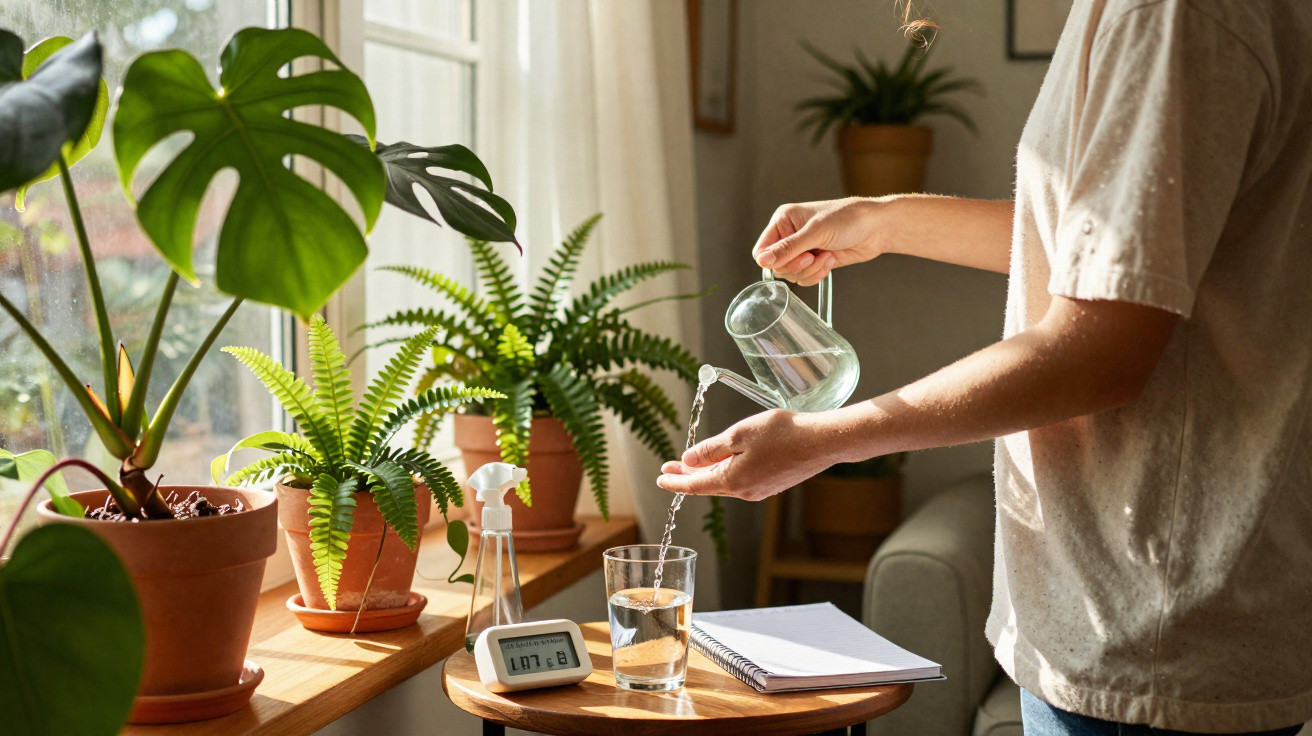
It has been a long evening, the air in the living room is dry, and your Monstera’s leaves are looking slightly tired and droopy. You head to the kitchen, turn on the tap without thinking, wait two seconds for the water to become “nicely cold”, then pour it straight into the pot. Done: plants watered, job ticked off. Only when the leaf edges turn brown a few days later do you briefly wonder whether you watered too much – or too little. Then you open Instagram again instead of giving it further thought.
We all know this automatic habit: tap water, straight from the tap, immediately onto the plants. It feels practical and efficient, and seems harmless – perhaps even caring.
But what if this very reflex is one of the most common houseplant care mistakes?
Cold water, a warm mistake: what it does to your plants
Houseplants exist in a fairly stable microclimate. The compost, roots and air are generally all somewhere around room temperature – roughly 20°C. Bringing in ice-cold kitchen tap water gives the roots a small temperature shock. It is not a disaster on the scale of a forest fire; it is more like being made to take a cold shower every morning while you are still half asleep.
The plant responds more slowly, briefly reduces its metabolic activity and absorbs nutrients less readily. At first, you will often see no obvious sign. Over several weeks, however, this repeated pattern can create a constant stop-start effect on growth. Leaves remain smaller, new shoots seem hesitant, and some species will “take offence” with yellow patches that you might mistake for a fertiliser problem.
A friend recently told me a familiar story. His Calathea, renowned for being a little drama queen, suddenly began letting its leaves droop. There had been no change of position, no sun scorch and no pests. The only new habit was that he watered it as soon as he got home from work each evening, using ice-cold tap water because he assumed that “nice and fresh must be good”. A few weeks later, there were brown edges, curled leaves and the classic feeling that “The plant doesn’t like me”.
It was only when he began keeping water in a watering can at room temperature that things settled down. The damaged leaf tips did not become fully healthy again, but the new leaves emerged larger and smoother. That modest adjustment – changing only the water temperature – was the game changer. There was no expensive specialist feed and no complicated plant relocation, simply less cold shock.
When you consider it objectively, the effect makes sense. Roots are the plant’s most sensitive area. Cold water causes the fine root hairs to constrict slightly, temporarily disrupting uptake. Combined with tap water, which is hard and high in limescale in many areas, this creates a kind of double strain: thermal stress alongside chemical irritation. You cannot feel it with your hand, but the plant “notices”. Its response can be slower growth, stress marks, or the familiar situation in which a plant appears unchanged for a long time before it suddenly deteriorates “for no reason”.
How to water houseplants properly: temperature, timing and simple routines
The easiest change is to prepare watering water before your plants become thirsty. Fill a watering can or glass bottle with tap water and leave it for at least a few hours – preferably overnight. This allows the water to reach room temperature, lets chlorine dissipate, and means you no longer rush to your pots with cold water from the tap. For sensitive varieties such as Alocasias, Calatheas or orchids, it can feel like a gentle spa treatment.
If you want a simple check, touch the inside of the watering can. If it feels neutral – neither cold nor warm – you are in a range that suits most houseplants. Some professionals even use a small aquarium thermometer and keep the water between 18 and 24°C. Do you need to do that? Let’s be honest: nobody really does it every day. Yet simply moving away from an ice-cold stream will achieve more than many plant-care tricks on social media combined.
Many plant owners struggle with guilt: “I water incorrectly, I forget them, I never do enough.” More often, the reverse is true: they are watered too frequently, too inconsistently or in a stressed rush. Cold tap water is part of that pattern. It is quick, done on the side, without pausing to notice how the pot and compost feel. This is especially pronounced in winter, when the heating is blasting and water from the tap feels particularly cold. The plants are already in a resting phase, and then they receive a frosty update from above.
One gentle approach is to link watering to a calm moment. Sunday morning, music on, watering can filled, then a walk around the home. It becomes easier to spot where compost is still damp, which leaves are drooping, or which plant may be catching a draught. You also stop pouring one sweep of cold water over every pot in succession because the clock is pressuring you.
“Since I started leaving my watering water to stand for a day, my plants look as though they have just come back from holiday,” wrote one reader who expanded her collection from three to twenty plants. “It is such a tiny change, but the effect is incredible. I never thought the temperature alone could make such a difference.”
A few practical measures can help make this new watering ritual part of everyday life:
- Keep your watering can filled at all times – then you will not be tempted to use cold water straight from the tap.
- Leave water overnight, particularly for sensitive varieties or in areas with hard tap water.
- Test it with a finger: if the water feels “neutral”, it is close to the comfort zone for most houseplants.
- Water less in winter, but do so more mindfully – plants grow more slowly and are more affected by cold shocks.
- For particularly sensitive plants (Calathea, Anthurium, orchids), use filtered or standing water if necessary.
More mindfulness, less stress: what this detail reveals about daily life
How we use water for our plants says a great deal about how we live ourselves. Cold tap water straight from the tap is convenient, quick and available. Much like so many of our choices. One click, one swipe, one “I’ll just do it quickly” – and suddenly we are standing at the right pot with the wrong water. The plant becomes a silent reflection of our pace. Slowly and almost unremarkably, it shows us where we are operating on autopilot.
Once you start preparing watering water, something else often changes too. You enter your home differently. You suddenly notice which corner is too dark, which pot has not produced a new shoot for months, and which plant is still sitting in its plastic nursery pot. This subtle move – away from the fast cold-water reflex and towards conscious watering – does not merely make your plants healthier. It makes your home feel more alive and your routine gentler.
Perhaps, after a few weeks, you will find yourself looking forward to picking up the watering can. You may pause briefly before turning on the water. Your plants will no longer feel like decoration, but a quiet project growing alongside you. Not perfect, not “Pinterest-ready”, but real. The temperature of the watering water then becomes a quiet promise: you do not have to transform your entire life. Sometimes a few degrees warmer are enough to shift something for the better.
| Key point | Detail | Benefit for the reader |
|---|---|---|
| Avoid temperature shock | Do not pour ice-cold tap water directly from the tap onto warm roots | Less stress for the plant, steadier growth, and fewer yellow and brown leaves |
| Prepare watering water | Leave water at room temperature for several hours or overnight | A straightforward routine with no added cost and noticeably healthier leaf structure in many varieties |
| Choose mindful watering moments | Pick calm times, briefly observe plants, and do not water in passing | Mistakes such as overwatering, cold shock and ongoing stress are reduced, making care more enjoyable |
FAQ:
- How warm should watering water be for houseplants? Water at approximately room temperature, between 18 and 24°C, is ideal. It should feel neither cold nor warm, but rather “unnoticeable”.
- Can cold tap water harm plants directly? A single use will not make them die immediately, but repeated cold shocks put roots under stress and may eventually affect growth, leaves and root health.
- Is it enough to leave water standing for a few minutes? This does little for the temperature, particularly in winter. A few hours is better, and overnight is ideal, especially for sensitive varieties.
- Which plants are particularly sensitive to cold water? Tropical varieties in particular, including Calathea, Alocasia, Anthurium, orchids and many types of fern. Young plants and cuttings are also more sensitive than hardy succulents.
- Do I need to buy expensive filtered water? In most homes, ordinary tap water that has stood and reached room temperature is sufficient. Filtered or rainwater is an added benefit if your water is very hard or you care for extremely sensitive varieties.
Comments
No comments yet. Be the first to comment!
Leave a Comment