
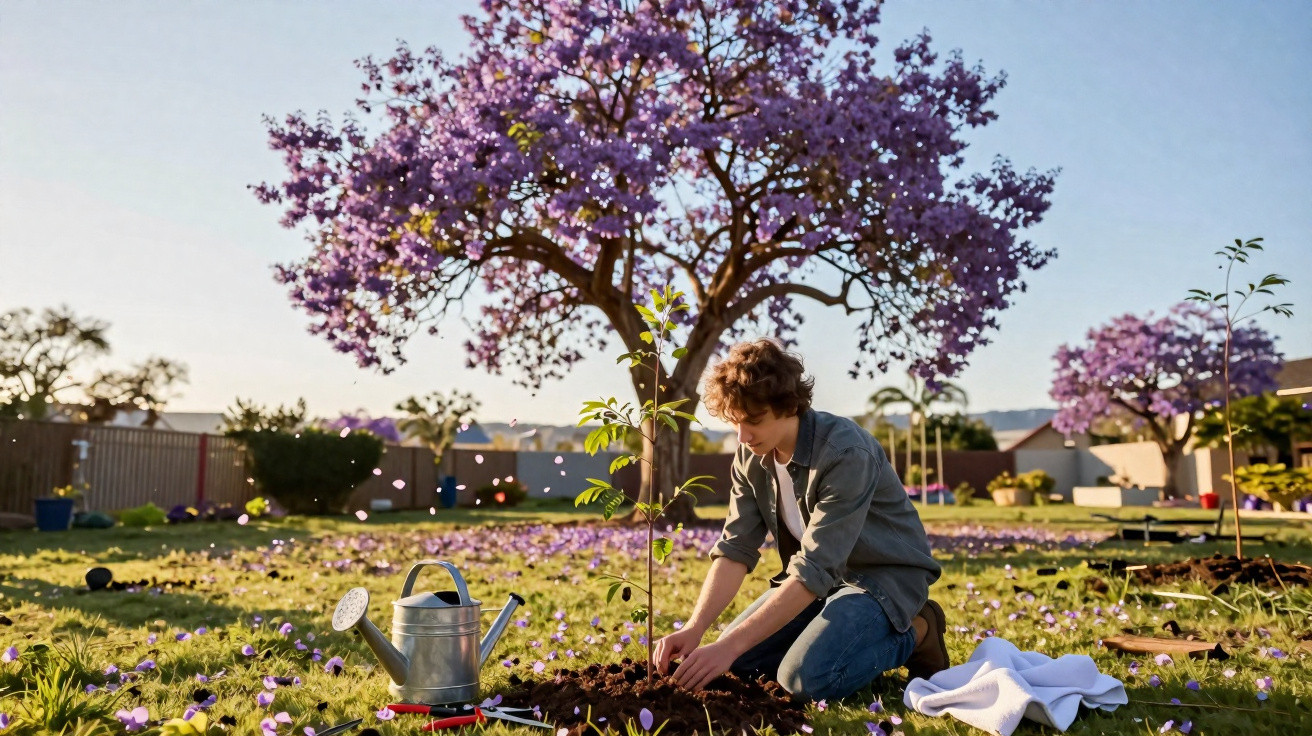
A tree that shoots upwards almost as quickly as bamboo, yet stays politely where you put it and, in spring, stands wrapped in a cloud of fragrant violet flowers: that’s exactly what Paulownia delivers, also known as the empress tree or bluebell tree. If you want fast impact in the garden, it’s one of the most interesting choices of recent years.
Why Paulownia is seen as a “turbo tree”
Paulownia is among the fastest-growing garden trees you can plant. In good conditions, a young tree typically puts on around 1.5 to 2.5 metres in height each year. After only three years, many specimens are already 5 to 7 metres tall, while mature trees usually reach 10 to 12 metres.
A single, straight trunk is typical, topped by a broad crown with enormous, heart-shaped leaves. The foliage looks almost exotic and quickly creates a dense, pleasant patch of shade - perfect beside a terrace, seating area or children’s play space.
"Paulownia achieves in a fraction of the time what other trees need a decade for - and also delivers a spectacular bloom."
Compared with bamboo, the tree has one crucial advantage: it does not produce rampaging rhizomes. It stays where it’s planted and is much easier to keep in check in an ordinary garden.
A violet cloud of flowers instead of a grey winter view
Its real star turn begins in spring: before the leaves appear, Paulownia covers itself in countless flower clusters. Bell-shaped blooms hang in dense panicles in soft lilac shades, from mauve through to slightly bluish tones.
From a distance, the crown can look as though it’s wrapped in pastel mist. Against dull suburban façades or in gardens that are still bare, it creates a striking splash of colour that can hold its own alongside classic ornamental cherries.
The flowers carry a lightly sweet scent and attract bees, bumblebees and butterflies. As a typical spring nectar plant, the tree provides both nectar and pollen for insects. If you want more life in the garden, Paulownia offers not only looks but also a small biodiversity boost.
Choosing a site: where the empress tree thrives
Plenty of sun, shelter from icy wind
Paulownia loves warmth and light. A spot in full sun, ideally protected from wind, supports strong growth and abundant flowering. In exposed locations, it pays to choose a corner buffered by walls, hedges or the house.
The soil should be deep, rich in humus and free-draining. The tree really dislikes waterlogging; saturated clay soils slow growth and increase the risk of root damage. Sandy ground can be improved with generous amounts of compost.
Planting properly: hole, compost, water
A bit of extra care at planting time makes a big difference to establishment. The following method works well:
- Dig a hole of about 60 x 60 x 60 centimetres
- Mix the excavated soil with 10 to 20 litres of well-rotted compost
- Refill with the mix and firm it gently
- Set the plant so the root collar sits level with the soil surface
- Then water in thoroughly with about 20 litres of water
- Create a 5 to 8 centimetre-thick mulch ring around the trunk
Mulch - for example bark compost, wood chippings or leaf mould - helps retain moisture and suppresses weeds. It also buffers young roots against temperature extremes.
The first years: watering, pruning, protecting
Water needs during establishment
For the first two to three summers, young Paulownia needs regular watering, especially during hot, dry spells. Around 10 to 20 litres per week is a useful guideline, depending on soil type and the weather. The aim is to encourage deep rooting so the tree can cope better with dry periods later on.
Pruning and shaping the crown
A light shaping prune straight after flowering is a sensible routine. This is mainly about removing dead growth and shoots that cross and rub. The crown stays sturdier, and the improved light penetration can benefit flowering the following year.
If you want a tall, airy crown, gradually remove lower branches and promote a clear central leader. If you prefer a shade-giving “umbrella” closer to the ground, keep more of the lower branches instead.
Frost protection for young trees
Young Paulownias are more sensitive to very low temperatures than older specimens. In particularly cold areas, horticultural fleece wrapped around trunk and crown can help. At ground level, a 10 to 15 centimetre layer of mulch made from leaves or straw protects the roots.
The tree forms its flower buds early. Late spring frosts can damage them, leaving brown, dried tips. Once the cold spell has passed, you can simply cut frost-damaged wood back to healthy, green tissue. The tree usually reshoots strongly in the same year, with flowering more likely to shift to the following season.
Risks, limits and legal questions
Keep an eye on self-seeding
Paulownia produces many lightweight seeds that can be carried by the wind. In milder regions, these may occasionally germinate beyond the garden. Where seedlings are not wanted, they are easy to pull up or cut out when small.
In Central Europe the tree is not usually considered a major problem at present, but extra caution makes sense in sensitive habitats. If you live in or near protected areas, it’s best to check with your local council or conservation groups to see whether any regional guidance applies.
Space requirements and roots
At 10 to 12 metres tall with a broad crown, Paulownia needs room. Planted too close to walls, eaves or service runs, it becomes impractical in the long term. A distance of at least 6 to 8 metres from buildings or other large trees is a proven rule of thumb.
Its roots are generally less aggressive than those of some poplars, but it still shouldn’t be planted right next to dry-stone walls or old, fragile pipes.
Suitable varieties and good uses
In the trade you’ll most often come across two species: Paulownia tomentosa and Paulownia fortunei, plus a number of hybrids. They differ in flower colour, leaf size and vigour. If you want a more manageable tree, ask specifically for slower-growing or more compact varieties.
Particularly good uses include:
- Specimen tree in a lawn: A single tree reads like a living sculpture, especially in spring.
- Shade beside a terrace or seating area: The large leaf mass creates a pleasantly mild microclimate in summer.
- Lightly planted driveway or avenue: With a planting distance of around 6 metres, you get an airy row of trees with a unified “bloom cloud”.
- A pollinator-friendly corner: Combined with spring perennials and flowering hedges, the tree becomes a magnet for pollinators.
The tree also produces a light, workable timber that is used in some countries for furniture, interior joinery and musical instruments. In private gardens, though, the ornamental effect is usually the main attraction.
Practical tips for hobby gardeners
If you’re considering planting a Paulownia, these straightforward rules of thumb are a helpful guide:
| Aspect | Recommendation |
|---|---|
| Planting time | Spring, as soon as the soil is free of frost |
| Distance from neighbouring boundary | at least 3–4 metres, preferably more |
| Feeding | each spring, about 10 litres of compost around the base |
| Watering | weekly in the first years, later only during prolonged drought |
| Pruning | light shaping prune after flowering; remove dead wood |
Paired with ground-covering perennials beneath the crown, it’s easy to create a cohesive look quickly. Plants that tolerate partial shade - such as epimediums, hostas or ferns - work well once the tree is larger and casts more shade.
What gardening newcomers should know about Paulownia
Despite its vigorous growth, the exotic-looking empress tree is not a “problem plant” if you plan for it properly. Give it enough space, choose a fully sunny position and water reliably in the first years, and you’ll usually be rewarded with impressive development.
For small terraced-house gardens it can feel too substantial, but for larger plots, front gardens or rural gardens it’s an exciting option - especially as an alternative to fast-growing, yet maintenance-heavy bamboo screens.
It’s also worth considering in the context of increasingly hot summers: the large leaves create a noticeably cooler area beneath the canopy without plunging the garden into permanent shade. In winter, only the branching framework remains, so light can still reach the house - an advantage compared with evergreen screening plants.
So if you want a focal point that combines rapid growth with a distinctive, early flowering display, Paulownia is an unusual but highly effective statement for the garden.



Comments
No comments yet. Be the first to comment!
Leave a Comment