
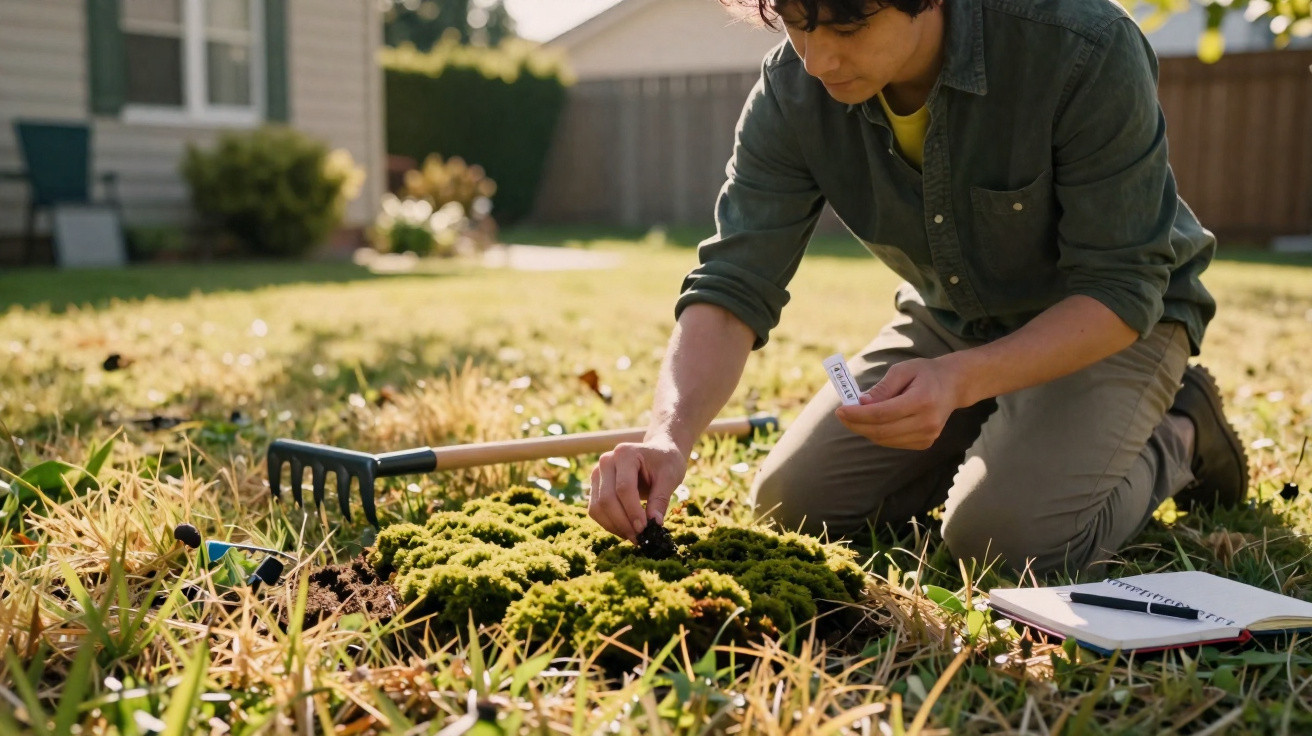
It often starts on a dull morning: the coffee is still steaming, and your gaze drifts, almost by habit, to the kitchen window. Outside, the lawn you sowed so hopefully in spring suddenly looks patchy. Instead of a dense green sward, there are dark, spongy cushions. Moss-persistent and quietly ambitious-has spread. You step outside, barefoot, and feel that cold, slightly slippery texture between your toes, and a small, familiar frustration rises. How did this happen when you were sure you were doing “everything right”? The neighbours appear to have a golf-green out front, while your own garden seems to be turning into woodland floor. Somewhere between shade, rain and mowing habits sits the answer. And that’s where it gets interesting.
When the lawn whispers: what moss is really trying to tell you
If you look properly, you soon realise moss isn’t a fluke-it’s a message. A lawn that’s being swallowed by moss is, in truth, a quiet distress signal: too dark, too wet, too short on nutrients-or all of the above at once. The grass weakens, and moss steps in like a soft-spoken opposition. At first it can look harmless, even a bit romantic, but in everyday use it’s irritating because every gap the lawn leaves behind gets filled immediately by those fine green pads. Moss is proof that nature dislikes bare patches. And it’s brutally honest about it.
The reason is straightforward. Grass thrives on light, airflow and a loose soil structure. Moss prefers moisture, stillness and very little competition. When soil becomes compacted, water sits near the surface and grass roots don’t get enough oxygen. If puddling is common, moss suddenly has the home advantage. Add a lack of nutrients-because fertiliser is rarely applied-and the lawn becomes sluggish and thin. Let’s be realistic: hardly anyone walks around the garden with a pH tester in one hand and a fertilising schedule in the other. Moss expands exactly in that gap-quietly, efficiently, consistently.
A typical scenario looks like this: a north-facing garden behind a terraced house, squeezed between two walls, with an old cherry tree casting heavy shade. Years ago the lawn was thrown down “quickly”, without any real soil preparation. In summer, hardly any direct sun reaches it; in autumn, water often lingers. In photos you can see it clearly: a soft, dark carpet with barely any grass blades pushing through. Studies from horticultural advisory bodies show that, in shaded and compacted spots like these, the likelihood of moss infestation is many times higher than in sunny gardens with good airflow. Most people only clock it once grass has already become the supporting act.
What you can do in practice so moss doesn’t stand a chance
The first genuinely effective step is rarely glamorous, but it makes a huge difference: help the soil breathe again. Scarifying sounds like something from a garden-centre advert, yet it’s fundamentally about basics. A scarifier lightly scores the turf by a few millimetres and pulls out moss, thatch and dead material. Immediately afterwards, the brown areas can look alarmingly large-and that’s useful, because it shows you what you’re really dealing with. After scarifying, overseed straight away with tough, site-appropriate grass seed, not just any “premium miracle mix” from the discount aisle. For a short while it can look like a terrible haircut, but with patience it grows out.
The second lever is light and air. Moss tends to dominate where the lawn exists in near-permanent shade: under trees, behind sheds, along north-facing edges. Thinning a tree canopy, cutting a shrub back, or slightly repositioning a screen can transform those areas. Then there’s watering. Many people water too frequently and for too short a time. That encourages shallow roots and keeps the top layer constantly damp-perfect conditions for moss. It’s better to water less often but more thoroughly. Deep, resilient roots belong to grass more than to moss. It sounds theoretical until you feel the difference during every dry spell in summer.
One factor that’s widely underestimated is feeding. If you let it, a lawn will limp along hungry: without nutrients it becomes pale, sparse and vulnerable. Moss needs far less to get by. A balanced lawn feed-leaning more towards nitrogen-in spring and summer strengthens the blades and helps the sward knit together. Mistakes are easy to make: feeding too late, feeding irregularly, using the wrong product.
“Moss isn’t an enemy you defeat once; it’s a neighbour that knocks every year when the lawn is weak,” says a master gardener I watched at an allotment site, calmly pacing up and down with a fertiliser spreader lane after lane.
- Care regularly, but don’t become obsessive-the lawn responds to rhythm
- Listen to your own site: heavy shade needs different seed mixes than a sunny, south-facing slope
- Have the courage to leave a gap: not every patch of moss is a disaster; sometimes a corner can deliberately stay a bit “wilder”
- Check the soil: pH, compaction, waterlogging-the invisible foundation makes the decision
- Keep expectations realistic: a garden isn’t a golf course, and that’s often its greatest charm
When moss stays: what your garden reveals about you
At some point you reach a simple acceptance: that one shaded strip by the garage is never going to be a pristine English lawn. That isn’t personal failure-it’s physics. Once you understand that, you relax. Instead of charging at every little island of moss, many people start asking what might actually thrive there instead: shade-tolerant ground cover, a narrow gravel path, a small seating area with timber boards. Moss stops being “the enemy” and becomes a sign that something else suits that spot better. Gardening grows quieter and more patient-less Instagram, more real life.
It gets even more interesting when you notice how closely the state of the lawn mirrors your everyday routine. When you’re permanently stressed, you mow too rarely, fertilise inconsistently, and water on impulse. If you treat the garden as a place to recover, you’re more likely to give yourself an hour: to walk barefoot over the soil after scarifying, breathe in the smell, and run your hand over the new shoots. Moss mercilessly highlights where routine is missing, where “I’ll do it later” is in charge. And yes-sometimes the honest answer is: I don’t actually want a perfect lawn; I want a living garden where moss has a place too. That’s where a relationship with your patch of green begins that lasts longer than any metal lawn edging.
Maybe that’s the quiet point: if you only see moss in the lawn as a flaw, you miss what it’s trying to teach. Soil, light, water, time-none of it can be fully controlled, only guided. A lawn that’s cared for but not over-staged comes from compromise: from days when you drag yourself out to scarify, and from days when you simply lie in the grass, feel moss under your fingers, and think for a moment: it’s allowed to be a little imperfect. In that blend of care and ease sits the real luxury of a garden-something no roll of instant turf can replace.
| Key point | Detail | Benefit for the reader |
|---|---|---|
| Soil and moisture | Compacted, constantly damp ground encourages moss and weakens grass | Understands why scarifying and aerating the soil are so effective |
| Light and shade | Shady areas are classic moss hotspots and require different strategies | Can zone the garden instead of forcing the same lawn ideal everywhere |
| Care rhythm | Regular mowing, feeding and infrequent but deep watering strengthen the lawn | Tackles root causes instead of only removing symptoms each year |
FAQ:
- How do I get rid of moss in the lawn for the long term? The key is combining scarifying, overseeding, suitable fertilising and adjusted watering. One-off measures like using only a moss killer usually bring short-lived results.
- Does lime really help against moss? Lime only helps if the soil is genuinely too acidic. A pH test first stops you liming unnecessarily and potentially throwing the balance off.
- Can I simply leave moss in the lawn? Yes, if you don’t mind how it looks and the area isn’t heavily used. In high-traffic play and lounging areas, however, moss breaks up more quickly.
- How often should I scarify? Once a year-usually in spring-is enough in many gardens. If there’s heavy thatch or very dense soil, a second pass in autumn can be worthwhile.
- Which grass seed is suitable for lots of shade? Shade mixes with a higher proportion of supine meadow-grass (Poa supina) and specialist shade varieties are more robust. Standard hard-wearing lawn mixes often fail there after a few years.





Comments
No comments yet. Be the first to comment!
Leave a Comment