
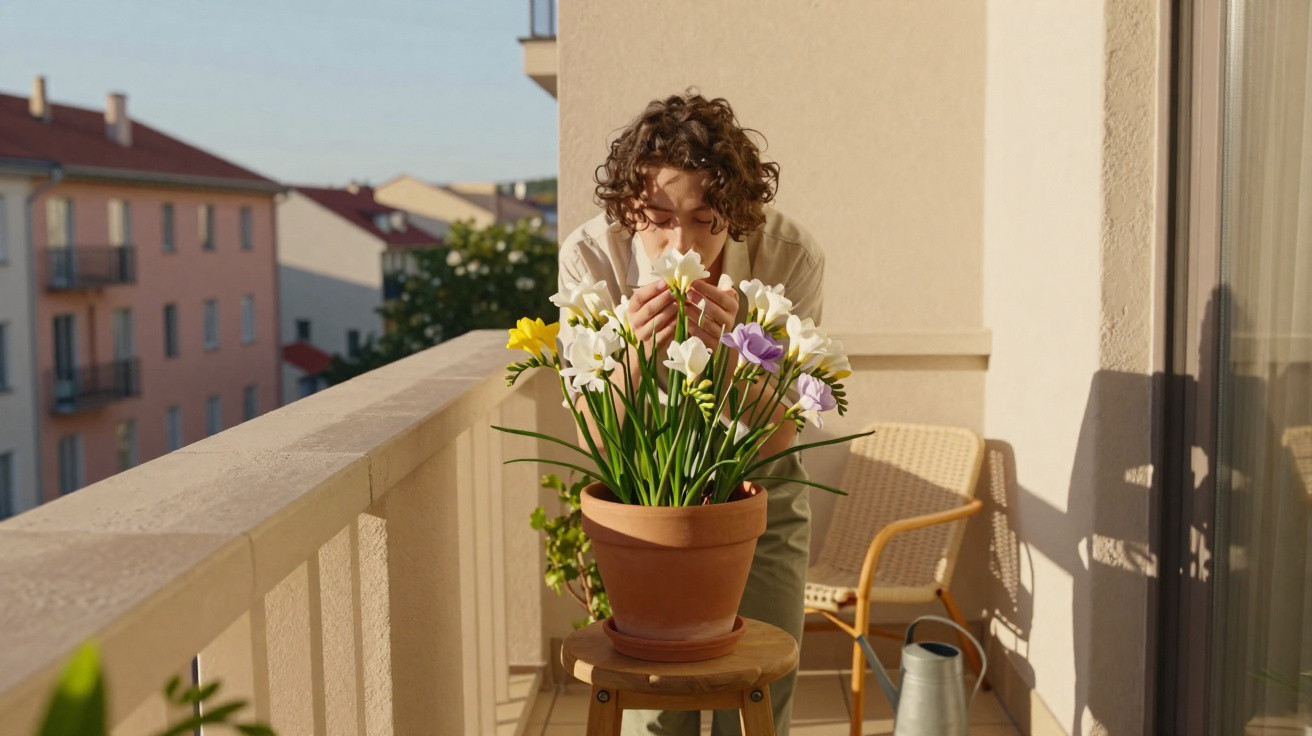
Many people want to recreate that holiday feeling just outside their own balcony door. Yet in reality, pots often end up piled everywhere, producing barely any flowers, demanding lots of attention and still failing to create a truly enchanting fragrance. One floral star, however, can be enough to turn a balcony or terrace into a summery scented retreat.
Why you do not need to fill every centimetre with pots
When people picture a fragrant terrace, lavender, jasmine or roses are often the first plants that come to mind. That leads to another pot, another variety and another attempt. In the end, there is little room left to sit down, maintenance takes up time and the scent still remains faintly dispersed.
"The secret is not the number of plants, but choosing one variety with an exceptionally intense yet pleasant fragrance."
This is where a flower comes in that has long been a star in perfumery but remains something of an insider tip for balconies: the freesia.
The one flower that scents everything: freesias
Originally from southern Africa, freesias grow from bulb-like storage structures known as corms. Gardening guides have described them for years as one of the most intensely scented plants for container growing, making them ideal for small outdoor spaces.
Their fragrance brings together honey and citrus notes: fresh, gently sweet and warm, without being heavy or overpowering. This particular combination means that only a few pots can noticeably change the air on a balcony or terrace.
Freesias also make a striking visual display. Their long, gently arching stems carry several trumpet-shaped flowers arranged in a small row along one side of the flower spike. Colours range from pure white to yellow and pink, through to red and violet. If you like, combine several colours in one large planter to enhance the “bouquet-in-a-pot” effect.
How to plant freesias in pots for maximum fragrance
The right pot and suitable compost
For freesias to thrive in containers, they need sufficient depth and a growing medium that drains water quickly. The corms do not tolerate waterlogging at all.
- Pot: at least 20–30 cm in diameter, preferably deep rather than shallow
- Drainage holes in the base: essential
- Saucer or planter with a raised base, allowing excess water to drain away
A mix that stays open while still supplying nutrients works particularly well:
- around 50% potting compost
- around 25% sand, for effective drainage
- around 25% loose organic material, such as compost or coir fibre
A 15 cm pot holds roughly 5 to 7 corms. Plant them 3 to 5 cm deep, pointed end upwards, leaving 5 to 6 cm between each one. This creates a dense clump of flowers rather than isolated stems.
The best time to plant
Freesias are somewhat sensitive to frost. In mild areas, corms can remain in the soil and produce new growth each year. Where winters are harsher, it is better to plant once overnight frosts are no longer expected.
In practical terms, this means:
- Areas with mild winters: corms can remain in their pots, protected beside a house wall.
- Cooler areas: plant in spring after the last frosts for summer flowering.
- Very sheltered courtyards: autumn planting can also be possible where frost is unlikely.
Positioning freesias for the strongest fragrance
Freesias need plenty of light; otherwise, they become weak and flower sparsely. A spot in full sun to light partial shade, with at least six hours of direct sunlight each day, is ideal.
"A warm, sheltered position close to a wall is ideal – this is where fragrance and warmth gather, enhancing that summer feeling."
You will get the greatest benefit by placing the flowerpots near the seating area or directly beside the balcony door. Whenever the door opens or a light breeze passes through, the scent will drift into the room or across the table.
Suitable places on a balcony or terrace
- beside the wall next to the patio door
- behind or alongside the lounge or dining area
- in a larger planter as a focal point by the railing, as sheltered from wind as possible
The smaller the outdoor space, the more noticeable the fragrance becomes. On a narrow urban balcony, just two or three pots can make the entire area feel aromatic.
Care: keeping your freesias healthy and richly scented
Watering and feeding
Water thoroughly after planting so the compost settles around the corms. After that, keep it consistently moist without allowing it to stay permanently wet.
- Water once the top layer of compost has dried slightly.
- Do not allow water to stand in the saucer.
- During very hot weather, give smaller amounts more frequently.
For abundant flowering, use a potassium-rich liquid feed every two weeks once buds appear and throughout the flowering period. Potassium supports sturdy stems and prolific blooms, which is exactly what you want on a fragrant balcony.
Supporting and cutting
The stems can grow quite long and may topple in wind or heavy rain. A few discreet canes or small plant supports will keep them upright.
Once the first flowers have opened, you can cut individual stems for a vase – the fragrance will still be clearly noticeable around the pot. That gives you balcony perfume as well as a natural room fragrance on the dining table.
What happens after flowering – and how to save the corms
Do not cut the leaves off immediately after flowering. They continue supplying the corms with energy for a while. Once the foliage turns yellow and dies back, reduce watering considerably.
In regions where frost is a risk, the following approach is recommended:
- Let the foliage yellow, while reducing watering sharply.
- Remove the corms from the pot after the first light frosts.
- Carefully brush away the compost and store them dry at 4–10 °C, in a dark, well-ventilated place.
- Replant in fresh growing medium the following spring.
If you live in a very mild area and have a sheltered position, you may simply be able to overwinter the pots beside a house wall. An insulating saucer or a piece of wood beneath the pot also provides extra protection from frost rising from below.
How many pots you really need
The big surprise for many balcony owners is that there is no need to pack every corner with plants. On a typical urban balcony, usually the following is enough:
- 1 large planter (30 cm) containing 10–15 corms for an intense fragrance experience
- or 2–3 medium-sized pots, positioned at different points
For a small loggia, even one densely planted pot of freesias can be enough to notice that familiar “perfumery fragrance” when opening the door in the morning. Those who want more can mix different colours while sticking to the same plant, keeping maintenance manageable.
Practical tips for beginners and urban balconies
Anyone with little experience of bulb and corm plants can begin with pre-grown freesias. Many garden centres sell rooted pots with plants already emerging in spring. These can then be transferred straight into a larger planter and will get going more quickly.
For tenants with heavily shaded courtyards, a position close to a wall that catches the most sun during the day is suitable. If conditions become very hot, a light privacy screen or semi-transparent parasol will protect the plants from heat stress without reducing their fragrance.
If you have children or pets, place the pots somewhere they are not likely to be knocked over repeatedly. Tall, narrow planters against a wall or sturdy balcony troughs are good options here.
Why freesias work so well for the “fragrance-from-one-pot” trick
Freesias bring together several benefits that work especially well in confined spaces:
- an intense but not overpowering scent
- a strong effect even with only a few plants
- suitable for pots and large planters
- a relatively compact growth habit that does not take up excessive space
- flowers suitable for cutting and displaying indoors
Anyone who has previously overloaded their balcony with many different fragrances will soon notice that one clear focus makes the overall look more relaxing and the outdoor area more usable. Rather than continually buying new varieties, focus on one plant that reliably provides summer fragrance – while leaving more space for a chair, a table and that all-important breakfast outdoors.
Comments
No comments yet. Be the first to comment!
Leave a Comment