
When the first buds begin to swell, it is tempting to get started: cut everything back, make everything “tidy”, and put the bed in order. Yet this is precisely when the worst pruning mistakes are made with roses. Anyone focusing only on appearance rather than the right shoots holds their plants back, then later wonders why flowering is sparse or delayed.
Why severe pruning in March holds back your roses
In late winter, many garden centres display rows of perfectly trimmed roses. Neat stems all cut to the same height, with no branch breaking the outline – so it is understandable to want to recreate that look at home. But roses are not box hedges. Every shoot stores energy reserves and contains the potential for future flowers.
If you cut everything “to one height” in March, you will often remove precisely the wood the plant needs for abundant flowering. Last year’s shoots are particularly important. They carry most of the flower buds that will develop later, even if they currently look like nothing more than unremarkable branches.
A rose bush that has been cut to look “tidy” may be depleted within – its most important flowering shoots may already be on the compost heap.
The consequences of pruning too severely in March include:
- The rose must first produce new wood instead of directing its strength into buds.
- The root zone has to work at full capacity, placing the plant under stress.
- Large cut surfaces become entry points for fungal diseases.
- A late cold spell can cause further damage to newly stimulated shoots.
Rather than producing a bush covered in flowers, the result is a weakened shrub that takes a long time to recover. Flowering is pushed back, is less impressive, or may partly fail altogether.
The detail eight out of ten gardeners miss: the bud rule
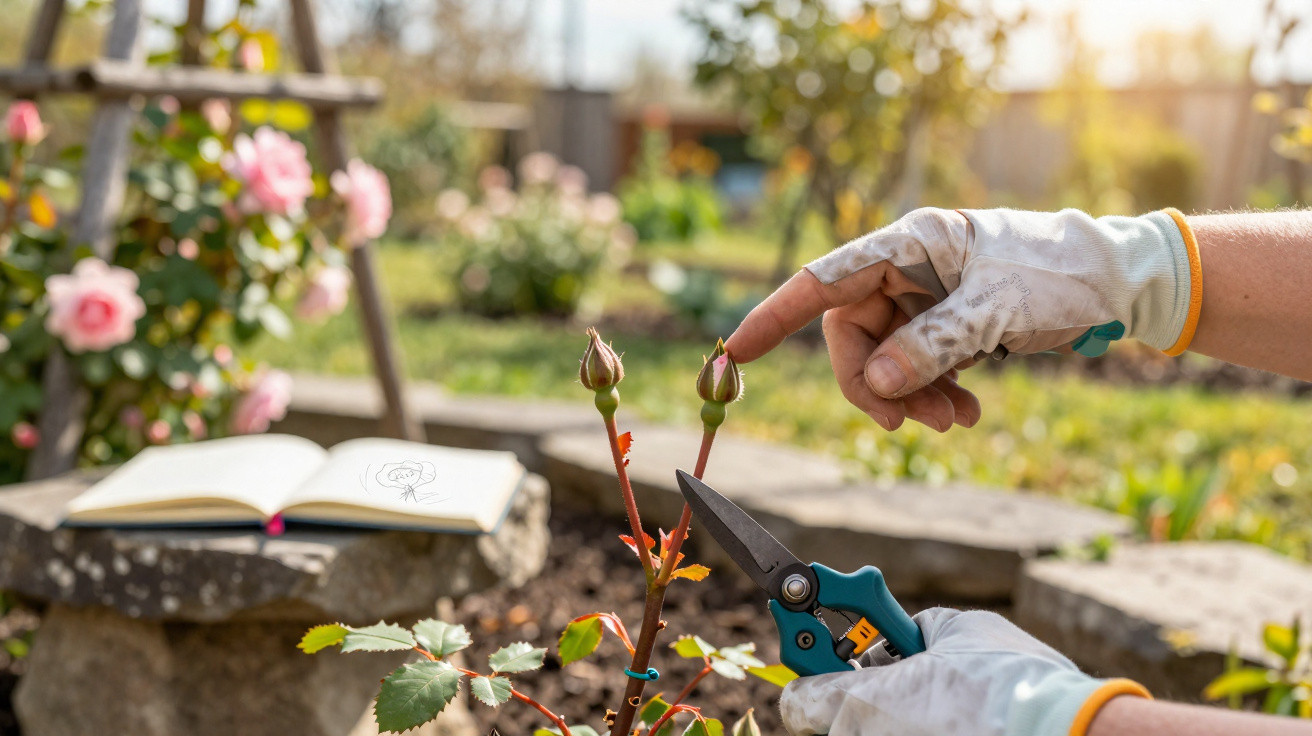
The crucial feature sits directly on the shoots, appearing as small swellings beneath the bark. These are the buds. Many people prune “by feel” or by eye, but overlook these tiny growth points. Yet they determine both the strength and direction of the rose’s later growth.
The basic rule for shrub roses and standard roses is to retain three to five buds on each strong shoot, counted upwards from the base. Thin, weak stems should be cut back more firmly or removed entirely, so that the rose can concentrate its energy on sturdy shoots.
Before every cut, consciously count the buds once – this small pause can save whole weeks of flowering.
How to make the cuts correctly
When buds are deliberately included in the pruning process, proceed methodically:
- Count the existing buds on each shoot from the bottom upwards.
- Decide whether three, four or five buds should remain, according to the shoot’s vigour.
- Make an angled cut roughly five millimetres above the final bud you intend to retain.
- Ensure that the uppermost bud faces outwards, so the bush develops an open shape.
The angled cut allows rainwater to run off more easily. A bud facing outwards directs growth away from the centre of the shrub, allowing more air and light to reach the heart of the rose and making fungal infections less likely.
Identify the type of rose before pruning, or you may cut away the flowers
Before even picking up the secateurs, there is one fundamental question: what kind of rose is it? Not every variety copes equally well with pruning in March. Many mistakes happen because all roses are treated in the same way.
Telling repeat-flowering roses apart from once-flowering varieties
Broadly, there are two groups:
- Repeat-flowering roses: These produce several flushes of flowers each season. They are pruned from late winter into early spring, around March. Pruning encourages fresh shoots and new flowers.
- Once-flowering roses: These bloom only once each year, on the previous year’s wood. Pruning them in March would be disastrous, as it removes the very shoots that already carry the buds for the coming display.
Once-flowering varieties should therefore be pruned only immediately after flowering. Once the last petals have fallen, old shoots can be removed and the plant thinned out without putting the next flowering period at risk.
Pruning climbing roses correctly: retain the framework and guide the side shoots
Climbing roses require a slightly different approach. The aim is to maintain a strong permanent framework while encouraging plenty of flower-bearing side shoots. Cutting everything back in March destroys that framework and forces the rose to start again from scratch.
A tried-and-tested approach for repeat-flowering climbing roses is:
- Keep three to five strong, healthy main shoots and tie them in securely.
- Train these leading shoots in a fan shape or as close to horizontal as possible, as this encourages more flowers.
- Shorten the side shoots on these main stems to two or three buds.
This produces many short, sturdy flowering branches along the main shoots instead of an impenetrable tangle of thin canes. Each of these short shoots can later carry a small cluster of flowers.
Recognising healthy and diseased shoots
Before carrying out the shaping and maintenance cut, remove any dead or diseased branches. Healthy shoots look greenish and feel slightly flexible. Brown, shrivelled or blackened stems should be cut back to healthy wood.
Typical warning signs include:
- Black spots on the bark
- Grey or whitish fungal growth
- Translucent, dried-out tips
Every affected shoot should be disposed of in household waste, not placed on the compost heap. This prevents fungal spores from spreading unnecessarily around the garden.
Practical tips for perfect rose pruning in March
Alongside the bud rule and correct pruning time, a few simple measures can protect flowering and strengthen the plants over the long term.
| Aspect | Good practice tip |
|---|---|
| Tools | Use sharp, clean secateurs and disinfect the blades before pruning. |
| Weather | Prune on dry, frost-free days, never in wet conditions or hard frost. |
| Pruning height | Do not rigidly cut every shoot to the same height; judge each one by its vigour and number of buds. |
| Care around the plant | Remove old leaves from the ground to reduce fungal pressure. |
| Nutrients | Feed with a specialist rose fertiliser a few weeks after pruning. |
Why buds matter so much – a brief practical look
A rose bud is more than a tiny dot on the bark. It contains the complete blueprint for a new shoot, including leaves and the beginnings of flowers. When a clean cut is made directly above it, the rose responds by producing strong growth at that exact point.
If you cut too low and remove buds, however, the plant has to draw on reserves lower down. That costs both time and energy. In extreme cases, the rose responds with many thin, weak shoots, which are more prone to disease and produce fewer flowers.
In small gardens, it is worthwhile deliberately leaving more buds on some shoots. This keeps the rose taller and creates a light canopy of flowers that gives beds structure and provides screening. In very exposed sites, you can cut back more firmly to prevent breakage, but should still focus consistently on the strongest buds.
Further care steps that noticeably improve flowering
After pruning, roses are sensitive to care mistakes. A consistent water supply is directly reflected in bud formation. Waterlogging is harmful, but so is drought lasting for weeks. A thin mulch layer of well-rotted compost or composted bark protects the soil while also supplying nutrients.
By regularly watching for signs of fungal disease, you can act early. Generous planting distances, open centres in shrubs and targeted pruning are often more effective than any spray. Many robust varieties reward this combination of suitable pruning technique and gentle care with a long, reliable flowering period – even in changeable years.
If you are unsure, try two different pruning methods on one individual shrub: follow the bud rule strictly on one side, and prune “by feel” on the other. After just one season, it will become clear which method delivers more numerous and more dependable flowers. This small personal experiment trains your eye for future years better than any theory.



Comments
No comments yet. Be the first to comment!
Leave a Comment