
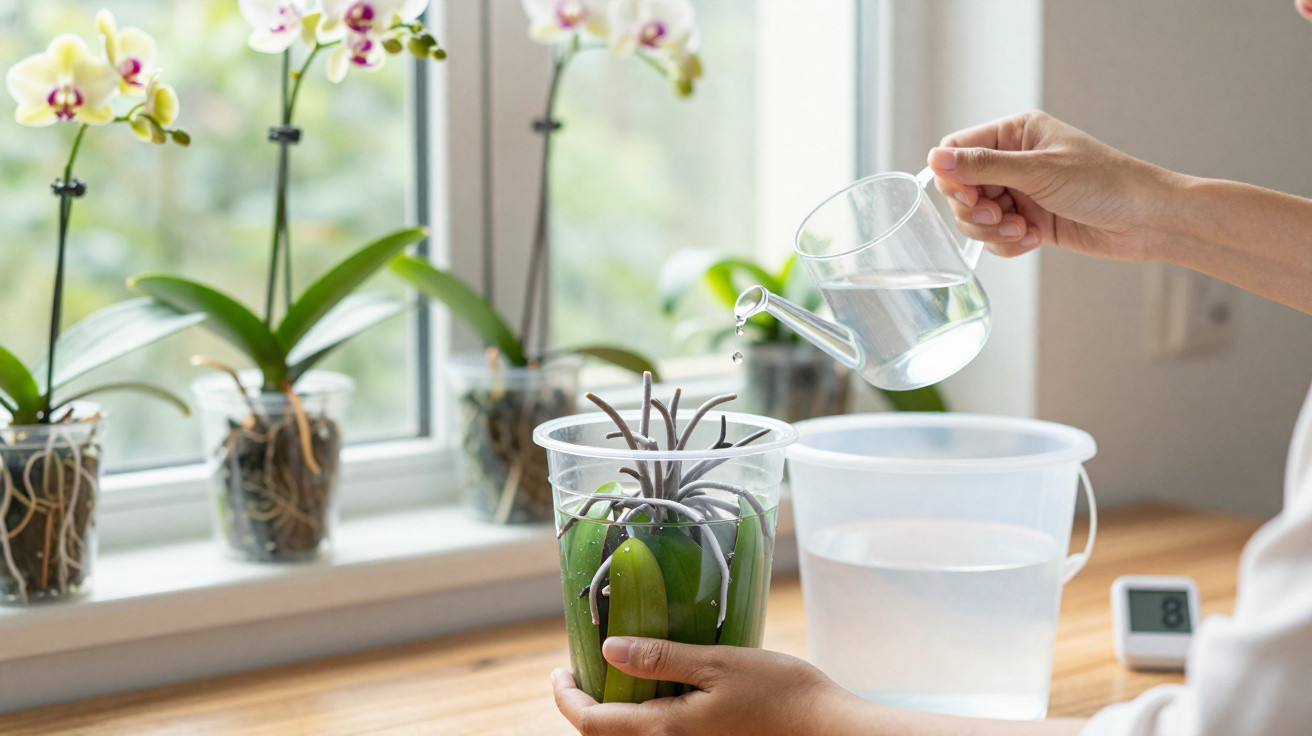
Anyone who waters their Phalaenopsis faithfully by the calendar usually means well, yet can still cause harm. What matters is not whether the compost looks dry on the surface, but the colour of the roots inside the pot. A close look shows whether the plant urgently needs water – or whether every extra drop is depriving it of oxygen.
Why so many living-room orchids drown
Phalaenopsis orchids are the familiar garden-centre favourites: keen to flower, resilient and supposedly easy to care for. Yet huge numbers are thrown away even though they could have recovered. The main culprit is a constant downpour from the watering can.
The usual situation will sound familiar to many people: watering happens on Sunday simply because it is “time”. The surface of the compost appears bone dry, so water is added. Inside the pot, however, the picture is very different. The roots are still sitting in damp, heavy growing medium, with hardly any air circulating, and the plant slowly suffocates.
Phalaenopsis are epiphytic plants. In nature, they cling to tree bark with their aerial roots, often high up in the canopy. Water drains away quickly, while the roots receive plenty of air and light. Indoors, the opposite can easily happen: a cramped pot, compost that is too fine, and continual moisture.
Most house orchids do not die because they receive too little water – they die because their roots remain wet all the time.
The secret of root colour: green means stop, grey means watering time
The easiest and most dependable watering test is found directly on the roots. Phalaenopsis have thick roots covered by a special layer known as velamen. This sponge-like tissue absorbs water and stores it briefly. Its colour changes according to the moisture level.
The rule of thumb is remarkably straightforward:
- Bright or deep green: The roots are well supplied. Do not water.
- Grey to silvery, sometimes slightly wrinkled but firm: This is the right time to water.
- Brown or black, soft and perhaps unpleasant-smelling: A warning sign of root rot – take action immediately and do not water.
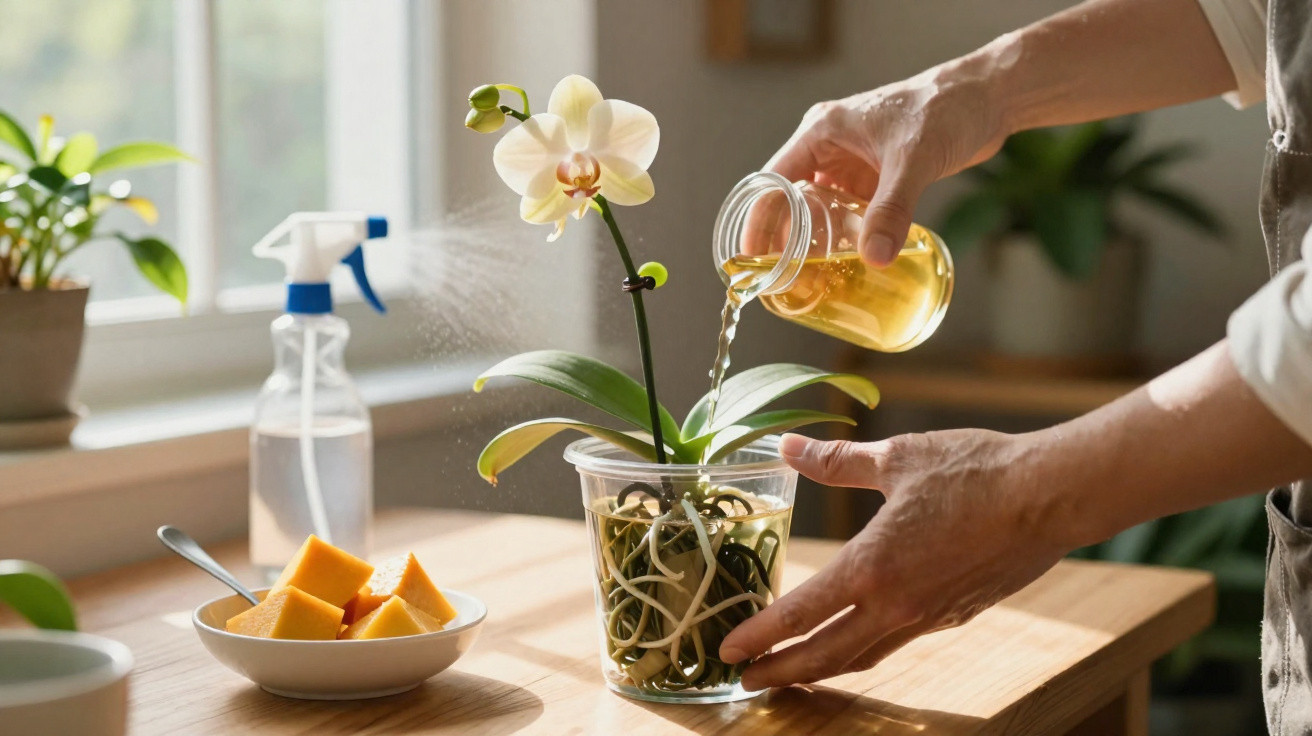
To make this visible at all, a Phalaenopsis should be kept in a transparent plastic pot. This can then sit inside a decorative cachepot. That makes it possible to check the root colour in seconds, without having to remove the plant every time.
Looking at the roots is more reliable than any watering app, calendar or fingertip test of the surface.
How to check before every watering in under a minute
Proper care starts before the first drop of water. Carry out this quick check before each watering:
- Look into the pot: What colour are the visible roots? Are they rich green or clearly grey-silver?
- Lift the pot: If it still feels fairly heavy, there is usually enough moisture left in the growing medium.
- Inspect the growing medium: If it looks very dark and slightly glossy, it is still damp; if it is lighter and matt, it is tending towards dry.
At least one of these signs should clearly point towards “dry” before fresh water is added. If the roots are still green or the pot feels unexpectedly heavy, wait two days and check again.
Watering Phalaenopsis correctly: soaking instead of constant showering
Once the velamen has turned its typical silvery-grey colour, it is time to water. The way water reaches the plant makes a considerable difference.
Soaking in a bucket – ideal for bark-based growing medium
If your Phalaenopsis is growing in loose compost made from coarse bark pieces, the soaking method is particularly suitable:
- Take the transparent inner pot out of the cachepot.
- Place it in a bucket or sink filled with lukewarm, preferably low-limescale water.
- Leave it for around 15 minutes, until no more air bubbles rise.
- Allow the pot to drain thoroughly and remove all excess water from the cachepot.
Water must never be left standing in a saucer or cachepot. Even a thin remaining layer creates a long-term risk of rot.
Water gently from above – for highly absorbent materials
If, instead of bark alone, you use highly absorbent materials such as sphagnum moss or coconut fibre, it is better to water carefully from above in measured amounts. Otherwise, the root ball stays wet for too long. Slowly run water over the growing medium until it is lightly moistened – not thoroughly saturated.
As a broad guide, a Phalaenopsis at a room temperature of around 20 degrees needs water roughly every eight to fifteen days. The interval varies with the season, pot size, growing medium and light levels. Checking the roots remains a better guide than any fixed number.
When the roots are brown and mushy
If large parts of the roots are dark brown to black, soft and smell musty, the plant has a serious problem. In this situation, swift action matters more than any new watering routine.
Proceed as follows:
- Carefully remove the orchid from its pot.
- Thoroughly shake off or rinse away the old growing medium.
- Using disinfected scissors, cut away every soft, brown or black section of root.
- Leave only firm, green or grey roots in place.
- Repot it in a clean, transparent pot with fresh bark and a few expanded-clay pellets.
After this “emergency operation”, give the plant water only very sparingly at first, followed by longer dry periods than before. This allows more air to return to the root area.
The most important rescue rule is: cut away rot, use airy growing medium, then water strictly according to root colour.
Location, light and common Phalaenopsis mistakes
Even perfect watering works only when the location is suitable. Phalaenopsis prefers bright positions without direct midday sun, such as an east- or west-facing window. Draughts, proximity to radiators and cold windowsills, on the other hand, quickly cause stress.
Take particular care not to leave water sitting in the crown of the leaves or where the stem meets the roots. Rot can develop there, often only becoming apparent once the leaves suddenly hang limp.
Common practical mistakes include:
- Watering by date rather than by root colour.
- A ceramic pot without drainage holes that traps water.
- Growing medium that is old and too dense, allowing hardly any air through.
- A sharp temperature change between day and night.
What grey, green and brown roots mean over time
| Root colour | Meaning | Action |
|---|---|---|
| Fresh green to dark green | Velamen saturated, sufficient moisture stored | Do not water; wait longer |
| Silvery-grey, slightly wrinkled | Water reserve nearly empty, plant ready for water | Water or soak now |
| Brown to black, soft | Root rot caused by waterlogging | Drastic pruning, fresh growing medium, pause watering |
Why velamen reacts so sensitively
Velamen is made up of dead cells that act like a multi-layered sponge. It absorbs water quickly and passes it gradually to the living root cells beneath. Its structure also improves the movement of air and light, giving roots in tree canopies major advantages.
In a pot, this same tissue works like a traffic light, revealing what is happening inside. Once you understand this “language”, it quickly becomes clear that the plant sends unmistakable signals – you simply need to learn how to read them.
Many amateur gardeners report that their “problem orchids” suddenly begin producing buds again once they follow one simple rule: leave green roots alone, water grey roots thoroughly, and consistently remove brown roots. With a little observation, the supposedly delicate diva becomes a remarkably long-lasting companion on the windowsill.

Comments
No comments yet. Be the first to comment!
Leave a Comment