
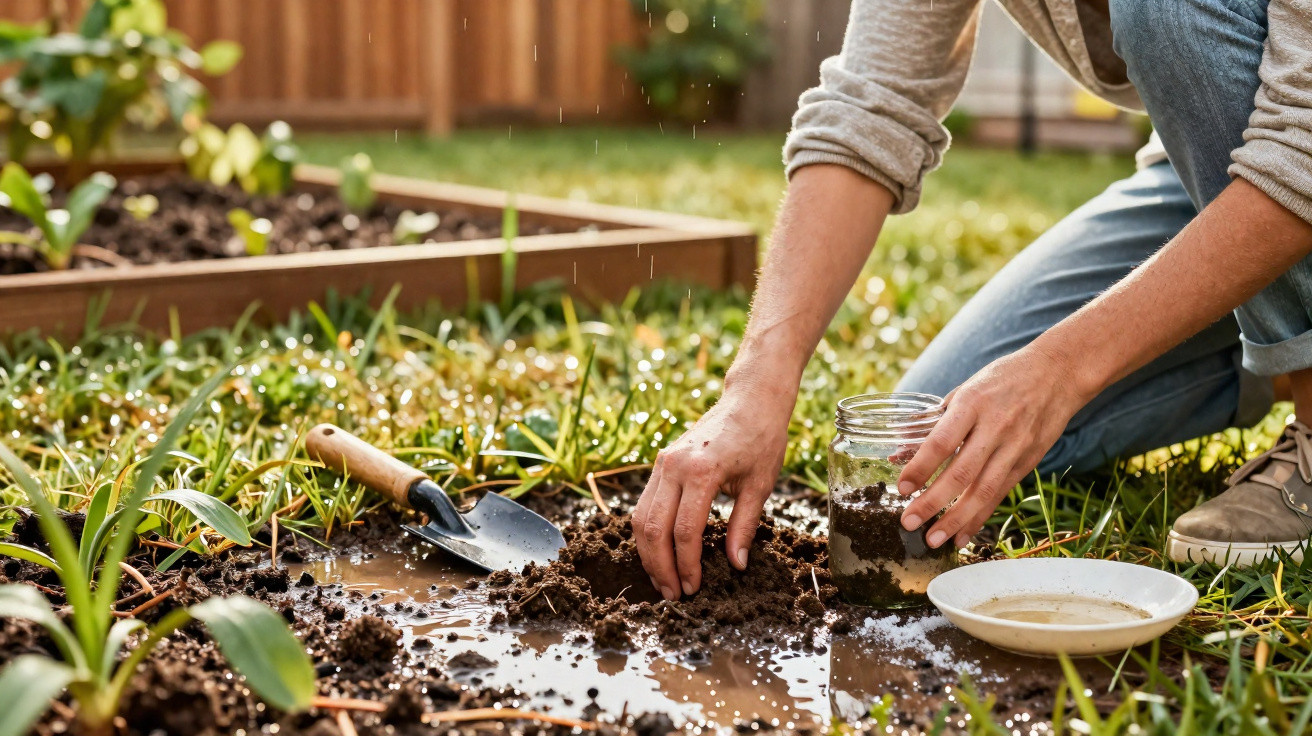
The rain had finally eased off. You walked outside with a coffee, expecting that clean, earthy scent and borders that looked freshly washed. Instead, something felt off: puddles still weighed down the lawn, beds remained slick and shiny, and your footsteps sank as though you were treading on sponge cake.
The sky had cleared, yet the ground stayed glossy and saturated long after the last shower.
You reassured yourself: “It rained a lot, it’ll dry.” But 48 hours later, the lawn still squelched underfoot. The plants looked drained rather than revived. Around the standing water, the grass even began to yellow at the tips.
There’s a quiet warning tucked into that picture.
And most gardeners walk right past it.
The subtle drainage signal your garden keeps repeating
The first hint rarely looks dramatic. There’s no indoor flooding and no lake forming in the middle of the garden. It’s simply that, after rain, everything takes far too long to return to normal.
If the soil is still springy and waterlogged 24 to 48 hours later, your garden is trying to tell you there’s a drainage issue.
Most of us fixate on what we can see-foliage, flowers, colour. But the real trouble is happening just under the surface. When water hangs around, oxygen gets pushed out. Roots quietly start to suffocate. They don’t fail in a single night; they just stop pushing outwards, stop feeding properly, and stop defending themselves.
That sluggish “bounce back” after rain is often the only early warning you’ll get before plants begin to decline for “no reason”.
Imagine this. A reader in Devon wrote to say her lawn turned into a “wet rag” whenever it rained. There were no obvious pools-just persistent damp. The grass never truly dried, and even her raised beds stayed tacky for days. Initially, she put it down to the weather.
Then the losses came one after another: first the lavender, then the rosemary, then a cherry tree that had looked absolutely fine the summer before.
When she eventually dug a test hole, water collected at the bottom… and didn’t shift. Twenty minutes. Thirty. A full hour. The soil was heavy with clay and tightly compacted from years of walking and mowing-plus an old surprise from a builder who had dumped rubble beneath the turf. Her garden wasn’t merely slow to dry; it had been struggling to breathe for years.
The sign had been there all along: water that simply wouldn’t move on.
What’s happening is straightforward cause and effect. Healthy soil is a blend of particles and tiny air spaces. After rain, water should drain through those gaps, oxygen should return, and roots keep breathing. When soil structure is crushed or overly dense, those spaces collapse.
Water stagnates. Roots are left sitting in a bath they never wanted.
That lingering wetness invites root rot, fungal problems, weak nutrient uptake, and shallow root growth. Lawns respond by thinning. Shrubs cope, but rarely look truly happy. Fruit trees may leaf up, yet produce very little. Above ground it can look like “just a slow garden” – below ground it’s a slow suffocation.
The awkward truth is that your garden told you early. It just said it in the language of stubborn, sticky wet soil.
How to test your garden’s drainage (without fancy tools)
The most revealing drainage test needs a shovel and less than an hour. Begin with a simple check after a heavy downpour. Walk around and note where water lingers, where your boots sink, and where the grass squishes most. That’s your first rough map.
Next, choose two or three locations-perhaps part of the lawn, a border, and an area close to the house. Dig a hole roughly 30 cm wide and 30 cm deep. Fill it to the top with water and let it drain away. When it has emptied, fill it again and time how long the second lot takes to disappear.
If water is still sitting there after 4 hours, drainage is slow. If it remains the following morning, there’s a serious problem beneath your feet.
This small routine tells you more than a dozen trial-and-error YouTube tips put together.
Many gardeners avoid this sort of test because it feels too simple-or a bit dull. It’s much more tempting to buy another plant, add a “miracle” feed, or chase a fashionable variety that promises instant results. Let’s be honest: hardly anyone makes a habit of doing this.
Yet this brief, muddy experiment can explain why your hydrangea sulks, why the veg patch rots at the base, and why moss thrives where you want the lawn to look thick and smug. If only certain patches stay wet, you may be dealing with compaction from foot traffic, a hidden pocket of builders’ rubble, or a subtle slope that funnels water to one unlucky corner.
Those areas aren’t cursed. They’re simply trapped.
Once you’ve proved drainage is slow, it’s easy to leap straight to dramatic “French drain” solutions. Sometimes they are necessary, particularly around house foundations. But for most home gardens, the first improvement is usually calmer and cheaper: rebuilding soil structure.
In practice, that means adding organic matter-compost, leaf mould, or well-rotted manure-gradually and consistently. Think light, regular top-dressings, not a single heroic dump once every ten years. In clay, organic material helps break up dense particles so water filters through instead of sitting on top. In sandy soil, it moderates drainage just enough to keep roots moist without drowning them.
Another quiet but effective change is reducing traffic on problem areas. Put in clear routes, stepping stones, or mulched paths so every trip across the garden isn’t tightening the soil further. It’s not glamorous, but it’s the sort of work that turns a boggy patch into soil that can breathe again.
Common drainage mistakes and the smarter moves to try
One of the worst responses to a waterlogged garden is continuing to dig, hoe, or till while the ground is wet. It may look workable, but each push of the spade compresses what little air remains and makes the soil tighter still. That leaves even less space for water to move the next time it rains.
A better approach is to wait until the surface has dried enough to crumble rather than smear. Then work in organic matter gently, forking from the top down and lifting to loosen, instead of stamping and chopping. Where ground is particularly stubborn, think in vertical channels: drive in a garden fork, rock it back and forth, and create passages for air and water without flipping the whole bed.
It can feel slower. But in the next downpour, you’ll see why it matters.
Another common misstep is trying to “lift” a soggy bed by tipping new soil straight onto compacted ground. All that does is add a fresh layer on top of a waterlogged base. Roots still end up sitting in the same wet bowl-just slightly higher. We’ve all had that wheelbarrow moment of thinking, “I’ll add a bit more and it’ll sort itself out.”
A smarter fix is a proper raised bed with a base that can breathe. Loosen the soil underneath first, add a coarse layer such as small wood chips or gravel if necessary, and then build up with a rich, free-draining growing mix. For lawns, aeration is the understated helper: hollow-tine aerators, or even a strong fork making a grid of deep holes, followed by a light top-dressing of sand and compost.
Drainage doesn’t improve through hope. It improves through small openings made repeatedly.
Sometimes the culprit is an old design decision. Downpipes dumping all roof water into a single border. A patio that sends runoff straight onto the lawn rather than into a gravel trench. A neighbour’s raised plot pushing water your way every time it pours. In those cases, a bit of honest detective work can save you years of frustration.
“Water will always find the lowest point and the easiest path,” says landscape designer Claire Morrison. “Your job isn’t to fight it. Your job is to guide it somewhere it can disappear without hurting anything alive.”
- Shape shallow swales or dips and plant them with moisture-loving plants so they catch and slowly absorb excess water.
- Put in simple gravel trenches or French drains alongside hard surfaces to send runoff away from beds and foundations.
- Fit gutters, rain chains and water butts to capture roof water before it reaches the ground.
- Treat naturally boggy corners as a feature, using willows, irises and other plants that actually like wet feet.
- Keep repeated foot traffic off the same patch, especially just after rain, to prevent fresh compaction.
Let your garden’s slow recovery change the way you see it
Once you clock that your garden takes ages to recover after rain, you start noticing it everywhere: the soggy patch beneath the apple tree, the border corner that never dries, the strip by the fence where moss is outcompeting grass. These aren’t random oddities any more. They’re information.
Paying attention can change how you garden. Rather than forcing every square metre to behave the same, you begin working with what the site naturally does. Wet zones become lush micro-gardens filled with shade-tolerant, moisture-loving plants. Better-drained areas take the Mediterranean herbs and sun-seekers. Some places are left as paths or wilder corners where the soil can recover over time.
You may find yourself saying “match the plant to the conditions” instead of “bad soil”. That slow recovery after rain isn’t only a fault to correct; it’s the start of a conversation with the ground you’re gardening on.
| Key point | Detail | Value for the reader |
|---|---|---|
| Notice the warning | Soil that remains wet or springy 24–48 hours after rain points to poor drainage and low oxygen around roots. | Lets you spot trouble early, before plants weaken or die without an obvious cause. |
| Test, don’t guess | A simple 30 cm hole test (fill, drain, refill, time) shows how quickly water moves through soil in different parts of the garden. | Replaces guesswork with clear evidence so you can make better decisions. |
| Improve the structure | Organic matter, aeration, raised beds and small design adjustments support long-term water movement. | Creates a healthier, more resilient garden that handles heavy rain and dry spells more effectively. |
FAQ:
- How long should my soil take to dry after heavy rain? Ideally, the surface should lose its wet sheen within 24 hours, and the soil should feel workable within 48 hours. If it stays shiny, sticky or waterlogged beyond that, drainage is likely restricted.
- Is standing water always a bad sign? Brief puddles during a storm can be normal. Water that remains a day later-or soil that still feels squishy long after the surface seems dry-suggests the soil isn’t getting enough air.
- Can adding sand fix heavy clay drainage? Mixing a small amount of sand into clay can make a cement-like texture. It’s usually safer to prioritise plenty of organic matter and improving structure, rather than relying on sand alone.
- Should I install a French drain right away? Not always. Begin by testing the soil, improving structure, and checking where runoff is coming from. Drains can help, but they’re often a later step and a bigger job.
- What plants cope best with poorly drained areas? Choose moisture-lovers such as Siberian iris, dogwood, willow, astilbe, hosta and certain ferns, and turn a persistently damp patch into a deliberate feature.



Comments
No comments yet. Be the first to comment!
Leave a Comment