
It begins on a grim Monday near the end of January, when daylight clocks off at four and the parsley on the windowsill seems ready to lodge a grievance.
I stir a pan of soup, remembering the fistfuls of basil I picked all summer: that self-satisfied, sun-warmed fragrance. It feels slightly absurd to miss a few leaves. Beyond the glass, the garden is a sodden novella. Indoors, the radiator coughs, while supermarket “living herbs” are less alive than awaiting an apology. One evening, I notice a soft blue light behind a neighbour’s curtains and discover it is not a gaming setup. It is a shelf full of herbs, glowing like a tiny version of June. I set down the spoon and reach for my laptop. Perhaps the year need not end in October. Perhaps the kitchen can carry the scent of August into February. Perhaps the garden does not need to freeze; perhaps it simply needs to come indoors.
The day I lost patience and bought a £25 shelf
Everyone I know has finished off a supermarket basil plant at least twice. You take it home, give it a hopeful drink, and five days later it collapses like a Victorian heroine. I managed three in a fortnight: a slaughter of green optimism on a south-facing windowsill that was, in truth, a wind tunnel. That was the point at which I surrendered and ordered a cheap metal shelving unit online, the kind normally used for storing tins in a shed.
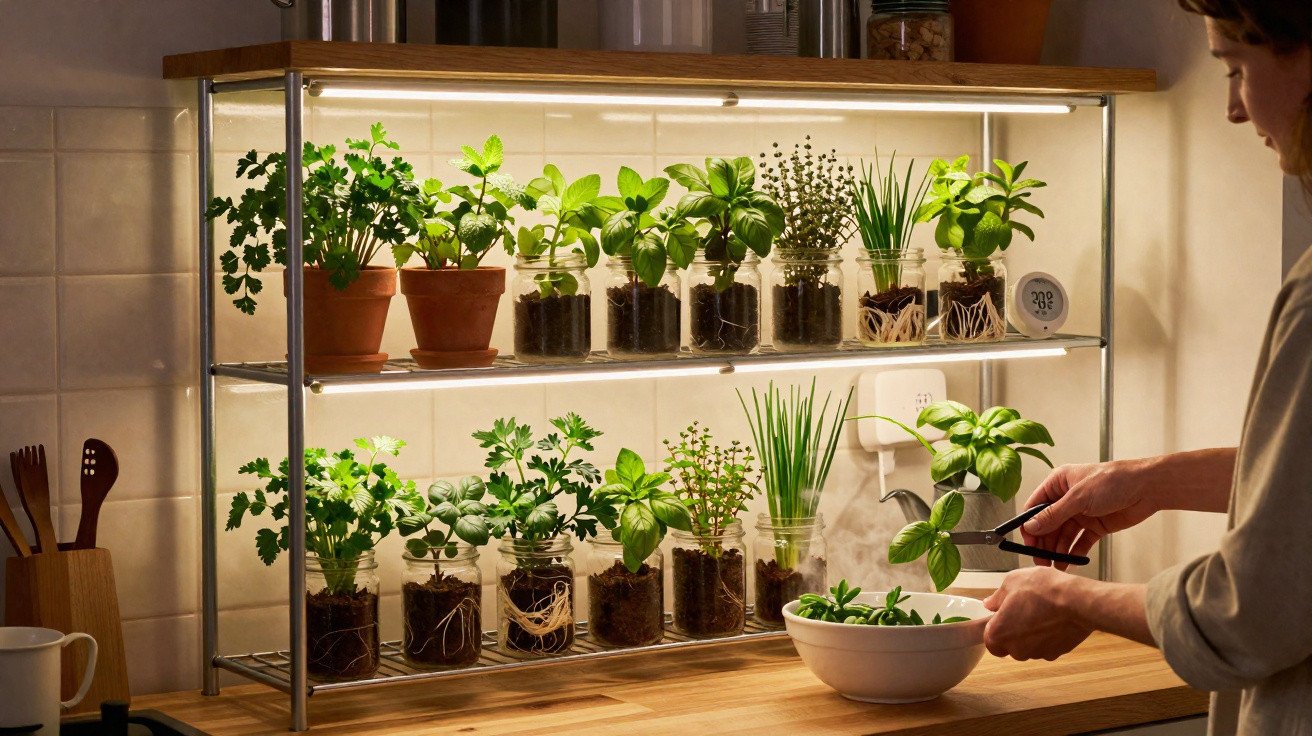
The following day, I headed to the hardware shop for a pair of LED grow strips that would not turn the kitchen into a nightclub, plus an inexpensive plug-in timer. At home, I assembled the shelf with a mild metallic clatter, feeling partly foolish and partly thrilled. When the lights first came on, there was a small mechanical click and the dreary room abruptly felt like a late July afternoon. It was a courteous way of cheating the weather.
An indoor herb setup that keeps on producing
The essentials: shelf, lights and timer
I have not constructed a spaceship. It is simply a shelf beside the back door, with two full-spectrum LED bars on each level, fixed with cable ties roughly a hand-span above the plants. The timer keeps them on for 14 hours daily, usually 7 a.m. to 9 p.m., recreating a lengthy UK summer day and stopping the herbs from becoming miserable. The LEDs sit in the 4000–6500K range, giving clean daylight rather than purple sci-fi, while around 30–40 watts per shelf is enough for a dozen small pots.
I also use a small USB fan, running for 15 minutes every hour. It is barely audible but creates enough movement to stir the leaves. That modest airflow strengthens stems and prevents damp from settling in like an unwelcome visitor. The entire arrangement uses less electricity than my kettle does to warm a third mug of tea. It adds only a few quid a month to the bill, and the reward tastes like a summer meal.
The growing parts: pots, compost and water
Herbs have no interest in stylish pots. They want room for roots and air. For basil, parsley and mint, I use pots measuring 12–15 cm; rosemary and sage go into slightly larger ones. Each shelf has saucers or a shallow tray lined with capillary matting beneath the pots. A peat-free compost mixed with a generous handful of perlite works well: it is airy, drains quickly and does not leave puddles. Imagine crumble topping that briefly holds its shape before breaking apart.
Watering from below preserves both leaves and patience. I fill the tray, allow the pots to draw up water for 30 minutes, then pour away what remains. There are no waterlogged roots and no fuss. The foliage stays free from marks, the compost remains agreeably damp, and I avoid finding myself at midnight holding a mister with a guilty conscience. When it works, brushing against the basil releases a sweet, peppery smell, as if somebody has just split a warm loaf in two.
Grow lights and a long June evening
Light drives the entire story. Herbs require reliably bright days, but British windows offer us a politely dim poem from October until March. Grow lights rewrite that tale. Position them close, 15 to 25 cm above the canopy, so plants do not stretch into something ridiculous. If stems resemble drinking straws, bring the lights lower; if leaf tips turn crisp, move them higher.
I use 14 hours because basil and parsley enjoy it. Chives and thyme tolerate almost any day length, while coriander does better with 12 hours to prevent it bolting like a teenager who has heard the ice-cream van. You do not need a meter to judge the conditions: inspect the foliage. Tight spacing between nodes and deep colour mean you have got it right. Pale, spindly growth quietly asks for more light or less warmth. I still recall that first January basil sprig, as green as a traffic light and scenting the kitchen like a promise.
Airflow, warmth and the understated issue of damp
Indoor growing usually fails through stillness, not spite. Warm, wet, stagnant air welcomes gnats, fluff and a fungal opera. The fan circulates air, the lights provide brightness, and I keep the room at around 18–22°C. Herbs are not ferns and do not want rainforest conditions. Ordinary British household humidity is suitable, and if your windows are steaming, your plants will be unhappy too.
Fungus gnats love compost that has been overwatered. The answer is unexciting: allow the top couple of centimetres to dry, put out sticky cards if they invade the party, and water from underneath. A light layer of horticultural sand or vermiculite across the surface also helps, rather like gravel over a muddy track. The fan does more than any spray; a gentle leaf-rustle tells you that the conditions are sound. It is the noise of resilience.
The routine: sow, cut and repeat
Herbs are lessons in patience and timing. Every few weeks, I sow modest batches: a pinch of basil, a pinch of parsley and a small pot of coriander. Basil is the crowd-pleaser, earning its keep quickly; coriander races ahead, then gets grumpy, so I sow it in cooler conditions and keep fresh batches coming. Parsley takes an age to germinate, then acts like a reliable neighbour who always gives your Tupperware back.
The key to harvesting is this: do not strip lower leaves as though grazing a hedge. Instead, pinch stems just above a pair of leaves, prompting the plant to branch and become fuller. With basil, the first pinch at three sets of leaves changes one stem into two, then four, then enough for a plateful. Cut mint stems and it replaces them like a magician producing scarves. Let us be truthful: hardly anybody disinfects scissors after every cut, but rinsing the blades and cutting cleanly avoids plenty of trouble.
Feeding herbs without the faff
Herbs are not especially hungry. Half-strength liquid feed every 10–14 days keeps them content without producing abundant but flavourless leaves. I favour seaweed extract or diluted tomato feed, watered down until it resembles weak tea. If leaves become pale between their veins, offer a little more at the next feed; if growth turns floppy and soft, reduce it. Think gentle background music rather than a brass band.
Once a month, I flush the pots with plain water to wash away fertiliser salts that collect below. This small flush takes five minutes and prevents later dead-leaf detective work. You can purchase pH kits, test the runoff and feel like a botanist. Or you can taste your pesto and smile. The plants will quietly show whether they need more or less, and you learn their accents within a fortnight.
Pests will appear: how to welcome them politely
Even indoors, living things find their way in. Aphids may arrive from the allotment on your jumper, or a tiny passenger may come back from the garden centre. At the first sight of a few, I move the pot to the sink and spray them firmly with water. I then make a gentle soap mix: one small squirt of washing-up liquid in a litre of water, used to wipe the stems. That is the job done.
For thrips or persistent aphids, neem oil proves useful, applied sparingly and never immediately before a harvest I intend to eat. Separate a troubled plant for a week, as you would a guest with a cough. Most pests dislike moving air, bright light and a gardener who examines leaves every few days while holding a mug. You do not need a greenhouse; you need routines.
Year-round indoor herbs that genuinely thrive
Basil is the star of indoor growing. Greek or bush basil remains compact, Genovese provides large leaves to tear over tomatoes, and both appreciate a long, bright day. Parsley, whether flat-leaf or curly, performs well under lights and tolerates the occasional forgotten watering. Chives are effortless, returning after every trim with an understated onion aroma that makes scrambled eggs feel special.
Thyme and oregano get on quietly, asking for very little attention. Rosemary needs a somewhat larger pot and detests wet roots; give it sun, airflow and a restrained hand with water. Coriander can be demanding: sow it thickly, keep it cool and regard it as a fast crop rather than a houseplant for years. Mint is unstoppable when it has a pot of its own. Dill is wonderful if frequently sown and picked young. Sage complains when overwatered, then forgives you by Easter.
Small pleasures of flavour and timing
We have all reached for dried herbs and wondered why supper tastes like last weekend’s rain. The first time you twist off indoor thyme in February and hear the stem make its tiny snap, winter looks different. Warm a pan with a knob of butter, add chives cut moments ago, and the kitchen takes on the smell of Sunday. Naturally, it is not a midsummer garden. It is a small patch of green refusing to accept the weather forecast.
It makes cooking feel like a dialogue. Basil rescues a weary tomato. Mint gives peas a mild coolness. Parsley lifts the heavy meals we tend to make when the sky resembles wet pavement. There is also a little performance to it: the timer clicks, the lamps brighten, you pull a pot forward and take only what you need. Your shoulders somehow relax.
The cost and the guilt
Electricity is expensive, so it is reasonable to hesitate before adding more plugs to the wall. I calculated the cost using my supplier’s unit rate and found that my two shelves came to less than one takeaway each month. LEDs are economical: they sip rather than gulp. In March and April, as daylight increases, you can shorten the timer; if you are away, you can turn off a shelf.
Another doubt creeps in: is it slightly indulgent to grow basil under lights while storms batter the windows? Then I think of the wilted supermarket packets we buy, the ones that die before we can finish them, and the food waste they promote. A live pot harvested to the last leaf feels economical and considerate. During a bleak week, a flash of green feels medicinal. Call it therapy with sandwiches.
If you do only three things this weekend
Build the basic structure: one simple shelf, two daylight LED bars and a timer. Attach the lights beneath a shelf with cable ties, plug them in, and allow that gentle glow to begin rewriting your kitchen weather. It ought to seem straightforward, light and almost mischievous. You do not have to convert a room into a laboratory; you only need to give leaves somewhere pleasant to live.
Sow little amounts regularly. Try two basil pots, one parsley pot and a mint plant in its own container. Then put a reminder in your calendar to sow again in three weeks. That small ritual repays you by maintaining a steady harvest. No glut and no shortage, only dependable handfuls. Sow small, sow often.
Adopt one useful habit: pinch rather than pluck. It separates a sulking plant from one that multiplies. Use clean scissor cuts above a pair of leaves, pausing briefly to choose where the next fork should form. It may feel overly precise for a day, but soon it becomes muscle memory. Pinch, don’t pluck.
Little upgrades with outsized benefits
If you get hooked, add another shelf and stagger sowing dates so a fresh batch is always on the way. Capillary matting in trays makes watering a five-minute task. A £6 clip-on fan cuts your gnat complaints in half. If you want to edge towards nerdy without putting on a full lab coat, place an inexpensive digital thermometer on the shelf to reveal when a cold snap is creeping in.
People may advise you to measure light in acronyms and cover every surface with reflective film, and perhaps one day you will. Or you might simply lower the lights slightly, see the leaves deepen in colour, and realise you can manage without becoming fluent in moles per square metre per second. Start with a shelf, two lights, and a timer. Everything else is seasoning.
The glow late at night
On some evenings, I pass the back door and notice the shelf at the edge of my vision: a quiet green stage. The leaves do not move because the fan has switched off. The room is warm, the home is silent, and the herbs appear to breathe. On my way upstairs, I pinch off a small basil shoot, and its clean, warm, rather audacious fragrance trails along the hall.
By morning, there will be eggs with chives, a lunch salad containing parsley that tastes like the colour green, and a rosemary pot demanding a larger home by spring. This arrangement has not turned me into a horticultural wizard. It has let me cheat the seasons a little and keep some summer close at hand. It has also softened the bleak months, one modest harvest at a time. If your kitchen is quietly asking for life, you already know what answer the shelf will offer when the timer clicks on.
Comments
No comments yet. Be the first to comment!
Leave a Comment