
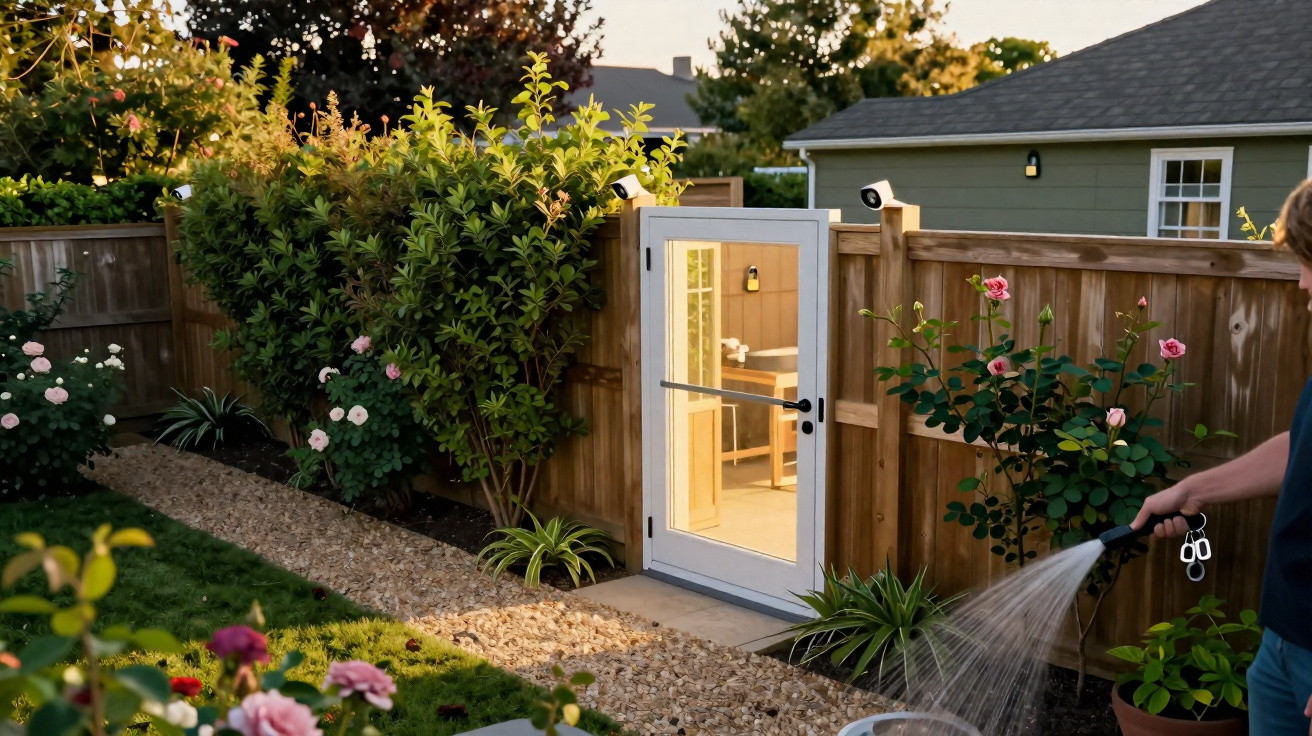
Your back garden may feel like the most secure and private part of your home.
But that peaceful refuge can also become the least protected area.
Burglars seldom approach the front entrance beneath a smart video doorbell. Instead, they observe from concealed positions, search for weak spots and frequently discover them in the garden at the rear of the property. By changing the way you use and arrange this outside area, you can transform it from a concealed route in into an exposed, unwelcoming space that discourages intruders.
Why burglars prefer the back garden to the front door
Many householders concentrate their security efforts on the side facing the street. They may fit a video doorbell, a porch light and perhaps a smart lock, while the rear garden receives little attention because it is not readily visible. That lack of attention is precisely what can appeal to burglars.
From a burglar’s point of view, a secluded garden offers time, cover and useful tools – all in one place.
Where the rear of a home is screened by fences and high hedges, an intruder may be able to:
- Enter through an unlocked side gate without attracting attention.
- Take several minutes to inspect windows and sliding doors.
- Search sheds for bicycles, power tools or ladders.
- Use those same tools to force open a patio door.
A well-kept front garden and a clearly visible camera can create a reassuring impression of security. However, a low, traditional “farmhouse” fence at the rear, a latch that is never secured and curtains that remain closed all the time may communicate something very different: nobody is paying attention here.
It is also commonly assumed that concealing a house behind tall planting makes it safer. Crime-prevention teams and security professionals generally advise the reverse. Thick shrubs growing directly against walls form ideal hiding places, allowing somebody to wait, crouch or interfere with a lock without being visible from the road.
Gardens that look secluded rather than lived in often tell burglars: you will not be disturbed here.
Designing the boundary: fences that delay rather than merely decorate
Garden security begins at the property boundary. No fence alone will prevent a determined intruder from entering, but an appropriate design can make access more time-consuming, noisier and less appealing.
Height, materials and gate routines
Low fences of around 1.2 m (4 feet) can look attractive, yet offer little resistance to anyone climbing over them. Many security advisers suggest a height of at least 1.37 m (54 inches), and sometimes greater, to provide a meaningful barrier. The construction material is as important as the height.
| Fence type | Security profile |
|---|---|
| Timber panels | Provide good privacy, but may be kicked in or cut through; they require regular maintenance. |
| Vinyl panels | Need little maintenance and offer moderate strength, although force can cause them to crack. |
| Chain-link | Straightforward to climb where horizontal bars are available, but provides clear visibility. |
| Steel or wrought-iron bars | Difficult to cut and harder to grip when the bars are vertical and set well apart. |
Vertical metal bars with no substantial horizontal rails offer fewer places to put a foot. They are also more difficult to cut using basic tools than timber fencing or mesh.
Side gates and garden entrances frequently create weaknesses because they are left unsecured, rather than because they are poorly designed. A side gate that is always free to swing open signals to anyone watching that the rear garden can be accessed easily. Establishing one straightforward habit can address this.
The least glamorous habit – locking every gate, every evening – often makes the biggest difference.
Practical improvements include:
- Installing a sliding bolt and weather-resistant padlock on timber gates.
- Securing metal or chain-link sections with a chain and padlock.
- Adding a drop bolt that goes into the ground on broad driveway gates.
These steps will not make a fence impenetrable, but they introduce delay and noise. That added inconvenience is often sufficient for opportunistic burglars to look elsewhere.
Defensive planting: turning flowerbeds into a barrier
Plants can either give intruders cover or make their route difficult. Their security value depends on placement, height and upkeep rather than species alone.
Thorny plants and open sightlines
Gardeners focused on security often refer to “defensive planting”. This simply means positioning thorny or uncomfortable plants where somebody may attempt to pass through, while preserving clear views around windows and doors.
Prickly shrubs commonly used for this purpose include:
- Climbing or shrub roses.
- Berberis varieties with thick, spiny growth.
- Bougainvillea in warmer climates, which develops dense, sharp tangles.
A waist-high strip of these plants beneath an at-risk window or beside a low wall makes passage physically unpleasant. It is also considerably less aggressive-looking than barbed wire or metal spikes.
Maintenance determines how effective planting is as a security measure. Police-supported garden advice in a number of areas recommends:
- Keeping shrubs near the home to around 0.9 m (3 feet) high.
- Maintaining clear gaps beneath tree crowns so that feet and movement remain visible.
- Using taller plants on the outside boundary instead of immediately beside the walls.
Low, well-trimmed planting near the house lets neighbours and passers-by spot someone who should not be there.
In contrast, untrimmed hedges behave like curtains outdoors. Once someone moves behind them, they are hidden from view. An annual pruning, followed by quick trims through the growing season, helps prevent this.
Lighting that interrupts the shadows burglars rely on
Unlit spaces between the patio and shed can give intruders the cover they need. A carefully planned lighting scheme can remove that advantage without making the garden feel like a sports ground.
Motion-activated floodlights remain a popular option for rear gardens. Mounted above entrances, beside paths and near gates, they produce an abrupt pool of light that makes sneaking about uncomfortable. Burglars often depend on the expectation that they will go unnoticed; a bright light activated by their movement challenges that assumption.
Certain lights use mains electricity, while others operate with batteries or small solar panels. Battery-powered units are particularly useful for detached sheds or distant areas where installing cables would be impractical. They can be activated by cats or branches during windy evenings, but this small inconvenience provides awareness and sends a clear message: movement is noticed here.
Good security lighting does not have to be harsh. The key is unpredictability for the intruder, not discomfort for you.
Cameras, smart devices and the outdoor limits of technology
Video doorbells rarely cover events at the back of a property. Outdoor cameras can fill this gap when they are positioned carefully.
Where and how to monitor the garden
A wide-angle outdoor camera providing coverage of at least 130 degrees can monitor much of a small or medium-sized garden from one location. Fitting it high on a wall or beneath an eave improves the view while keeping the device beyond easy reach.
Important locations include:
- The primary route towards the back door or patio doors.
- The garden gate or entrance from a side passage.
- Sheds and outbuildings containing tools, bicycles or fuel.
Clearly visible cameras can deter burglars before they try to enter. However, they depend on electricity and, in many cases, Wi-Fi. A severed cable or router fault may leave areas unmonitored. Battery backup and local recording can lessen that vulnerability, although they cannot eliminate it entirely.
Some people also use motion-activated sprinklers as part of their garden security measures. Connected to a hose or water butt, these devices release a sudden spray when their sensor detects movement. The outcome is more amusing than threatening, but can be highly effective at interrupting someone expecting to move quietly in the dark.
Any device that forces an intruder to react – to sudden light, water or noise – exposes them and steals their confidence.
Securing the doors and glazing between the garden and home
The route from the garden into the house often involves large glazed areas, including sliding doors, French windows and patio bi-fold doors. They bring daylight and views in daytime, but may become vulnerable points after dark.
Making sliding doors more difficult to force
Many sliding doors can be lifted from their tracks or prised along them with a lever. A number of inexpensive precautions can increase the effort needed:
- Fit an anti-lift device or screw block at the top of the frame.
- Place a strong bar, tube or timber strip in the bottom track whenever the door is shut.
- Install a suitable internal deadbolt instead of relying solely on the door’s existing latch.
- Apply security film to the glazing to make smashing the glass and entering quickly more difficult.
Individually, these measures make little difference to the appearance of the door. Combined, they take away the “easy win” burglars generally seek.
Daily garden habits that show a home is occupied
Garden security involves more than physical equipment. Everyday routines can strongly indicate whether the space is monitored.
A lawn mown regularly, generally to between 2.5 and 7.5 cm (one and three inches), suggests that someone cares for the property. Toys left around, ladders left upright, tools beside the fence or costly barbecues uncovered overnight suggest the opposite: convenience has been prioritised over care.
A neat, used garden whispers that people come and go, look around and care about what happens there.
Helpful evening routines include:
- Storing away tools, bicycles and toys after use.
- Covering or locking away valuable items, including barbecues and garden furniture.
- Inspecting gates, shed doors and patio doors during a simple final walk around the garden.
When you are away on holiday or a business trip, an untouched and silent garden can quickly reveal that nobody is home. Asking a neighbour to water plants, move bins or make footprints in fresh snow disrupts that pattern. Timers for selected garden lights offer another sign of activity.
Your selection of outdoor surfaces can provide a discreet additional safety benefit too. Non-slip tiles or porcelain paving around terraces and pools, for instance, can reduce the likelihood of falls if you need to move quickly outdoors after dark. This is useful when a light suddenly comes on and you go outside to investigate a noise following rain.
Viewing the garden as a buffer between the outside world and your home, rather than purely a place for relaxation, can alter the way you plan it. Features that make the space enjoyable, such as open views, easy paths and well-considered lighting, can also serve as a subtle protective barrier for the rooms beyond the glass.


Comments
No comments yet. Be the first to comment!
Leave a Comment