
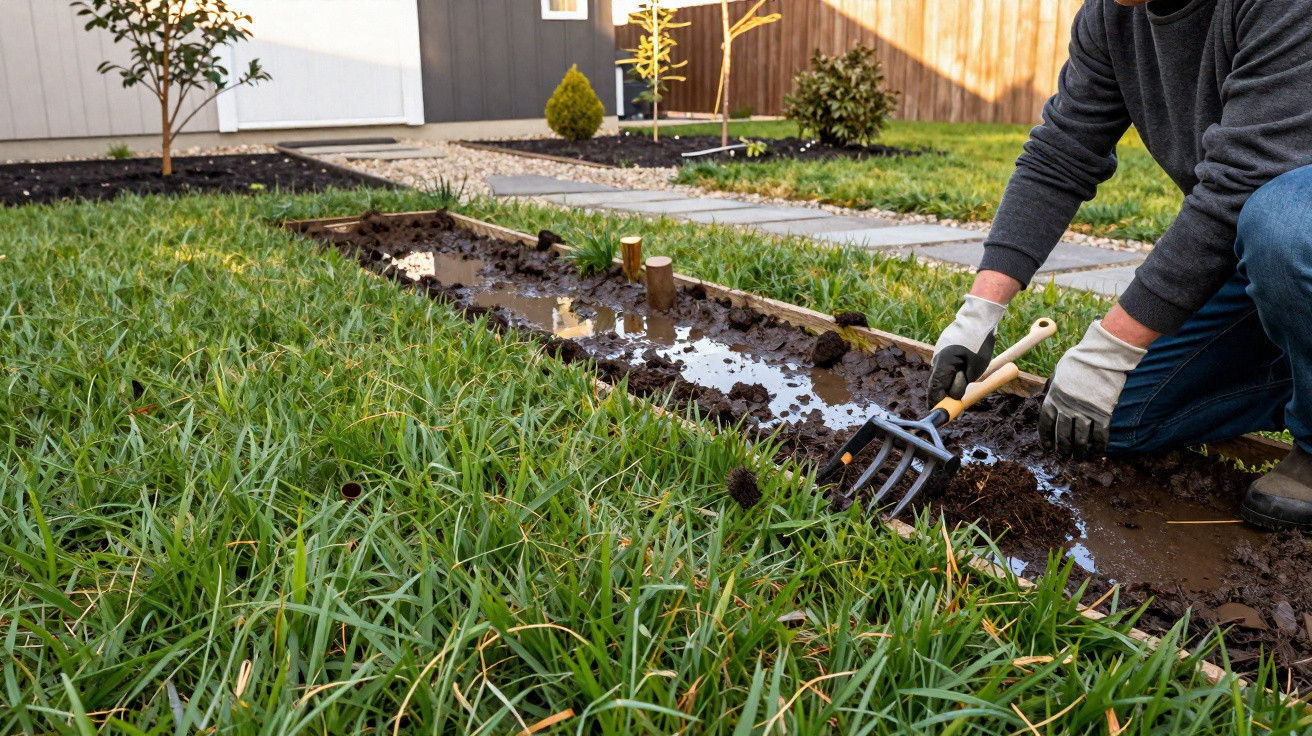
Across the UK and large parts of the US, homeowners see their lawns turn into mud every winter and assume that is simply unavoidable. Professional gardeners tend to take a different view. By taking a few focused steps before and throughout the colder months, they keep grass more walkable, reasonably green and much less boggy.
Why winter turns your lawn into a mud bath
When a lawn becomes sludge, rain is only one part of the explanation. Downpours may set the problem off, but the underlying causes are usually beneath the surface.
Most muddy lawns combine three issues: compacted soil, poor drainage, and too much foot traffic in wet conditions.
Clay-heavy and very fine soils hold on to water rather than allowing it to drain away. Repeatedly walking across the same areas, whether by people or pets, presses soil particles even closer together. This compaction removes the air spaces in the ground, leaving water to pool on the surface instead of soaking through. Grass roots then struggle and weaken before eventually dying back, creating bare areas that become muddy after the first shower.
Shady gardens are particularly vulnerable. With limited sunlight, less water evaporates. Dampness remains, moss takes hold, and the surviving grass cannot cope with the continuing damage.
How gardeners fix drainage before winter
Experienced gardeners do not usually regard poor drainage as a permanent problem. They approach the lawn as a living sponge whose internal structure needs restoring.
Aerating the soil: simple holes, big results
Aeration is often the first job professionals carry out. It involves making numerous small holes in the turf, allowing air and water to reach the root zone.
- Small lawns: use a garden fork or hand aerator at intervals of 10–15 cm
- Larger lawns: use a mechanical aerator that removes small soil plugs
- Frequency: once or twice yearly, commonly during autumn or early spring
Afterwards, the holes are commonly filled with sand or a sandy topdressing. Over time, this gradually improves soil structure, so water can pass through rather than collecting on top.
Punching holes and brushing sand into them sounds basic, but over a few seasons it can transform a wet, heavy lawn.
Feeding the soil with organic matter
Gardeners also pay attention to the soil’s composition. Spreading a light layer of compost, leaf mould or well-rotted manure across the lawn, then gently brushing it in, can slowly loosen dense and sticky ground.
Organic material promotes a more crumbly soil texture. It also supports worms and microbes, which form countless small channels of their own. These channels work as natural drains, taking excess water down and away from the lawn surface.
Quick fixes for those “boot-sucking” areas
Some issues cannot wait for gradual soil improvement. Around gates, patio doors, sheds and play equipment, winter mud can become an everyday frustration.
Using absorbent materials after heavy rain
When conditions become especially bad, gardeners may use temporary solutions. They spread materials that absorb moisture and provide a firmer surface underfoot.
- Sharp sand to improve grip and drainage
- Fine gravel around entrances and along paths
- Wood chips or bark for play spaces or routes used by dogs
These options are not lasting repairs, but they provide breathing space. They limit further churning while more substantial drainage work and soil improvements begin to work.
Think of sand, gravel and bark as crutches: helpful for walking now, while the lawn slowly heals underneath.
Hard-wearing routes: grids, stepping stones and paths
In places where people consistently walk during winter, professional gardeners often stop trying to maintain uninterrupted lawn. Instead, they establish clear, robust routes that preserve the surrounding grass.
Stabiliser grids for soggy zones
Plastic stabilising grids, widely used in horse paddocks and parking areas, are increasingly found in muddy gardens. They interlock over a prepared base and can be filled with gravel, sand, or even soil and grass seed. By distributing weight, the grids prevent the ground below from becoming churned up.
For smaller gardens, a more subtle option may be preferable. A basic gravel path or bark-chip strip running from the back door to the shed or bin store can protect the lawn and keep footwear cleaner.
Stepping stones for stylish access
“Japanese steps” or paving slabs placed along a route offer a dry passage through the garden while retaining a decorative appearance.
| Step | What gardeners do |
|---|---|
| 1. Mark the route | Position the stones on the grass first to test the spacing and ensure they feel comfortable to walk on. |
| 2. Dig shallow recesses | Take out approximately 8–10 cm of soil beneath each slab. |
| 3. Add a sand bed | Add sand or fine gravel, then level it to provide drainage and stability. |
| 4. Lay and adjust | Set the stones in place, tap them down firmly and ensure they sit just above the grass level. |
This straightforward alteration greatly reduces turf wear and significantly cuts mud around the points where people enter and leave the house.
Planting allies: trees and plants that drink up water
Some gardeners choose a more ecological approach. Rather than battling excess water, they introduce plants that cope well with it and help absorb it.
Moisture-hungry trees and shrubs can act like natural pumps, drawing litres of water from the ground every day.
Willows, alders, poplars and certain birches tolerate wet ground far better than many ornamental trees. In larger gardens, planting a small group in the lowest corner can gradually help dry out an area that remains boggy.
Nearer the house, moisture-tolerant grasses, sedges and flowering perennials can take the place of lawn that never grows well. This creates a “rain garden” style space, collecting runoff while helping the main lawn stay drier.
Habits gardeners change to prevent future mud
Methods alone will not solve the problem. Professional gardeners also alter how the garden is used over winter.
- Moving children’s football games to a sacrificial area or hard surface whenever the ground is saturated
- Changing dog access routes with temporary fencing, allowing one strip of lawn at a time to recover
- Mowing slightly higher during autumn, so the roots remain stronger and more resilient
- Avoiding mowing and heavy use when the soil is soft and squelchy
The less a wet lawn is trampled, the more easily it can bounce back once the weather turns.
Where gardens flood every year, specialists may recommend a basic land drain. This consists of a shallow gravel-filled trench containing a perforated pipe that directs water towards a soakaway. It requires more effort and generally some planning, but it can save a lawn that would otherwise never dry out.
How this looks in real life
Picture a small suburban garden in Manchester or New Jersey: clay soil, a dog, two children and a gateway that becomes slimy every January. A gardener could suggest the following straightforward plan:
- Autumn: aerate the entire lawn, then brush in sand and compost.
- Early winter: create a bark-chip path between the back door and shed.
- Wettest weeks: keep ball games off the lawn and use the local park instead.
- Spring: overseed sparse patches with a hard-wearing grass mix and aerate again.
By the following winter, the lawn may not be flawless, but the worst of the mud should have disappeared. Repeated aeration and additions of organic matter build stronger, drier turf year by year.
Useful terms gardeners quietly rely on
Two terms regularly confuse homeowners dealing with a muddy lawn. The first is “soil compaction”, which means that soil particles have been pressed so tightly together that the air gaps disappear. With no gaps, water cannot drain, roots cannot breathe and mud develops rapidly. Forking, aeration and organic matter all address this issue directly.
The second term is “drainage capacity”. It describes how quickly a soil can allow water to travel down through it. Sand has a high capacity, whereas heavy clay has a low one. Viewed this way, the solutions become clearer: gardeners aim to raise that capacity by improving the soil mix, using plants that absorb more water, or installing physical routes for excess water to escape.
For households considering the expense, a balance is needed. Straightforward measures such as aeration, bark chips and planning routes are inexpensive and can be completed over a weekend. Larger projects, including drainage systems and tree planting, offer longer-term improvement but require more preparation and sometimes professional guidance. Combining both approaches, as many gardeners do, is usually what changes a winter mud field into a lawn that can genuinely be walked on.



Comments
No comments yet. Be the first to comment!
Leave a Comment