
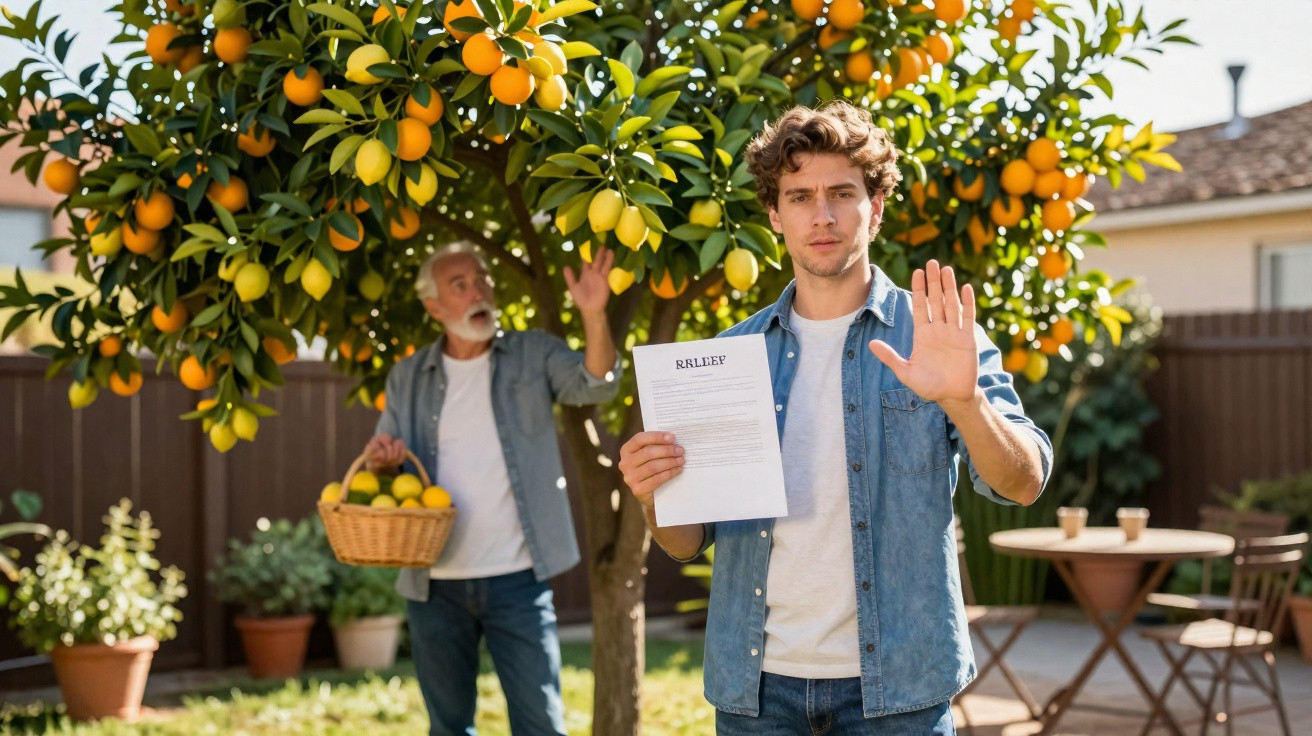
Emma first spotted her landlord in the garden when he was not there to repair anything. Beneath the apple tree, he casually twisted a red Bramley from its branch and placed it in a canvas tote, as though browsing at a Sunday market. From the kitchen window, toast in hand, she watched him repeat the act. Again and again. There was no knock at the door and no “Do you mind?” - only the muted fall of fruit into the bag and the gate creaking as he departed.
When she raised it with him later, he simply shrugged. “It’s my property,” he said. “You’re only renting it.”
That one remark landed harder than a door being slammed.
At what point do your rights stop and his “property” begin?
When your landlord treats your garden like a free buffet
Once you notice accounts like these, they seem to be everywhere. Tenants see landlords passing through rear gardens “to check the fence”, only to leave carrying berries. Some landlords take figs, pears, lemons or even herbs, breezily claiming, “Oh, they’d only go to waste.” Legally, the house may belong to them. In everyday reality, however, you are the person watering and pruning, paying the rent - and quietly seething when the cherry harvest disappears overnight.
The disagreement is seldom about the cost of a handful of apples. It is about boundaries: who actually “lives” in the space, and who merely holds the title deeds.
A viral discussion on a UK tenants’ forum began with an almost identical account, involving a landlord helping himself to strawberries from a small raised bed. By the end of the week, it had attracted thousands of comments. Some described it as “stealing” and “creepy”, while others argued, “Relax, it’s his land.” One contributor said they had begun harvesting fruit before it ripened, not because it was ready, but because they were competing with their landlord.
Another tenant shared photographs of a landlord turning up with crates and clearing a plum tree in under an hour. “Those plums were my summer,” she wrote. The humiliation and anger were evident between the lines.
In legal terms, the issue is far less straightforward than the casual claim, “It’s my property”, makes it sound. In most countries, signing a tenancy agreement gives you exclusive possession of the home and any garden or yard included with it. Even where a landlord owns every brick and root, they cannot normally wander in whenever they please. Except in a genuine emergency, they generally require notice, a proper reason and your consent.
Fruit sits squarely in the untidy overlap between land ownership and the right to enjoy a home in peace. The tree may technically be his, but the calm patch beneath its branches is yours in day-to-day life.
How to respond when your landlord raids “your” fruit
The most measured response begins well before anyone starts shaking a pear tree. Read your tenancy agreement and check exactly what it says about the garden. If it explicitly confirms that the outdoor area is for your exclusive use, you have a strong starting point. If the wording is unclear, that is the first indication that this grey area could cause trouble.
Then have a straightforward, human conversation. You could say: “I noticed you came into the garden to pick fruit. Could we agree that you’ll ask first?” It need not become dramatic; it simply acknowledges what occurred and draws a boundary.
Many tenants feel immediate anger, and that reaction is understandable. An unexpected person entering your space can touch a deeply rooted nerve. Even so, escalating at once can damage a relationship over something that one uncomfortable but candid conversation may resolve. Explain how it made you feel, that you spend time looking after the garden, and that you would like to be asked first.
Let’s face it: hardly anyone reads every rental-contract clause or records every raspberry picked. But even a brief written follow-up, such as an email after your conversation, can avoid months of “I never said that” later.
At times, the emotional intensity exceeds the value of the fruit itself. You may start to feel like a visitor in a home for which you pay every month, while your landlord may feel like an outsider in a place they legally own. That combination creates friction.
“Living somewhere is about more than paying rent or holding the title deed. It’s about feeling like the space around you respects you back,” says a housing adviser from a London renters’ charity. “When a landlord walks in unannounced, even just to pick apples, it tells the tenant, ‘This will never fully be yours.’”
- Confirm in writing that the garden forms part of the space you rent.
- Make clear that visits - even those “just for fruit” - require advance notice.
- If you wish, suggest a compromise: share the harvest, agree particular days, or leave a box by the door.
- Record unannounced entries, including the dates and anything taken.
- If the conduct continues, contact a tenants’ association or obtain legal advice before you reach breaking point.
When the law is grey, social rules get loud
The more closely you examine it, the clearer it becomes that this is not simply about apples on a tree. It concerns who is allowed to feel “at home”. A landlord may sincerely think they have done nothing wrong: in their mind, it remains “their” soil, “their” tree and “their” harvest. Yet for the tenant who sits on the back step after work and watches the same tree catch the sunset, it is part of daily life rather than an asset.
We have all experienced the moment when a minor action suddenly reveals how unequal a situation is. Once that realisation arrives, it is difficult to return to acting as though everything is fine.
The law often trails behind these emotional realities. It deals with access rights, notice periods and contractual clauses, rather than the quiet humiliation of seeing someone enter your garden without knocking. This is why social expectations take over. Increasingly, tenants set out their expectations from the outset: no unannounced visits, no wandering through the yard “for a quick look”, and no touching what grows there without permission.
It may appear to be a very small request, but it carries the full weight of respect. A simple “Is it okay if I pick a few?” can alter the entire atmosphere.
The central truth is uncomfortable for both parties: a landlord’s legal ownership does not remove a tenant’s right to feel safe and sovereign at home. Equally, a tenant’s emotional connection to a space does not erase the legal framework the landlord must operate within. There is considerable room between those realities for kindness - or conflict.
This is where individual decisions begin to count. Some landlords place a basket by the door and ask tenants to share any surplus they will not use. Some tenants invite landlords to an annual “harvest day” to make arrangements friendly and unambiguous. Others, affected by previous experiences, lock their gates and grow only in pots they can take away when they leave.
The law may still be catching up, but the everyday etiquette of who picks what, and when, is already being reshaped in kitchens, stairwells and back gardens everywhere.
| Key point | Detail | Value for the reader |
|---|---|---|
| Garden access is not a free-for-all | Although the landlord owns the land, tenancy agreements commonly give tenants exclusive use of the area for the duration of the tenancy. | Recognise that surprise visits or fruit-picking may breach your right to quiet enjoyment. |
| Clarity beats assumptions | Setting out garden use and visiting rules in writing helps to prevent conflict later. | Provides a calm script and evidence if the matter escalates. |
| Small gestures change the mood | Ask permission, share surplus produce and agree straightforward harvest rules. | Turns a power struggle into a respectful, practical relationship. |
FAQ:
- Can my landlord legally pick fruit from the garden? In many places, the landlord owns the tree, but your tenancy grants exclusive use of the garden. They will therefore usually need your permission to enter and take anything, unless your agreement clearly provides otherwise.
- Is it trespass if my landlord comes into the garden unannounced? Rather than classic trespass, it may amount to unlawful entry or a breach of “quiet enjoyment” rights. Repeated unannounced visits can often be challenged through complaints procedures or tenancy tribunals.
- What should I say the first time this happens? Be calm and clear: say that you felt uncomfortable seeing someone in the garden without notice, and ask them to seek permission before entering or taking fruit.
- Can I stop them by locking the gate? You can generally secure your home and garden, but check the tenancy agreement, as some contracts require access for maintenance. You may still require notice and agree times that work for you.
- Should I involve a lawyer or tenants’ union? If discussions and written requests do not alter the behaviour - or if you feel intimidated - a tenants’ advice service or lawyer can offer guidance tailored to your local laws and particular tenancy agreement.




Comments
No comments yet. Be the first to comment!
Leave a Comment