
On a grey Saturday morning, two plastic trays stood side by side on the narrow windowsill of a flat. They contained the same potting mix, the same basil seeds and the same warm light filtering through the glass. One tray was full of rich green leaves stretching upwards. The other appeared to have surrendered halfway through growing: thin stems, yellow-tipped leaves and a few forlorn seedlings slumped over as though they had been awake all night.
Their owner insisted that everything had been done “exactly the same.” They had used the same watering can, the same spray bottle and the same YouTube tutorial.
Even so, the contrast between the trays was stark.
Somewhere beneath the surface, their roots were following very different stories.
Why “identical” plants secretly grow at different speeds
Uneven growth can initially seem like simple bad luck. One tomato plant bursts into flower while its sibling sulks at 5 cm tall, leaving you to blame the seed packet, the weather or your supposed “black thumb”.
However, a closer look reveals that the leaves often conceal a quiet struggle below the soil. Roots may split in marginally different directions, curl around an unseen stone or meet the side of a pot at an awkward angle. One plant develops a robust underground network, while another becomes confined to a tight circular route, rather like traffic trapped in a one-way cul-de-sac.
They may appear equal above ground, but underneath they are experiencing entirely different conditions.
A horticulture teacher once arranged a line of lettuce seedlings in matching plug trays. They had been sown on the same day, grown in the same batch of compost and supplied by the same irrigation system. Yet, after three weeks, the variation was remarkable: some rosettes were broad and open, whereas others were only half as large and a little pale.
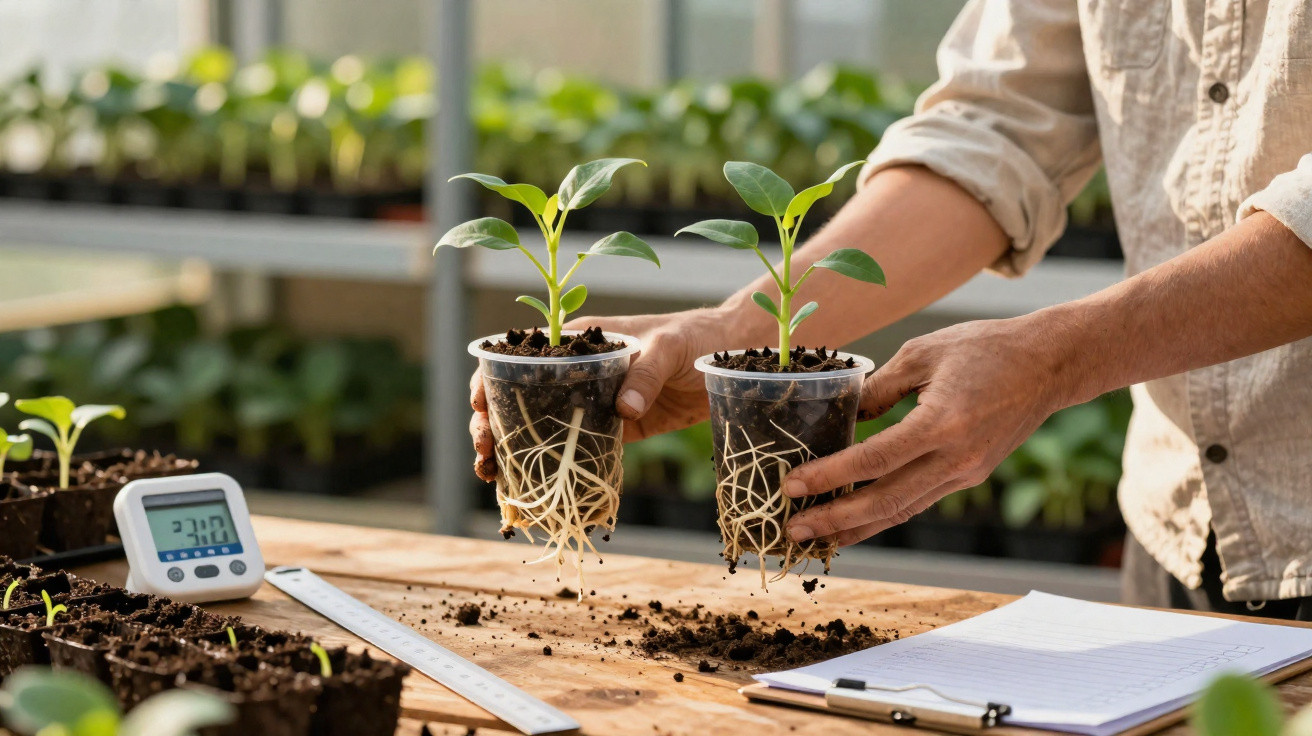
When she carefully removed them from their cells, the reason became clear. The healthiest seedlings had fine, feathery roots spreading outwards and already probing every part of the plug. The weaker plants told another story. Their roots clung to one side, coiled around themselves or plunged straight down as a thin, sparse taproot.
The leaves had offered no warning of what the roots had already determined.
This is an often-overlooked behaviour known as root exploration bias. Faced with even the smallest difference in direction or resistance, a young root takes one route and then repeatedly strengthens that choice. If it encounters a smooth pot wall early, it is likely to circle. If it reaches a soft, open area of soil, it will branch into it and occupy the space.
That slight divergence occurs during the first days and weeks. From then on, the plants begin to head towards different outcomes. A dense, widely spreading root system can reach more water, nutrients and oxygen. The other plant may survive perfectly well, but it becomes the “slow sibling”, always trying to catch up.
What looks like a weak plant from above is, below ground, a strategy that has become trapped.
How to “coach” roots so plants grow more evenly
The most important change is to stop viewing watering as something you do only for the plant and instead consider how it trains the roots. That process starts on the first day, when a seedling begins exploring the darkness around it.
Choose a loose, crumbly growing medium that falls apart easily between your fingers. Large clumps, compressed peat plugs and firm compacted layers can all function as barriers. When a young root meets one, it turns sideways, and circling can begin.
Containers with air-pruning holes or fabric sides can transform this process too. A root tip that reaches the edge and encounters air gently dies back, prompting new branches behind it. Rather than forming a tangled spiral, the plant develops a compact fibrous network.
Many gardeners get everything right above ground while unintentionally undermining the roots. Soil that remains constantly sodden deprives root tips of oxygen and encourages them to stay close to the surface, where water is dependable despite limited air. When the first dry period arrives, those plants collapse because they have never been encouraged to grow deeper.
Inconsistent watering can create a similar problem. Drenching a pot after several dry days can destroy delicate root hairs, placing the plant in a cycle of stress and repair rather than allowing steady exploration. Let’s be honest: nobody really does this every single day. Yet soil that stays consistently “almost moist, never swampy” encourages roots to continue branching calmly outwards.
Transplanting presents another potential problem. Plants kept in small pots for too long develop thicker roots that begin to circle the container. Once this spiral has formed, moving the plant to a large bed will not completely reverse the pattern.
The small, invisible decisions roots make in week one can echo for the whole season.
Garden researcher Daria Cole once summed it up like this: “We fuss over fertilizer and sunlight, but the plant only cares about one thing: whether its roots feel free or trapped. You can’t fertilize your way out of a bad root system.”
Use loose, aerated soil
Break up clods, prevent heavy compaction and add materials that retain structure, such as perlite or fine bark. This creates channels for roots to investigate rather than hard barriers.Choose root-friendly containers
Fabric pots and air-pruning trays limit circling while promoting branching. Even adding extra slits to a plastic pot can alter root behaviour.Water for depth, not for habit
Maintain even moisture that gradually becomes drier towards the base, drawing roots downwards and outwards instead of indulging them near the surface.Transplant before circling starts
Ease seedlings from their cells and inspect them. A dense ring of roots pressed against the pot edge means you have waited too long. Next time, lightly tease them apart or pot on earlier.Disturb the surface, not the whole root ball
Lightly scratching the top layer before watering breaks up a thin crust and helps water penetrate further, without disturbing the central root mass.
The quiet mindset shift that changes how you see your plants
Once you begin observing root behaviour, uneven growth no longer feels like a personal failure in the garden. Instead, it becomes a form of detective work. You start noticing which pots dry more quickly on one side of the balcony, or which plant always leans towards a small gap in the paving and sends its finest roots there first.
There is an emotional aspect too. We have all had that moment when two “identical” plants develop as complete opposites and the weaker one somehow feels like a personal rejection. Understanding the root story reduces that sting. You are not cursed; it is a matter of physics, architecture and timing.
| Key point | Detail | Value for the reader |
|---|---|---|
| Early root choices matter | The first weeks determine whether roots spread and branch or coil into circles | Helps you direct your effort towards the brief period that affects long-term growth |
| Soil and containers shape behaviour | Loose mixes and air-pruning pots encourage fibrous, balanced root systems | Provides straightforward, practical ways to limit uneven growth in “identical” plants |
| Watering patterns train depth | Consistent, moderate moisture draws roots deeper rather than leaving them shallow | Produces sturdier plants that cope better with heat, repotting and minor neglect |
FAQ:
Why do some seedlings in the same tray stay tiny?
Their roots often encounter a compacted area, a cell edge or a build-up of salts early on, causing them to stall or circle. Nearby seedlings may find an easier path and branch outwards instead.Can I fix a plant with badly circling roots?
You can improve the situation. When repotting, gently separate the outer roots or make a few shallow vertical cuts in the mat to encourage fresh branching, then plant it in loose soil.Do I need special “air-pruning” pots for better roots?
No, although they are useful. Fabric grow bags, slotted trays and even extra holes drilled into ordinary pots can reduce circling and promote a denser root system.Is uneven growth always a root problem?
No. Pests, disease, genetics and differences in light can all contribute. Nevertheless, roots are a hidden cause far more often than people realise.How soon should I check roots on young plants?
Carefully remove one seedling from its cell after 2–3 weeks. If its roots have only just reached the edge and are not densely circling, it is a good time to transplant or pot on.
Comments
No comments yet. Be the first to comment!
Leave a Comment