
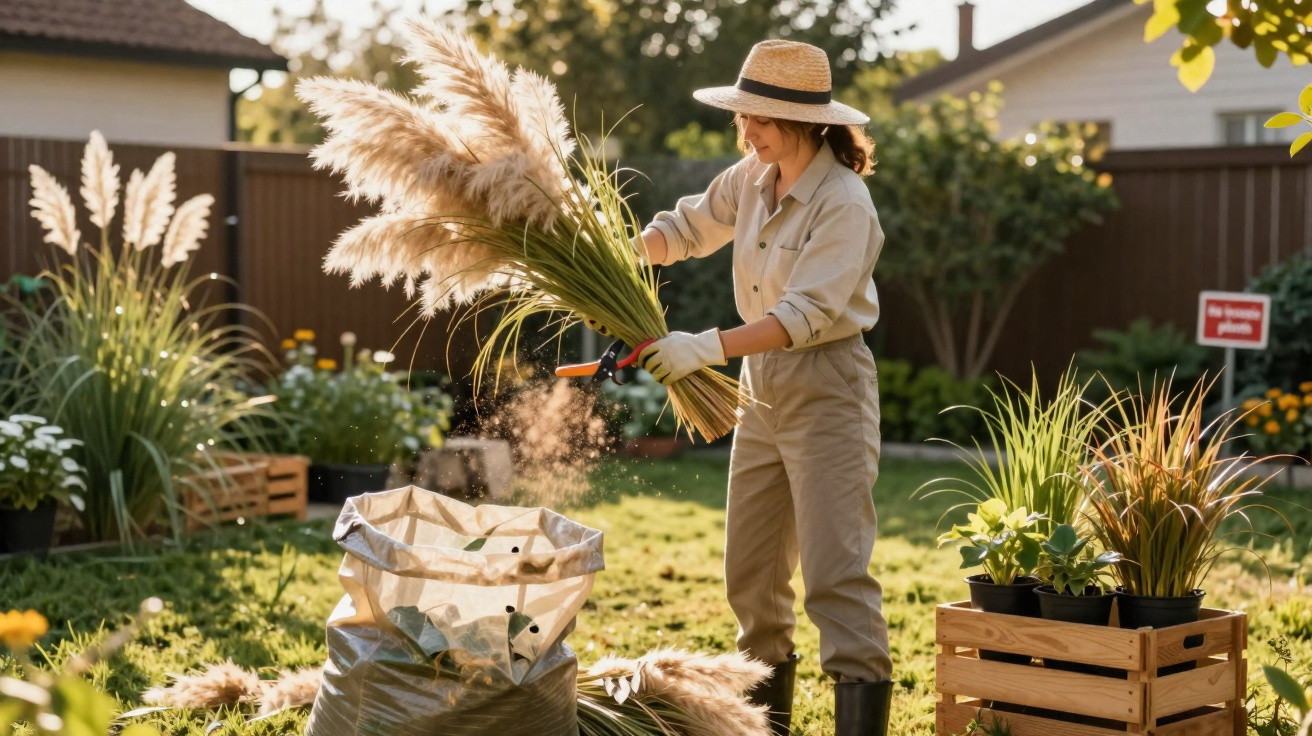
Pampas grass was long regarded as the fashionable plant for front gardens, patios and indoor vases. Since a change in the law in France, however, this striking perennial has been subject to strict controls. The ban is not about changing fashions, but solid environmental and safety concerns. Many amateur gardeners are now asking whether they could face difficulties if the plant is already growing in their garden – and whether it really has to go.
Why pampas grass is strictly regulated in France
Pampas grass, botanically known as Cortaderia selloana, originates in South America and forms dense clumps that can grow beyond 2 m tall and almost as wide. Its gently swaying plumes may look harmless, but specialists regard the plant as highly problematic.
Each flower head produces hundreds of thousands of tiny seeds, which can be carried by wind for several kilometres. If a seed lands on a roadside embankment, a dune or fallow ground, it can quickly establish a new plant. In this way, the species colonises open areas, displaces native plants and alters entire habitats.
Pampas grass is considered a “non-native invasive species”: it spreads independently and damages native nature in the process.
French environmental authorities have observed the grass spreading extensively through dunes, roadside banks and nutrient-poor wetlands. These are precisely the places where rare plants adapted to sparse conditions depend on having little competition. Once pampas grass arrives, it forms thick stands that deprive other vegetation of light, water and space.
There are also further risks that are often overlooked in everyday gardening:
- Risk of injury: Its leaves have razor-sharp edges that can cut deeply into the skin.
- Problems for allergy sufferers: Its pollen can trigger or worsen irritation.
- Fire hazard: During summer, the clumps become very dry and may encourage fires close to homes.
Against this background, France added the grass to its list of prohibited invasive plants in 2023. The measures are based on European legislation on invasive species, supplemented by national rules.
What the pampas grass ban in France specifically prohibits
Since the relevant decree came into force, very clear limits have applied to living pampas grass. Activities that were entirely routine for years are no longer permitted, especially the trade in and planting of new specimens.
Living plants, young plants, seeds and divisions of pampas grass may no longer be placed on the market in France.
The rules prohibit, among other things, the following uses of living pampas grass:
- deliberately releasing it into the wild;
- planting it anew in gardens or on public land;
- selling or giving it away, whether commercially or privately;
- transporting it if it can still reproduce;
- using it for new planting, for example by dividing established clumps.
Garden centres and nurseries have had to remove the plant from their ranges. Penalties for professionals can be severe: in certain circumstances, prison sentences and substantial fines may apply. In practice, inspections focus mainly on businesses, imports and newly planted specimens.
One important exemption remains: dry decorative bundles made from cut plumes are allowed, provided that no viable plant material is left. Strictly speaking, the rules concern every form in which pampas grass can still reproduce.
Can pampas grass remain in a private garden?
For many amateur gardeners, the key question is whether an established plant must now be removed. In France, a practical distinction is made between plants already in place and newly planted ones.
Anyone who planted pampas grass in their garden before 2023 is not automatically required to dig up the clump immediately. There is no blanket obligation to remove it at once. However, that does not end the owner’s responsibility.
Garden owners should prevent the grass from spreading further – for instance through seeds reaching neighbouring properties or the wider countryside.
A number of precautionary measures are recommended:
- Cut flower heads in good time: Remove the plumes before seeds ripen to prevent seed dispersal.
- Do not divide the clump: It must not be split up and replanted elsewhere.
- Wear protective equipment: Long clothing and sturdy gloves are sensible because of the sharp-edged leaves.
- Dispose of it correctly: Cuttings, roots and plumes should not go on the compost heap. Instead, put them into sealed bags for a household waste or recycling centre.
In sensitive locations – such as riverbanks, dune areas or protected wet meadows – environmental agencies advise gradually removing established clumps completely. Large, mature plants are extremely firmly rooted. In such cases, employing a specialist contractor to excavate the root system mechanically can be worthwhile.
How to remove pampas grass safely
Anyone wishing to get rid of the plant should prepare carefully, as removing a mature clump is physically demanding. The job can be completed in several stages:
- Cut all plumes close to ground level to gain access to the centre.
- Use a spade or crowbar to expose the root ball in a circle.
- Split the root stock into sections and lever them out; for large specimens, it is better to work in pairs.
- Seal every plant part in sturdy, airtight bags and take them to an appropriate collection point.
Any piece left in the soil can grow again. It is therefore worth monitoring the area for several months and removing any regrowth immediately. Chemical treatments are generally neither needed nor desirable in private gardens, as they place an additional burden on soil and the environment.
Safe alternatives for the decorative pampas grass look
What many garden owners value most about pampas grass is its relaxed Mediterranean appearance. This effect can be recreated relatively easily with other species, without supporting an invasive plant.
Popular alternatives include:
- Mexican feather grass (Stipa tenuissima): A delicate ornamental grass with fine movement, ideal for pots and borders.
- Purple moor-grass: Forms elegant, airy clumps and works well in naturalistic gardens.
- Blue fescue: Compact blue-green grasses that combine easily with other plants.
- Chinese silver grass (suitable varieties): Retailers offer site-appropriate, less problematic varieties with impressive stems.
| Species | Height | Visual effect |
|---|---|---|
| Pampas grass | over 2 m | large, cream-coloured plumes, very dominant |
| Mexican feather grass | 40–60 cm | light, soft movement, ideal at the front of a border |
| Purple moor-grass | 80–150 cm | upright stems, natural meadow effect |
| Blue fescue | 20–30 cm | blue cushions, very low maintenance |
Anyone who already has dried plumes from earlier displays at home does not need to throw them away in France. Indoors or in another protected interior space, there is hardly any risk that viable seeds will escape and establish themselves in nature. The only important point is not to propagate any new living material.
What gardeners in German-speaking countries can learn
Although the ban applies specifically to France, it reflects a wider issue: ornamental plants can become a threat to nature in certain regions. Species that appear harmless in a garden centre can sometimes cause major harm in coastal areas, bogs or dry grasslands.
Before buying, gardeners would be wise to carry out a quick check: Does the plant come from a different climate zone? Does it reproduce through large quantities of seed? Are there indications that it has already spread aggressively elsewhere? Questions like these can help avoid problems before planting begins.
Neighbours can often be brought on board easily when the reasons why a fashionable plant is problematic are explained. Together, residents can plant a street or neighbourhood in a way that benefits bees, butterflies and native wildflowers, while still keeping gardens modern and decorative.
Those particularly fond of pampas grass can stick to safe alternatives in the garden and create the characteristic boho look with dried flowers, grass arrangements and other textural elements. This preserves the style without allowing dunes, embankments and wetlands to be overtaken by a single species in the long term.



Comments
No comments yet. Be the first to comment!
Leave a Comment