
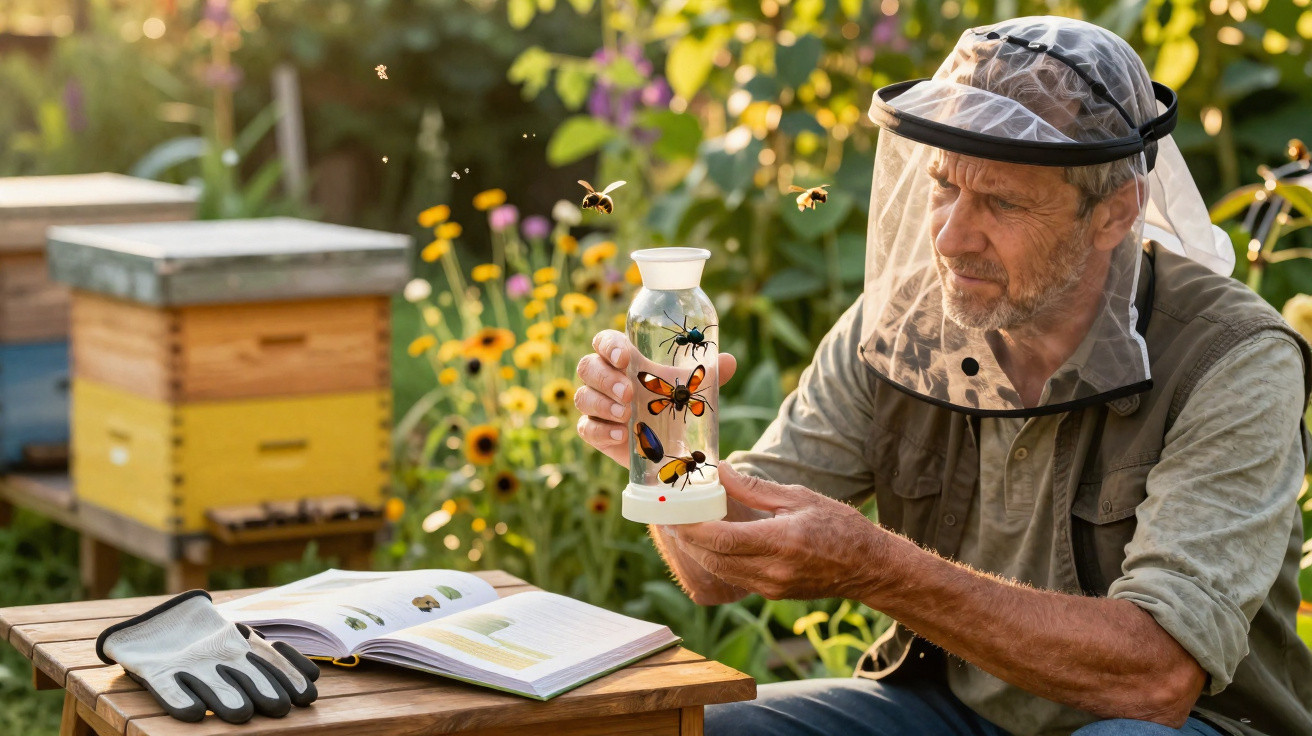
Social networks are currently awash with instructions claiming that a plastic bottle, beer and sugar water can be used to fight the Asian hornet. What sounds like a simple DIY solution proves, on closer inspection, to be a major problem for bees, hoverflies and many other beneficial insects – while doing surprisingly little against the invasive species.
How the Asian hornet became a scapegoat
The Asian hornet (Vespa velutina), also known as the yellow-legged hornet, was first recorded in Europe in the mid-2000s and has spread widely since. It hunts other insects, including honey bees, and builds large nests in trees and on buildings.
Beekeepers in particular regard it as an additional threat to colonies already under pressure. When a nest is located close to an apiary, the impact can be considerable: foraging bees are intercepted as they leave and return, colonies remain under constant stress, and both honey yields and winter survival decline noticeably.
At the same time, agricultural pesticides have faced criticism for years because of their harm to pollinators. While political pressure to tackle pesticides builds only slowly, a new and visible insect with a “villainous” image appears to offer the ideal target. Comment sections quickly create the impression that anyone wishing to help bees must kill hornets – as many as possible, and preferably immediately.
“The Asian hornet strikes a raw nerve: it threatens an economically important livestock animal, which is why it receives more attention than invisible chemicals on fields.”
How DIY traps work – and what they actually catch
The classic homemade trap uses a plastic bottle filled with a mixture of beer, juice, syrup or wine. A hole is cut into the top, or the upper section is turned upside down and placed back inside – and the supposed miracle solution for the Asian hornet is complete.
The reasoning is straightforward: the sweet, mildly alcoholic smell attracts the hornet, which crawls inside, cannot find its way out and drowns. Posts often claim that other insects avoid the bait or are supposedly able to escape.
Research contradicts this at precisely this point. Studies by organisations including INRA, the Muséum National d’Histoire Naturelle and the CNRS present a clear picture: these typical DIY traps are not selective. They catch anything drawn in by the scent – a remarkably varied and, above all, valuable range of insects.
- Pollinators such as solitary bees, bumblebees and hoverflies
- Butterflies and moths
- Beneficial insects including ladybirds and lacewings
- Various species of wasps and flies
In many trials, Asian hornets accounted for only fractions of a percentage or a low percentage of the insects caught in these traps. The remainder consisted of countless other insects urgently needed in gardens, from pollinators to natural pest controllers.
“Anyone hanging up a sweet-smelling bottle trap is not creating a specialist tool against the Asian hornet, but an indiscriminate insect-killing machine.”
Why widespread trapping has little effect on the species
There is further disappointment: even if a bottle catches several Asian hornets, it makes virtually no difference to the overall population. The species is established across large parts of Western Europe, reproduces efficiently and exploits available ecological niches.
The key factors in population development are the overwintering young queens and the large nests. Removing individual workers may briefly ease frustration, but it does not address the heart of the issue. The colony remains, and new nests are formed.
Meanwhile, numbers of other insect species in the area noticeably decline when traps hang from numerous balconies and garden fences. In rural regions already affected by insect decline, this amateur war on hornets adds substantially more pressure.
| Measure | Effect on Asian hornet | Effect on other insects |
|---|---|---|
| DIY bottle traps with sugar/alcohol | minimal, virtually no local effect | strongly negative, many pollinators die |
| Professional attractant traps | more targeted, especially at hotspots | reduced, but not entirely free of by-catch |
| Nest removal by specialists | high, particularly near apiaries | low, as this is a targeted intervention |
How dangerous is the Asian hornet to people?
Many posts give the impression that this is a particularly aggressive insect that deliberately attacks people. Practical experience suggests otherwise: people who keep an appropriate distance from a nest usually find the insects reserved. Individual hornets around fruit trees or bee hives will generally fly away if given space.
Danger arises where a nest is shaken, damaged or directly disturbed. Hornets then defend their colony vigorously, whether they are European hornets or Asian hornets. Multiple stings can be painful and, in individual cases, medically serious, especially for people with allergies.
The focus on supposedly “evil” insects often distracts from the real essentials: respecting nests, keeping a few metres away and seeking professional help where necessary reduce the risk far more effectively than putting up indiscriminate traps.
What beekeepers and garden owners can do instead
Rather than relying on DIY instructions from the internet, it is worth considering the alternatives more carefully. Beekeepers whose apiaries are severely affected can use targeted methods which may cost more, but are markedly more effective and less damaging to other species.
Targeted Asian hornet management around the apiary
- Locate nests and have them removed by trained professionals, especially where they are close to apiaries.
- Where appropriate, use professional traps with specialist attractants that focus more strongly on the target species.
- Reduce entrance sizes or use protective screens to make it easier for bees to enter the hive.
All of these measures require more effort than a cut-up plastic bottle. In return, they work specifically where damage occurs and cause far less disruption to the surrounding environment.
What garden owners can genuinely do for insects
Anyone without an apiary who nevertheless wants to “do something good” will achieve far more with very different steps than with traps:
- Create flowering areas that provide food over as many months as possible.
- Avoid insecticides in the garden and use alternative methods to manage pests.
- Leave dead wood, leaf piles and small wild areas in place so that solitary bees and other insects can find nesting sites.
- Provide water sources, such as shallow bowls with stones to serve as landing places.
“The most effective ‘weapon’ against insect decline is not the hornet trap, but a diverse garden free from poisons.”
Why large-scale eradication remains unrealistic
Many campaigns suggest that enough traps could get rid of the Asian hornet again. Entomology specialists take a different view: the species is established, and complete eradication in Central Europe is considered unrealistic.
What remains realistic is limiting damage locally, for instance at heavily affected apiaries or in sensitive locations such as school grounds and nurseries. In these cases, the focus is on targeted nest removal rather than an area-wide small-scale war against individual insects.
For private gardens, this means that a homemade trap in an apple tree changes nothing about the overall Asian hornet population, yet it makes a noticeable contribution to further reducing hoverflies, butterflies and other pollinators. This harms exactly those insects that make fruit trees, berry bushes and vegetable beds productive in the first place.
Context: invasive species, climate change and how we treat insects
The Asian hornet is an example of a trend likely to increase in the coming years. Global trade and climate change are bringing more and more species into regions where they were previously absent. Some integrate relatively unobtrusively, while others are classified as invasive because they substantially alter native ecosystems.
The reflexive call for “eradication” quickly overlooks how complex these systems are. Many native birds, bats and larger insects learn to use the new species as a food source. Some balances shift, while others stabilise at a new level after a transition period.
For everyday gardening, one simple question ultimately matters: does my behaviour contribute to greater diversity, or does it create additional gaps in an already weakened system? With homemade traps for Asian hornets, the answer is clear – they cause far more harm than good.





Comments
No comments yet. Be the first to comment!
Leave a Comment