
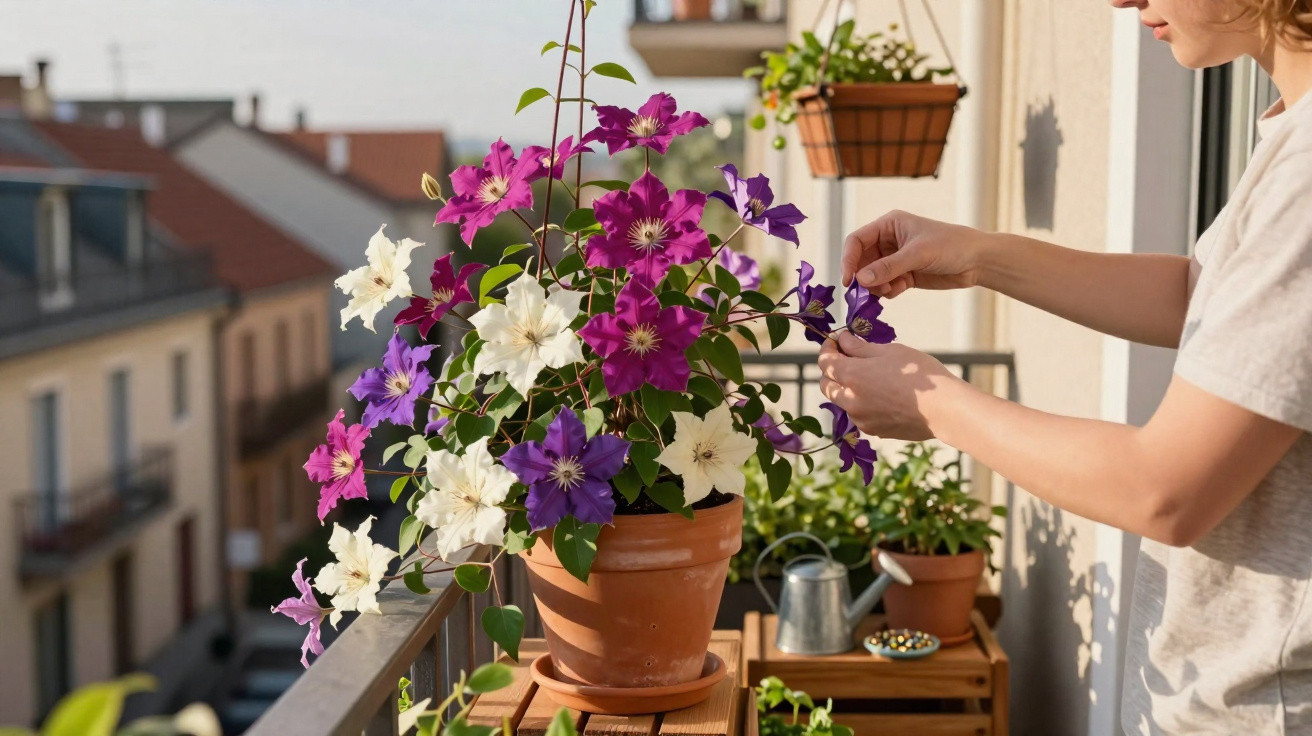
With the right climbing plant, that is exactly what you can achieve.
Anyone living in a city will know the issue: ground space is scarce, containers get in the way, and conventional shrubs quickly become too much. In narrow courtyards and slim balconies especially, every extra pot can soon feel like an obstruction. A particular group of climbing plants makes use of almost exclusively vertical space, turning tight corners into densely flowering walls without taking away room to move at ground level.
Why compact climbing plants save small gardens
Every square centimetre matters in compact urban gardens. Rather than spreading outwards, the answer is simple: garden vertically. Climbing plants make use of existing walls, fences and railings, giving the eye somewhere to travel upwards. This can create the impression of a real garden where there was previously only a rectangular concrete box.
Compact cultivated varieties that are deliberately bred to stay small are particularly appealing. They reach just one to two metres in height, yet neatly cover an entire climbing support. Flowers appear from the base right up to the top, so there are no bare stems to spoil the effect. Even the tiniest balcony can therefore look like a living painting.
The principle is this: use one large container instead of lining up ten pots, then stack the flowers vertically.
There is another benefit, too: the area appears more spacious. As plants grow upwards, the floor remains clear. The eye sees more greenery, but people do not feel as though they have to squeeze through a jungle. That is invaluable on narrow urban loggias.
Dwarf clematis: maximum flower power in minimal space
Among compact climbing plants, low-growing clematis varieties have been especially pioneering. They have been bred specifically for containers, small gardens and narrow courtyards, so they do not need towering pergolas. A low fence, a small trellis or a simple frame is enough.
These miniature varieties are typically characterised by:
- a growing height of usually only 1–2 metres
- very dense foliage with hardly any bare areas
- flowers from just above the soil all the way to the tip
- large blooms like those of traditional clematis, but with a more compact habit
Visually, these varieties provide a broad choice. Some produce white, bowl-shaped flowers with pink central markings, while others shift from soft blue to pure white; others make a vivid pink statement against dark façades. This makes them ideal for concealing dreary walls, grey concrete surfaces or uninspiring privacy screens.
Using colours with purpose
Those with a dark inner courtyard benefit from stronger shades. Rich pink or violet stands out well against brickwork and concrete features. Pale colours, such as white or pastel blue, suit bright, contemporary façades instead and enhance their airy appearance.
Flowering duration is also highly important in an urban garden. Many compact clematis varieties flower for weeks, with some producing several flushes. This keeps the area attractive for a long time - essential when the balcony effectively becomes a “second living room” in summer.
The right pot: sufficiently large and well drained
For a container-grown plant to become a true flowering star, the container itself matters. A pot that is too small dries out too rapidly, while one without drainage holes holds water like a bath - both conditions put the roots under stress.
As a rule of thumb, choose:
- a diameter of at least around 30–35 centimetres
- suitably large drainage holes in the base
- a drainage layer of expanded clay or coarse gravel
- high-quality container compost with a loose structure
A combination of the main plant and companion plants is particularly useful: low-growing or gently trailing flowers around the pot edge shade the compost surface. This keeps the roots cool while also disguising the rather plain-looking container.
When roots are kept cool and evenly moist, clematis reward this with noticeably more flowers.
Narrow balconies, windowsills and hanging baskets: using every corner
Not all climbing plants need to grow upwards. Some clematis types have a more bushy habit, grow only a few decimetres high and look perfect in hanging baskets. Their stems then drape elegantly over the edge and sway in the breeze, carrying dense clusters of colourful bells or star-shaped blooms.
These forms are particularly suited to:
- railings on narrow balconies
- windowsills with hanging baskets
- wall hooks beside the front door
- covered entrances and terrace roofs
Fresh flowers continue to appear for months, followed later by decorative seed heads with a charm of their own. Even in late summer, when many other plants start to fade, these cultivated varieties still provide structure and character.
Climbing support, watering and feeding: keeping the flower wall in shape
For a compact climbing plant to genuinely form a wall of flowers, it needs firm support. Narrow trellises, bamboo canes, wire cables or metal frames are practical options, either placed directly in the pot or fixed to the wall.
The plants naturally wrap their leaf stalks around thin supports. Where supports are thicker, such as balcony railings, young shoots can be loosely tied in with plant ties. This guides them where needed and allows the wall to fill out evenly.
When watering, aim for consistency without constantly soaking the plant. Waterlogging is harmful, but so is letting it dry out completely. Container plants make it easy to check what is needed: test the compost with a finger, water when the surface is dry, and wait if the growing medium is still moist.
The right fertiliser is central to abundant flowering. From the first sign of buds, apply a potassium-rich product - such as tomato fertiliser - in measured doses to encourage plentiful blooms. It is worth stopping feeding shortly before flowering begins: this slight “stress” often prompts the plant to set flowers even more intensively.
Feed sparingly but purposefully: this achieves more than continually adding nutrients.
On hot days, when temperatures rise well above 25 degrees, leaves may turn yellow temporarily. This does not automatically signal a problem; it often indicates a kind of resting phase. During this period, the roots should not be drowned. Keeping them lightly moist is sufficient, and the plant will recover.
Avoiding care mistakes: what harms compact climbers
When space is limited, it is tempting to manage with small containers. For many clematis, however, this causes precisely the stress to be avoided. Too little compost heats up heavily, dries out quickly and holds only a small amount of nutrients. The result is short, weak shoots and very few flowers.
A completely shaded position with no direct sunlight is equally unsuitable. Most flowering climbers prefer their leaves to receive light while the root zone remains partly shaded and cool. Companion plants can effectively shield the pot edge from full midday sun.
Locations that work particularly well
In practice, three settings have proved especially effective:
- East- or west-facing balcony: Sun in the morning or evening and protection at midday - ideal for container growing.
- Narrow inner courtyards with a light-coloured wall: Reflected light provides enough brightness without excessive heat.
- Loggia with an open edge: Airy but not completely exposed - stable climbing frames can be incorporated easily here.
Benefits for the climate, wellbeing and neighbours
Compact climbing plants offer more than visual appeal. They provide habitat for insects, soften the look of hard façades and improve the balcony microclimate. A planted surface heats up less than bare concrete, and the air feels fresher.
They also create a little privacy: a planted climbing support in front of a railing shields the area from views opposite without requiring a heavy privacy screen. Neighbours will probably prefer seeing a flowering wall rather than a grey plastic panel.
Anyone keen to experiment can combine compact clematis with other climbers - for instance delicate sweet peas, low-growing nasturtiums or small-growing ivy. This creates layered displays that change their appearance throughout the year. Even the smallest urban space can then become a vertical mini-garden project that brings pleasure for almost the entire year.



Comments
No comments yet. Be the first to comment!
Leave a Comment