
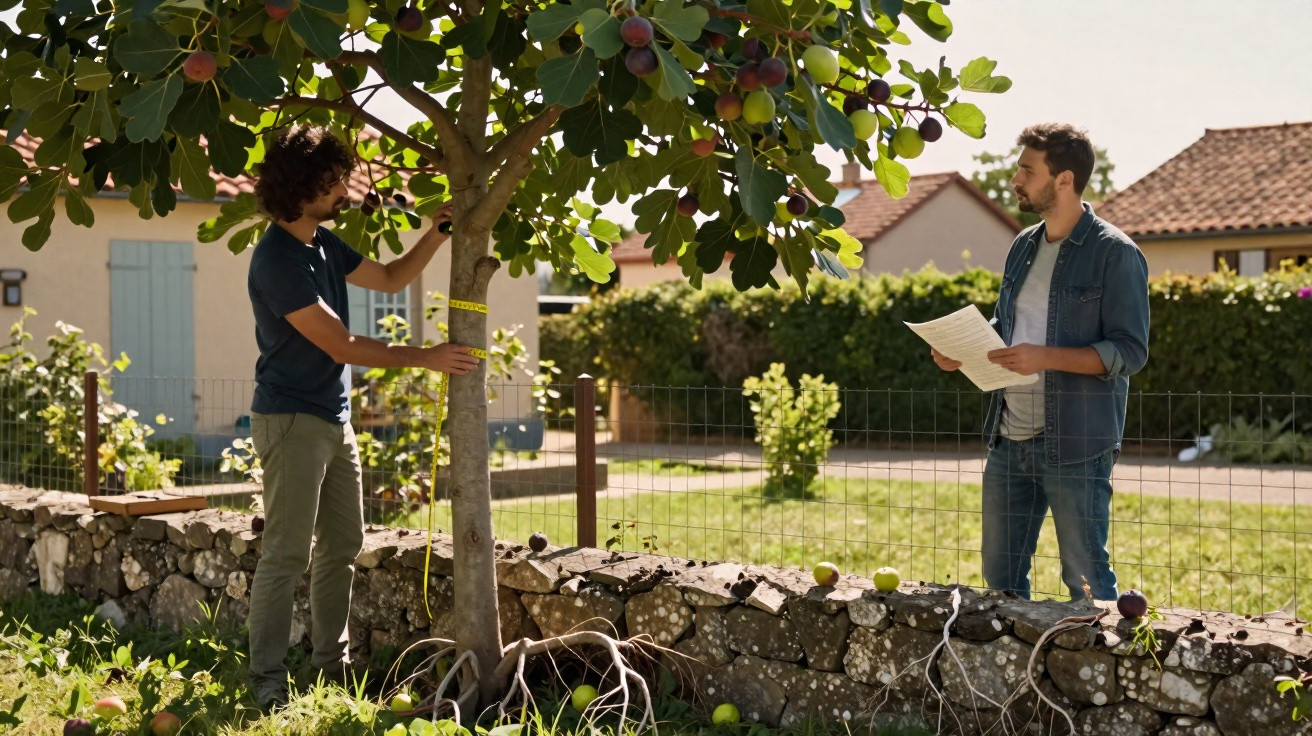
One Saturday morning, you open the shutters to the familiar scene: your neighbour’s branches stretch over the fence, leaves cover the patio, and the vegetable patch is gradually losing sunlight. At first, it seems like a minor issue, almost too awkward to raise between polite greetings. Then the gutters become blocked, fruit starts falling, and sometimes roots lift a paving slab. We all know the point at which one ordinary tree begins to occupy an outsized place in a neighbourly relationship. The reassuring news is that French law does not leave the matter unclear. It sets out specific distances, remedies and several exceptions that are worth understanding before a conversation turns into a dispute.
Two metres or 50 centimetres: the rule that often catches neighbours out
The starting point is Article 671 of the French Civil Code: a tree intended to grow beyond 2 m in height must be planted at least 2 m from the boundary between the two properties. For plants that remain no taller than 2 m, the minimum distance is 50 cm. This measurement is not taken from the outer edge of the branches or from an approximate fence line: it runs from the property boundary to the centre of the trunk. That detail is behind many misunderstandings, particularly on housing estates where an old hedge hides the reference points. A tree is not lawful simply because it appears to have always been there.
Consider a cherry laurel planted 70 cm from your wire fence. When it was put in, it may have stood at 1.20 m and caused no inconvenience; ten years later, it reaches 3.50 m, blocks the light and sheds leaves onto your property. Once it exceeds 2 m, the 50 cm distance is no longer sufficient, unless an exception applies. Depending on the circumstances, the neighbour may be required to cut it back to 2 m or remove it altogether. Height is measured from ground level to the top of the tree, rather than only to the first branches that are bothering you.
The law nevertheless recognises a particularly French reality: local rules can take precedence. A housing-estate regulation, a local development plan, an established practice in a rural municipality, or a specific provision in a specification document may impose different distances. Before reaching for a tape measure, you should therefore check which documents apply to your plot. In truth, hardly anyone does this routinely. Yet a visit to the town hall or a careful reading of the deed of sale may prevent an unfounded request-or reveal a right you did not know you had.
What you can actually ask the tree owner to do
When a tree has been planted too close to the boundary, the most useful first step is also the simplest: speak to your neighbour, with photographs and measurements to support your case. A calm conversation is often more effective than an abrupt letter pushed through a letterbox on an angry evening. Where the tree complies with neither the statutory distances nor a local requirement, you can request that it be removed or reduced to the permitted height. You should then make the request in writing, ideally by recorded delivery with acknowledgement of receipt, and allow a reasonable period for action. Keep copies of everything: dated photographs, the cadastral plan, measurement records and correspondence.
A common mistake is to cut back branches that extend onto your own land. It can be tempting when a branch rubs against a window or fills the swimming pool with leaves, but Article 673 of the French Civil Code is unambiguous: you may require your neighbour to cut the branches, but you may not cut them yourself. The rule differs for roots, brambles and twigs that encroach onto your land: you may cut these at the boundary line. Act proportionately, however, as weakening a tree may expose you to complaints and claims for damage. Do not pick up the pruning shears before checking your rights.
Some situations can prevent a claim that otherwise appears justified: the 30-year limitation period, a particular title, or what the law calls “destination du père de famille”. A tree positioned too close to the boundary for more than 30 years may, subject to certain conditions, no longer be challenged on the basis of distance.
“The owner of land onto which a neighbour’s tree branches extend may compel that neighbour to cut them.” - Article 673 of the French Civil Code
Before considering conciliation or proceedings before the judicial court, gather the following information:
- the distance between the trunk and the precise property boundary;
- the actual height of the tree or hedge;
- the estimated age of the planting and any available evidence;
- local rules, easements and housing-estate regulations;
- photographs showing the branches, roots or damage identified.
Branches, fruit and roots: the small details that can transform a dispute
Trees extending over a neighbour’s property are never solely a question of centimetres. They involve light, privacy, a garden becoming difficult to maintain, and sometimes an old grievance that had never been named. Fruit that falls naturally onto your land belongs to you, while fruit still attached to the branches remains the property of the tree owner. The distinction can sound trivial until crushed plums attract wasps around the outdoor table. The law is seeking a practical balance here: each person remains on their own land without imposing the burden of their vegetation on someone else.
If your neighbour refuses any discussion, a justice conciliator is often a free and calming next step. This route can be tried before bringing the matter before the judicial court, especially if you want to keep living door to door without an icy atmosphere at every encounter. A chartered surveyor may also be needed where the boundary itself is disputed; the cadastre provides guidance, but it does not always establish the precise legal boundary. A solicitor is not invariably necessary, although their advice may be helpful where property damage, a 30-year limitation period or an easement forms part of the case.
A protected tree requires an additional degree of caution. In some municipalities, felling or pruning a notable specimen requires administrative permission, particularly where the local development plan protects planted or green spaces. This requirement does not remove a neighbour’s rights, but it may alter both the process and the timetable. It is also important to distinguish a tree from a simple hedge: the distance rules are broadly similar, whereas routine maintenance and local practices may carry greater weight. Between strict legal rules and neighbourhood life, there is often room for discussion. It is worth attempting, particularly when the tree has watched both gardens grow.
| Key point | Detail | Benefit for the reader |
|---|---|---|
| Legal distance | 2 m for a tree over 2 m high; 50 cm if it does not exceed 2 m | Makes it possible to check quickly whether the planting meets the general rule |
| Overhanging branches | The neighbour must cut them when asked; you may not cut them yourself | Prevents an error that could worsen the dispute |
| Possible exceptions | Local practice, housing-estate regulations, a title or a 30-year limitation period | Helps you act on evidence rather than a simple impression |




Comments
No comments yet. Be the first to comment!
Leave a Comment