
Laid in the late 1980s, the TAT-8 transatlantic cable represented a watershed moment in telecommunications history. More than three decades after carrying the first fibre-optic data between Europe and the United States, this trailblazing infrastructure is now being brought up from the seabed for recycling.
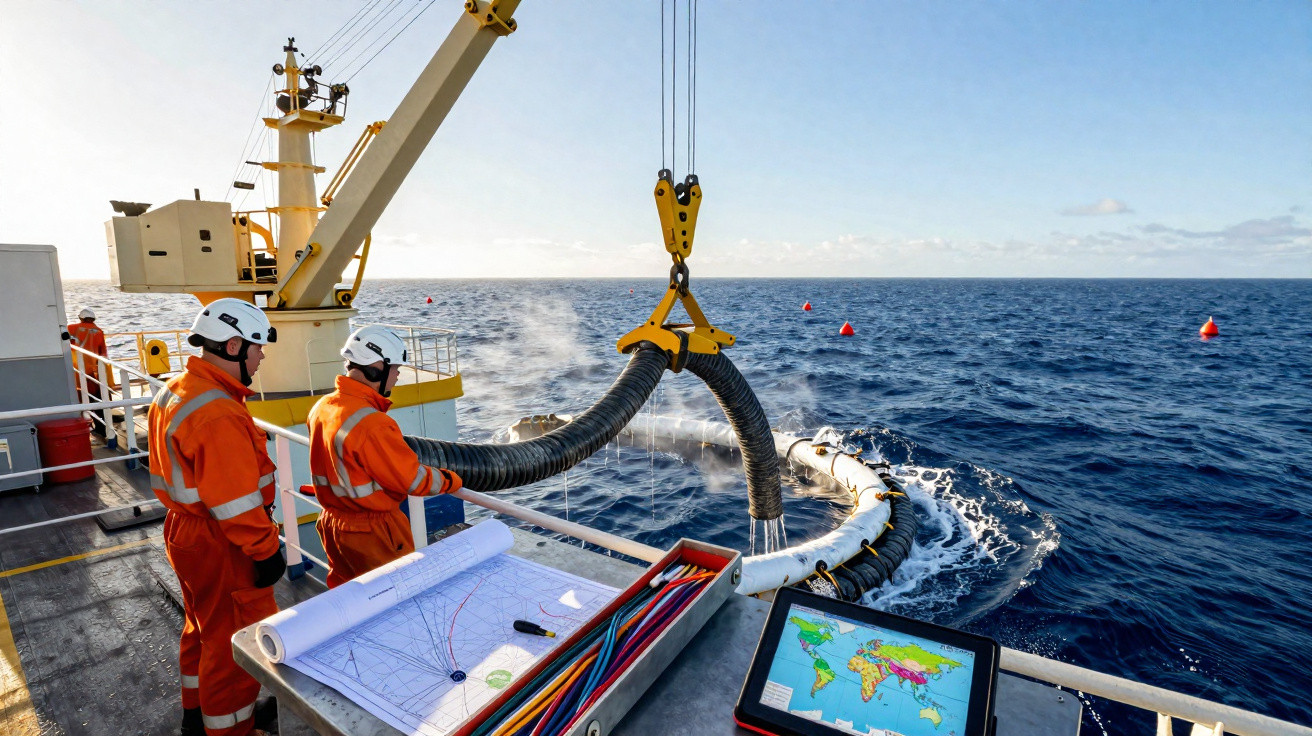
Off Portugal’s coast, a chapter in the history of the internet is gradually being removed from the ocean floor. The MV Maasvliet, chartered by Subsea Environmental Services, is currently recovering TAT-8, widely regarded as the first fibre-optic transatlantic cable. Installed on 14 December 1988 by AT&T, British Telecom and France Telecom, it transformed communications by replacing copper with light pulses capable of carrying vastly more data.
TAT-8, the first fibre-optic transatlantic cable
At the time, it seemed like science fiction. From New York, author Isaac Asimov spoke by videoconference to audiences gathered in Paris and London, hailing “an inaugural voyage across the sea on a beam of light”. The symbolism was striking: for the first time, the Atlantic was crossed by a cable designed for fibre optics.
Its success came swiftly. Reaching capacity in under 18 months, TAT-8 proved the immense potential of the technology and paved the way for the thousands of modern cables that now form the invisible backbone of the global network.
However, this technological relic did not endure without difficulties. A fault that was too expensive to repair led to the cable being taken out of service in 2002. It is now being raised to the surface.
A strategic recovery operation
Naturally, retrieving a cable laid several kilometres beneath the surface is no straightforward task. Technicians must pinpoint every section, secure the line with grapnels, and lift it gradually aboard the vessel, where it is coiled by hand to prevent damage to the glass fibres. Storms and heavy seas make the operation even harder: during this mission, the ship has already had to alter its route because of an early cyclone season.
The operation also carries major strategic importance. Despite their fibre optics, these installations still contain substantial quantities of high-quality copper, a metal that the International Energy Agency expects could face shortages within the next decade. The steel will be reused, while the polyethylene sheath will be converted into recycled plastic.
Subsea cables remain vital to global data traffic
It is worth remembering that cables carry almost all intercontinental traffic. Although satellites are becoming increasingly prominent, they remain far behind in both capacity and reliability when handling large-scale data transfers. TAT-8 is only one case: of the roughly 2 million kilometres of cables decommissioned worldwide, most still lie on the ocean floor. Recovering them makes room for new lines, ready to support an internet with ever-growing bandwidth demands.






Comments
No comments yet. Be the first to comment!
Leave a Comment