
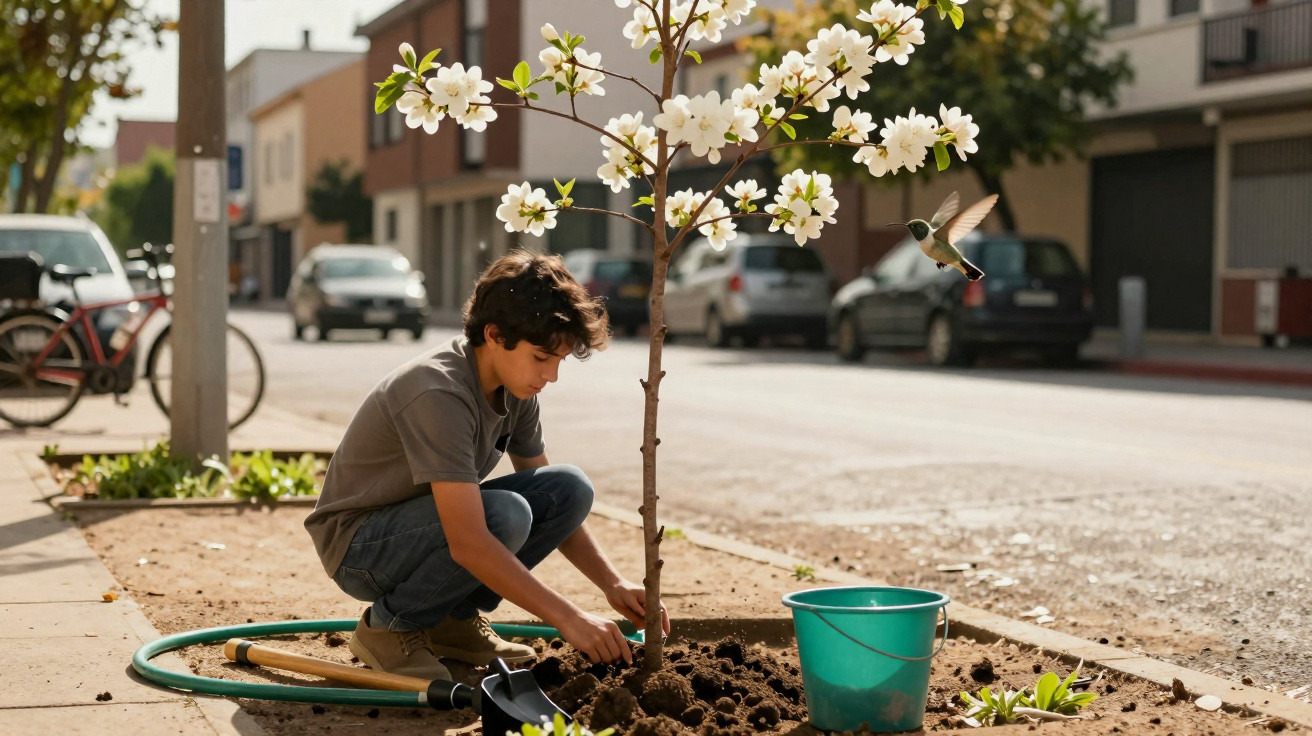
This little-known tree, native to Mexico and increasingly attracting interest from urban design professionals, achieves an unusual balance: it coexists well with pavements and pipes, tolerates neglect and produces a floral display that hummingbirds find irresistible.
The street tree that behaves itself
Urban planners face a familiar problem: fast-growing trees can crack paving and damage pipes, while smaller, safer choices often provide less shade and visual presence. The cazahuate tree (Ipomoea arborescens) sits quietly between these two options.
Reaching roughly 5 to 9 metres at maturity, it grows large enough to shade a pavement while remaining compact enough to avoid overhead cables on most streets. Its limbs extend sideways to create a light, open crown, rather than a thick canopy that leaves windows and gutters in darkness.
The cazahuate offers shade without wrecking pavements, light without glare, and flowers just when cities look most lifeless.
In contrast to problematic species including ficus, whose roots may break up concrete and push out kerbs, cazahuate roots generally remain well behaved. Accounts from Mexican towns, where the tree is frequently planted along streets and in public squares, indicate markedly fewer problems with raised paving slabs or damaged pipes.
Why urban planners are paying attention
Beneath its delicate white flowers is an exceptionally practical set of characteristics. Having evolved in dry and frequently nutrient-poor ground, this species is naturally suited to demanding urban environments, where water budgets are limited and maintenance teams are already stretched.
- Root systems that generally avoid lifting paving or harming underground services
- Strong drought tolerance once established, reducing irrigation costs
- An open canopy that shades pavements without cutting daylight to nearby homes
- An ability to grow in low-fertility soils where more demanding trees struggle
For cities contending with hotter summers, stricter water limits and demands for greater green coverage, this combination makes the cazahuate more than a botanical novelty. It is a useful urban tool.
A winter firework of white blossoms
While most street trees put on their principal display in spring, the cazahuate reverses the pattern. Its defining season falls from late autumn into early spring, just as many urban settings become flat and devoid of colour.
Across its native range, from approximately October to April, the tree may shed much of its foliage and become covered in white, trumpet-shaped flowers. Measuring five to eight centimetres across, each bloom commonly has a pale yellow or faintly reddish throat, while their dense clusters can almost conceal the branches.
In dry-season streets, the cazahuate can look like a cloud of white resting on a dark trunk, set against a hard blue sky.
The blooms open chiefly during late afternoon and evening. They then provide plentiful nectar, making the tree a feeding point for wildlife at a time when many alternative food sources have disappeared.
The hummingbird magnet effect
Urban gardeners often link hummingbirds with bright red and orange flowers. However, observations from Mexican communities show that these birds visit cazahuate trees heavily despite their white blooms.
The reason is driven less by colour than by timing and reward. Nectar is limited during the dry season, so one tree covered in easily reached, sugar-rich flowers becomes highly valuable territory.
Hummingbirds are joined by nectar-feeding bats, native bees and butterflies around these trees. In places with dense cazahuate populations, whole hillsides can seem sprinkled with white throughout the dry season, while the soundscape shifts as birds and insects gather there.
Basic care: low effort, high payoff
For residents and councils wary of trees requiring intensive upkeep, the cazahuate offers a simple proposition: provide sunlight, drainage and some early support, then largely leave it alone.
Planting and establishment
This tree performs best in full sun. Shade, particularly from high-rise buildings or taller trees, may lessen flowering and slow its development. Freely draining soil is more important than high fertility. Water sitting around the root zone can harm the tree more quickly than insufficient fertiliser.
| Stage | Main need | Risk to avoid |
|---|---|---|
| First 2 years | Regular but moderate watering | Waterlogging and compacted soil |
| After establishment | Full sun, minimal irrigation | Heavy pruning that distorts canopy |
| Long term | Occasional light shaping | Allowing dead or crossing branches to persist |
While establishing deeper roots, young trees benefit from reliably moist conditions. Once roughly two years have passed, they usually cope with prolonged dry spells, especially in climates with a distinct dry season.
Pruning and long-term structure
The cazahuate’s natural form is already appropriate for pavements: a rounded, airy crown with horizontal layers of branches. Intensive pruning can upset this structure, whereas occasional light work is sufficient.
- Take out dead or crossing branches every year or every two years
- Train the principal trunk early to prevent low leaders over pavements
- Do not top the tree, as this produces weak regrowth and ungainly shapes
The tree tends to build its own architecture; human intervention works best when it feels almost invisible.
Ecological value in hardscaped cities
As well as offering visual appeal, the cazahuate provides an understated ecological benefit that is often absent from city planting plans: it bridges a seasonal shortage.
Nectar supplies in urban areas generally reach their height in spring and early summer, then decline as temperatures rise and irrigation reductions take effect. The cazahuate follows the opposite cycle. As other plants close down to retain water, it opens thousands of floral nectar sources.
For hummingbirds, which must feed often to maintain their rapid metabolism, this dependable supply may shape their chances of surviving the most difficult weeks. Nectar-feeding bats, which are already under pressure in many areas, likewise gain from a dependable winter food source within or close to urban environments.
Native bees and butterflies also use this resource, helping to support food webs that can otherwise fail in heavily paved neighbourhoods. In time, this may support a wider variety of birds, improve pollination in surrounding gardens and create modest cooling as shade and evapotranspiration rise.
Is the cazahuate suitable beyond Mexico?
For gardeners and councils in the UK or northern United States, the cazahuate’s cold tolerance is likely to prevent outdoor cultivation, since it originates from warm areas that can experience frost but not severe cold. Locations with gentle winters, including parts of coastal California, the American Southwest and certain Mediterranean cities, offer a more realistic setting.
Before any non-native tree is imported or planted, local rules and ecological concerns require careful consideration. Some species adapted to drought can become invasive when they spread outside designated planting sites. Existing reports do not identify cazahuate as aggressively invasive, although controlled long-term trials remain uncommon beyond its native range.
What urban designers can learn from it
Even in places where cazahuate cannot be planted, its characteristics offer a model for future street-tree selection:
- Roots that respect pavements and pipes
- Seasonal flowering that addresses ecological shortages instead of coinciding with spring peaks
- Suitability for low-input conditions: less water, less fertiliser and fewer interventions
- Open canopies that balance shade with daylight
Landscape architects already seek combinations of function and beauty. Trees such as the cazahuate move this discussion towards resilience: species able to withstand budget reductions, heatwaves and water restrictions while continuing to benefit people and pollinators.
For householders thinking about planting beside a pavement where rules permit, one useful exercise is to chart the year month by month and note when surrounding vegetation provides almost no food for birds or insects. Trees or shrubs can then be chosen to flourish during that quiet interval. Even if local nurseries do not stock cazahuate, this seasonal approach can transform one narrow planting strip into a meaningful ecological stopover.

Comments
No comments yet. Be the first to comment!
Leave a Comment