
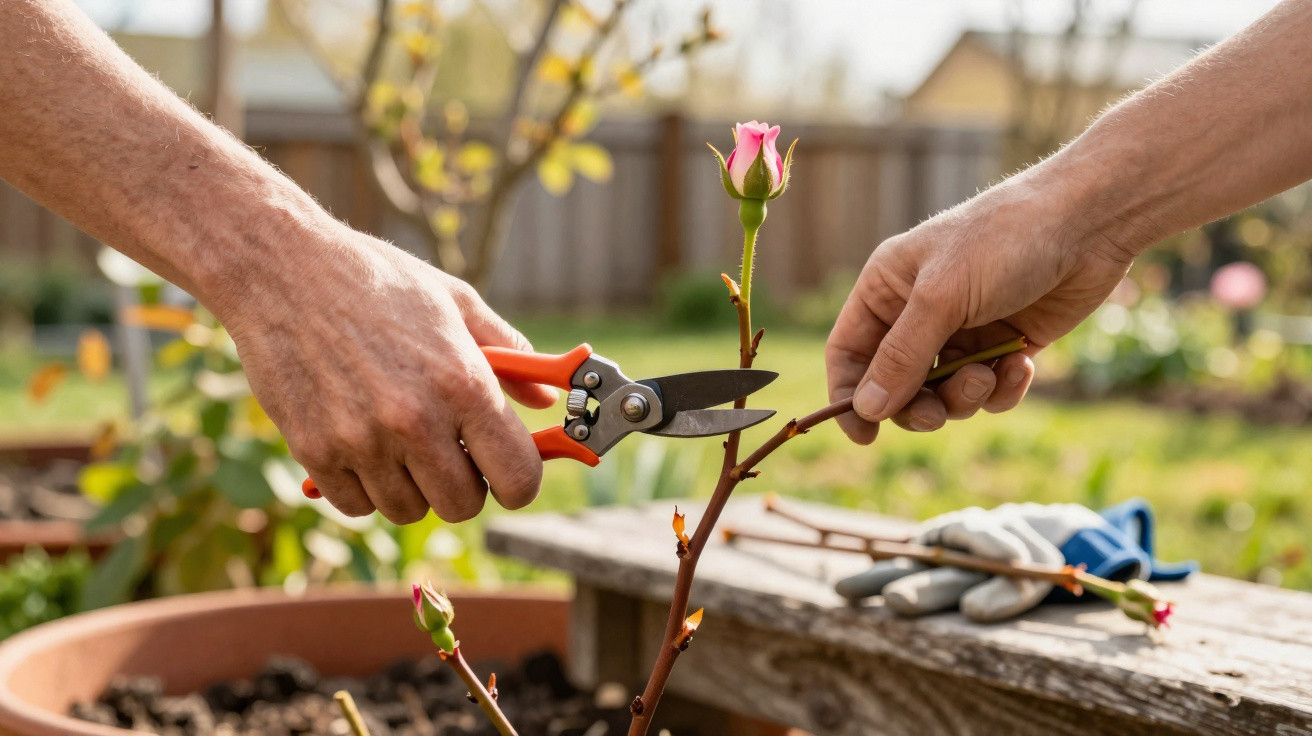
The secateurs snap, the air carries a faint scent of cold earth, and the roses appear to have survived a minor battle. Winter has left behind blackened ends, dead spurs and a confusing tangle of thorny decisions. You put on your gloves, study the bare canes and pause. Do you cut here, or there? One misplaced snip can seem as though it might sacrifice a whole summer of flowers.
A neighbour peers over the fence, offers a breezy “Just prune at an angle!” and vanishes again. Useful advice… except it is not quite enough. Which angle? How steep? Above what exactly?
That is when it becomes clear that pruning roses is not simply a matter of removing growth. It is about guiding the life that is ready to return.
The subtle strength of a small angle
Examine a rose cane closely and you will see a small but vital feature: a tiny raised point on the stem called a dormant bud eye. This is where the next flower-bearing shoot will emerge. The direction of your cut influences how water drains, how well that bud is shielded and the route the new shoot takes. In effect, you are directing the plant towards the precise point where you want it to stir into growth.
When gardeners refer to “pruning at an angle”, they are not merely repeating an old gardening-book cliché. They mean a straightforward mechanical technique that helps prevent rot around the bud and encourages new growth in the preferred direction.
Imagine a rose bush in early April, when it is still largely bare. Its canes on one side have all been cut level, straight across. On the other, every cane has received a modest sloping cut immediately above an outward-facing bud. A few weeks later, the difference is apparent. The flat-cut side produces poorly placed shoots, with some growing inwards, crossing over, creating shade or rubbing together. The angled-cut side develops a gentle, open vase form, with each new stem reaching out towards the light.
A Yorkshire gardening club once tested both approaches on matching shrubs. The plants given angled cuts showed fewer areas of dieback and generated more outward-facing shoots. This resulted in improved air movement and noticeably fewer black-spot issues by midsummer.
The reasoning is simple. A sloping cut of about 45° lets rain run away like water from a miniature roof. By angling the cut away from the bud, water cannot linger on the wound and travel down towards the eye. Instead, it drains off the opposite side. Less retained moisture means less risk of rot or fungal infection at this vulnerable point of growth.
Cutting only a few millimetres above the bud also focuses the plant’s healing response and sap movement around that eye. Leave too much of a stub, and its upper portion often dies back, creating an opening for disease. Cut too tightly, and you may injure the bud. That narrow space above the bud, combined with an angled cut, is a small piece of practical geometry that quietly encourages sturdier, healthier new growth.
Rose pruning: the angle rule step by step
Most experienced rose growers follow one straightforward rule: make the cut around 5–8 mm (a quarter of an inch) above an outward-facing bud, at a gentle 45° angle that slopes away from it. This should not be a severe diagonal; think instead of the angle of a book resting lightly on a surface. Choosing an outward-facing bud is important because it tells the plant, “Grow that way, not into the tangled centre.”
Step back occasionally and consider the shape you are creating. Every angled cut acts as a small arrow, guiding new shoots towards light and air rather than into a tight, disease-prone mass of stems.
If the centre of your roses has ever become a dense, twiggy tangle, you are certainly not alone. Many gardeners know the feeling when summer arrives and the bush resembles a prickly hedgehog rather than a graceful fountain of blooms. Much of that disorder begins months earlier, with poorly considered cuts that overlook both the angle rule and the bud’s direction.
The good news is that you do not need perfectly precise equipment or a degree in horticulture. Clean secateurs, a steady hand and a moment of thought before every cut are enough: “Where’s the nearest healthy bud? Which way is it facing? Can I tilt the blade so the cut slopes away from it?”
A veteran rose grower once told me, “Every angled cut is you having a quiet conversation with the plant. You’re not just removing wood, you’re giving directions.”
- Angle – Target roughly 45°, with the cut sloping away from the bud like a tiny roof.
- Height – Keep approximately 5–8 mm of cane above the bud: neither a long stub nor a cut directly on top of it.
- Bud choice – Select an outward-facing bud to create a more open centre to the plant.
- Tool care – Sharp, clean blades make tidy wounds that heal more quickly and are better able to resist disease.
- Timing – Late winter through to early spring, as buds start to swell, is the most forgiving time to prune.
Spring pruning as a gentle reset
Pruning in spring is less like giving the plant a harsh haircut and more like pressing a reset button. You are not punishing the rose; you are helping it restart with a stronger structure. Repeating the angle rule across every cane gradually changes an unhappy, leggy shrub into an airy, sunlit framework capable of carrying abundant flowers.
In reality, nobody carries out this level of attention every day. You will not be outside monitoring every shoot. Spring provides the main opportunity to make your intentions clear in one concentrated session, directing where you want the plant’s energy to go.
| Key point | Detail | Value for the reader |
|---|---|---|
| Angled cut direction | Slope away from the outward-facing bud at roughly 45° | Encourages open, airy growth and reduces crowded, disease-prone centres |
| Cut height above bud | Leave 5–8 mm of cane above the bud eye | Protects the bud from damage while avoiding dead stubs and dieback |
| Timing in spring | Prune when buds begin to swell but before strong leaf-out | Maximizes recovery, directs new growth, and minimizes stress on the plant |
FAQ:
Question 1 Do I really need the 45° angle, or is that just gardening folklore?
The angle is less myth and more basic physics. It allows water to drain away and prevents moisture sitting on top of the cut and bud. Your roses will not die without it, but they are likely to heal more cleanly and grow more strongly with it.Question 2 What if I accidentally cut too low and nick the bud?
If you remove the top of the bud and it appears damaged, do not worry. Cut a little farther down at the next healthy bud, then make the angled cut there. Roses are hardier than they appear and will often send up new shoots from lower eyes.Question 3 Is it bad if I prune flat on thick, old canes?
A flat cut at the base is fine when you are completely removing very old, woody canes. The angle rule is most important on stems you intend to retain, where you want new growth to emerge beside the bud.Question 4 How do I find an “outward-facing” bud when the cane is almost vertical?
Turn the stem in your hand and find the bud pointing away from the middle of the plant, even if only slightly. It does not need to point horizontally; it simply should not face into the already crowded centre.Question 5 Can I still prune in spring if my roses have already started leafing out?
Yes. You might lose several early leaves, but a careful angled cut above a healthy bud will still redirect energy and neaten the plant’s framework. Avoid pruning if a period of hard frost is expected immediately afterwards.





Comments
No comments yet. Be the first to comment!
Leave a Comment