
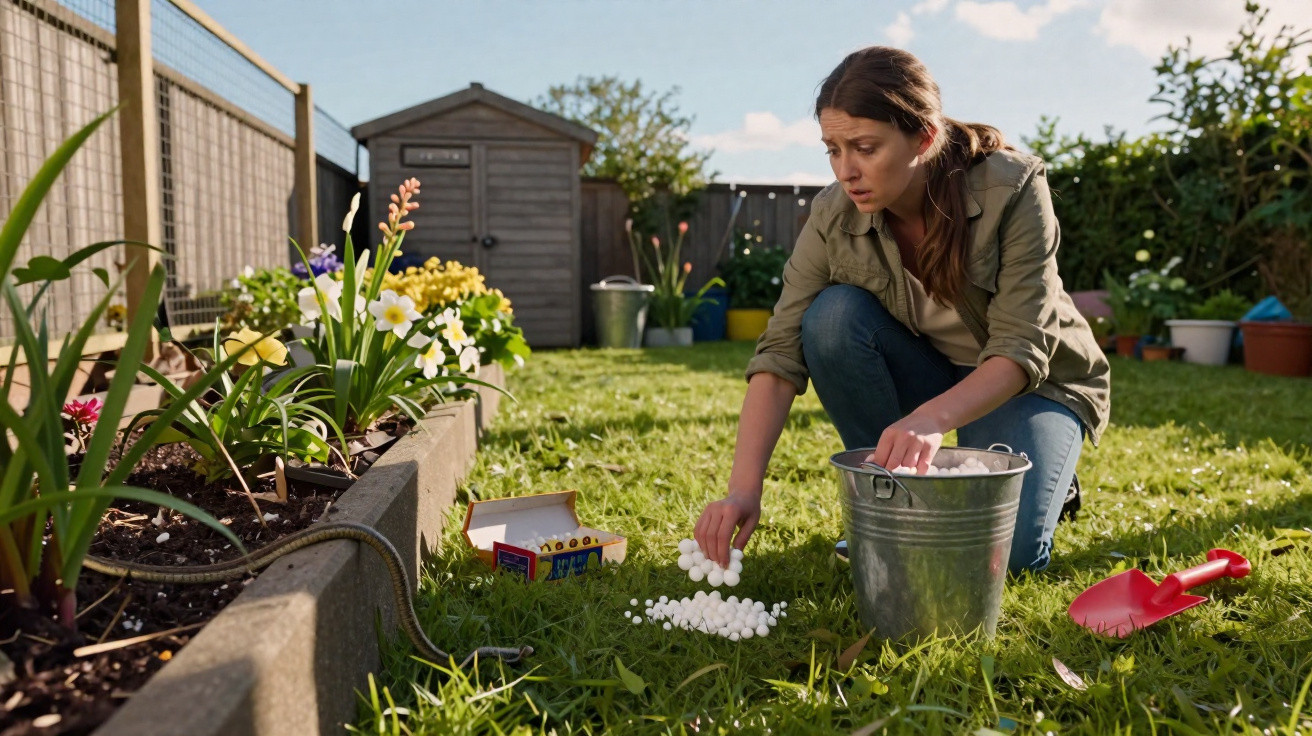
The tip refuses to disappear: mothballs are said to keep snakes away from yards and gardens. This advice circulates on internet forums, in neighbourhood groups and even between garden fences. What few people realise is that the white balls do virtually nothing against snakes while posing a risk to people, pets and the environment.
What mothballs are actually for
Mothballs are a traditional household product from our grandparents’ generation. Their intended purpose is to protect clothes stored in enclosed containers from clothes moths and their larvae.
They generally contain one of two active ingredients:
- Naphthalene – a strongly scented, volatile hydrocarbon
- Paradichlorobenzene – another toxic substance that evaporates easily
Both substances work properly only when used in an enclosed space. Their vapours must build up to a concentration that kills moths and their larvae. That is precisely what these products are approved for: sealed boxes, garment bags and airtight wardrobes.
Outdoors, the toxic vapours disperse so quickly that almost no effect remains – apart from the risk.
Anyone scattering mothballs in the garden or around the house is therefore using them outside their approved purpose. In many countries, this is legally regarded as improper pesticide use and may even result in fines. More seriously, believing that this has dealt with snakes creates a false sense of security.
Do mothballs keep snakes away? What research shows
Herpetologists, or reptile researchers, and pest-control professionals agree: mothballs are not effective snake repellents.
Why snakes are largely uninterested in the smell
Many people assume: “If the stuff smells that strong, it must be unbearable for snakes.” That may reflect how humans perceive odours, but it is not true for reptiles.
- Humans react strongly to intense smells through their noses.
- Snakes detect chemical signals mainly through the Jacobson’s organ, sampling them with their tongues.
- Their responses are primarily guided by prey, other snakes and predators – not every pungent smell.
In field trials, mothballs were placed directly in areas regularly used by snakes. The result was clear: many animals simply crawled past them or even over them. There was no detour and no frantic escape response.
Snakes mainly follow food, shelter and temperature – not the smell of mothballs.
So why does this myth persist so strongly? Chance is often involved. A snake may move on anyway because temperatures are falling, prey is scarce or it is leaving its summer shelter. Someone scatters mothballs shortly beforehand, and a pattern quickly forms: “Right, it has gone now, so that must have worked.” The story spreads, and the misconception remains.
Health risks in the garden: what mothballs do outdoors
Spreading mothballs outside introduces an entire range of risks to a property – with no benefit against snakes.
Risks to children, pets and neighbours
The white balls look harmless. That is exactly what makes them so concerning:
- Children may mistake them for sweets, chewing gum or toys.
- Dogs and cats may investigate them out of curiosity, and some animals even eat them.
- Neighbours can breathe in the vapours when the wind is blowing in the wrong direction.
Possible effects of contact or inhalation include:
- Headaches, dizziness and nausea
- Vomiting following higher exposure
- Anaemia, especially in young children or people with G6PD deficiency
- Liver and kidney damage after repeated exposure
- Irritation to the respiratory tract, eyes and skin
Veterinarians and wildlife rescue centres repeatedly report poisoning cases involving birds, hedgehogs, dogs or cats that have eaten mothballs. In gardens where children play, the balls can resemble a dangerous buffet of foreign objects.
Gradual environmental contamination of the soil
With every shower of rain, some of the active ingredients leach from the balls. They enter the soil and groundwater, affecting not only unintended targets but often beneficial organisms too:
- Earthworms and soil organisms that help keep soil fertile
- Pollinators such as solitary bees and other insects
- Small mammals including moles and shrews
A few supposedly harmless balls can upset the balance of an entire garden ecosystem.
Anyone who values a thriving, insect-friendly garden is therefore harming themselves twice over by using mothballs: they do not work against snakes, yet they affect precisely the animals people generally want to encourage.
What really attracts snakes – and how to get rid of them
To keep snakes away from a property, it helps to consider their basic needs. Three factors matter most to them:
| Factor | Importance for snakes | Action for homeowners |
|---|---|---|
| Food | Rodents, frogs, insects | Avoid clutter and reduce exposed food sources |
| Shelter | Woodpiles, dense undergrowth, gaps | Tidy up, raise or remove piles |
| Warmth | Stones, walls, dark surfaces | Seal cracks and secure critical areas |
Make the habitat unattractive to snakes
The most effective approach is relatively straightforward: remove the habitat they need. In practical terms, this means:
- Cut back tall grass and dense vegetation along paths and house walls
- Store woodpiles, rubble heaps and old boards neatly and, where possible, raised off the ground
- Do not place compost heaps directly beside the patio or house entrance
- Seal holes, cavities and cracks in the foundations
- Position bird feeders so that spilled seed does not trigger a mouse infestation
Fewer mice, fewer suitable hiding places and fewer snakes – this connection is demonstrated far more clearly in many studies than any effect from chemicals.
Physical barriers: fences that genuinely help
For particularly sensitive areas, such as chicken runs or children’s play areas, a


Comments
No comments yet. Be the first to comment!
Leave a Comment