
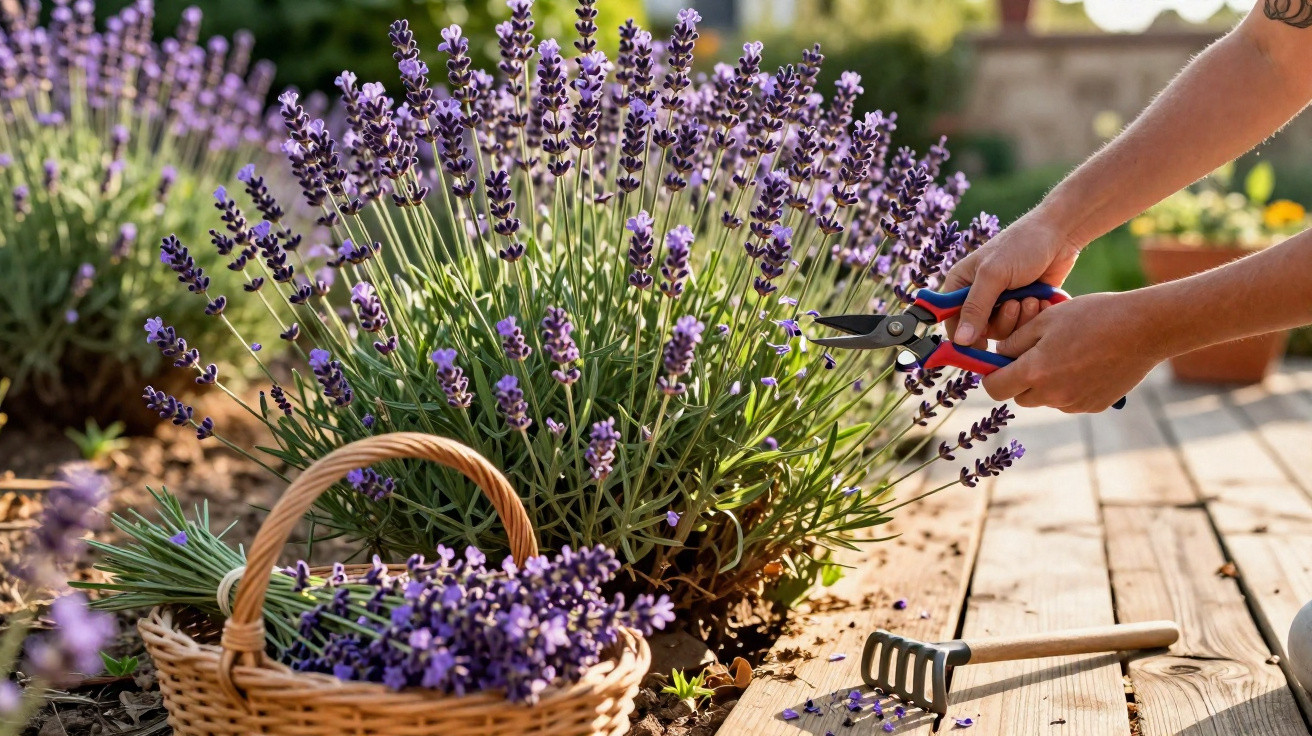
Anyone who loves the scent of lavender knows the frustration: at first it forms a perfect purple cushion, but after a few years there are only woody stems, bare patches and very few flowers. Weather, soil or the plant’s age are quickly blamed. In reality, much is decided in just a few minutes each year – by using the right secateurs at the right time.
Why lavender becomes woody so quickly without pruning
Botanically, lavender is a subshrub. This means it soon develops hard, brown wood at its base, while the soft green growth with leaves and flowers sits above it. That is precisely where the difficulty lies.
There are scarcely any dormant buds left in old wood that could produce new shoots. If the shrub is simply allowed to grow unchecked, the following happens:
- The centre becomes bare and the plant falls open.
- The woody growth becomes ever thicker, while green shoots remain only at the tips.
- Flowering declines, leaving the shrub looking straggly and dry.
Many amateur gardeners eventually take drastic action with the secateurs, cutting deeply into the old wood out of desperation. Lavender generally does not survive this. Branches then dry out and the plant gradually dies back.
“When cared for correctly, lavender bushes remain vigorous for 15 to 20 years – when treated incorrectly, they often give up after fewer than ten years.”
Regular, restrained pruning keeps lavender permanently within its young green growth. New, floriferous shoots develop there, helping the shrub remain dense and compact.
The two ideal times to prune lavender
The biggest mistake with lavender is uncertainty: “Am I cutting too early? Too late? Too much?” Rather than relying on instinct, it pays to follow a fixed annual schedule with two pruning dates.
Main prune after flowering
The key pruning session takes place in late summer. As soon as the main flowering period has ended and the purple flower spikes have faded and dried, carry out the first cut:
- Period: late August to late September
- Aim: remove spent flowers, restore the shape and rejuvenate the plant
- Weather: dry conditions, with no prolonged rain or frost forecast
This gives lavender sufficient time to produce fresh shoots before winter without exhausting itself. It enters the colder months compact rather than bare.
Light trim in late winter
The second session is for adjustment and shaping. It belongs at the end of winter, once the hardest frosts have passed but before the plant is growing strongly again.
- Period: February to March
- Aim: trim lightly, round off the shape and remove dead tips
- Important: do not cut once the buds have begun swelling significantly
The final adjustment depends on the local climate:
| Region | Autumn | Late winter |
|---|---|---|
| Mild areas and wine-growing regions | Carry out a more substantial maintenance cut immediately after flowering | From the end of February, give it a light shaping and inspection cut |
| Cooler regions, upland areas and the north | Remove only flower heads and damaged growth | In March, prune for structure on frost-free days |
The golden rule for lavender pruning: cut only green growth
The most important rule for lavender is this: never cut back into the brown, old wood. The plant produces fresh growth from it only very unreliably.
“The invisible lifeline sits directly above the last tier of green leaves – below it, the secateurs must remain strictly off limits.”
A simple reminder provides confidence: before pruning, mark this “safety line” in your mind. Sticking to it prevents entire branches from dying back.
Prune as follows in detail:
- Cut off every spent flower spike just above the first leaves.
- Shorten the whole green section by around one third.
- Shape the shrub into an even cushion, allowing light and air to reach every part.
Young plants can tolerate a slightly harder cut, removing up to roughly half of their green height. This encourages branching and makes the lavender denser.
With older specimens, be more cautious and always retain three to five centimetres of leafy shoots. A severe cut would be risky at this stage.
What you should never do with lavender
A few common mistakes cost countless lavender plants their lives every year – entirely unnecessarily, if they are avoided.
- Do not cut back hard into brown wood: Cutting deeply into old, bare wood often means entire branches fail to shoot again.
- Do not carry out drastic pruning in spring once growth has started: Cutting late and then too severely risks shoots drying out.
- Do not work in frost or prolonged rain: Wounds heal poorly, and fungal diseases can take hold easily.
- Do not use blunt tools: A clean cut made with sharp tools heals far better.
Disinfected, sharp secateurs ensure pathogens have little opportunity to enter. This care is particularly worthwhile for older plants.
How to keep lavender young for many years
Those who care for their plants consistently can enjoy dense, fragrant shrubs for many years. A practical routine throughout the gardening year could look like this:
- After flowering (late summer): Remove flower heads, reduce the green cushion by one third and shape it into a compact mound.
- Late winter: Lightly trim frost-damaged tips and unevenly grown shoots, then correct the shape.
- For very old plants: Rejuvenate gradually, removing only a few old branches with hardly any leaves each year.
If no fresh green growth appears at the base, there is usually only one solution: replace the shrub with a young plant. Conveniently, lavender is very easy to propagate from cuttings. Take several semi-woody shoots in late summer and place them in sandy soil, and you will soon have new plants of your own.
Particular features of different lavender varieties
Several types are available in shops, and their growth habits differ slightly.
- English lavender (Lavandula angustifolia): Usually remains fairly compact and, with the method described above, becomes very long-lived and robust.
- Lavandin: Generally grows more vigorously and has longer flowers; it tolerates pruning well but becomes particularly woody without regular care.
- French lavender: More sensitive, especially in colder regions. Prune it carefully and protect it well over winter.
The basic rule – cut only within the green growth and never into dead wood – applies to all of them. Adjust how hard you prune according to vigour and climate.
What lies behind the flowering miracle
From a gardening perspective, the result is logical: every cut stimulates the plant to form more side shoots. More shoots mean more potential flowers and denser foliage. At the same time, the shrub stays lower and is less likely to fall open.
Regularly pruning lavender not only extends its lifespan, but also creates a more stable microclimate in the border: air circulates more freely, moisture is less likely to build up, and fungal infections find it harder to establish themselves.
There is another benefit: well-maintained lavender cushions provide bees, bumblebees and butterflies with a reliable nectar source for years. So, by picking up the secateurs, you are not only prolonging the life of your own plants but also supporting the insects in your garden.




Comments
No comments yet. Be the first to comment!
Leave a Comment