
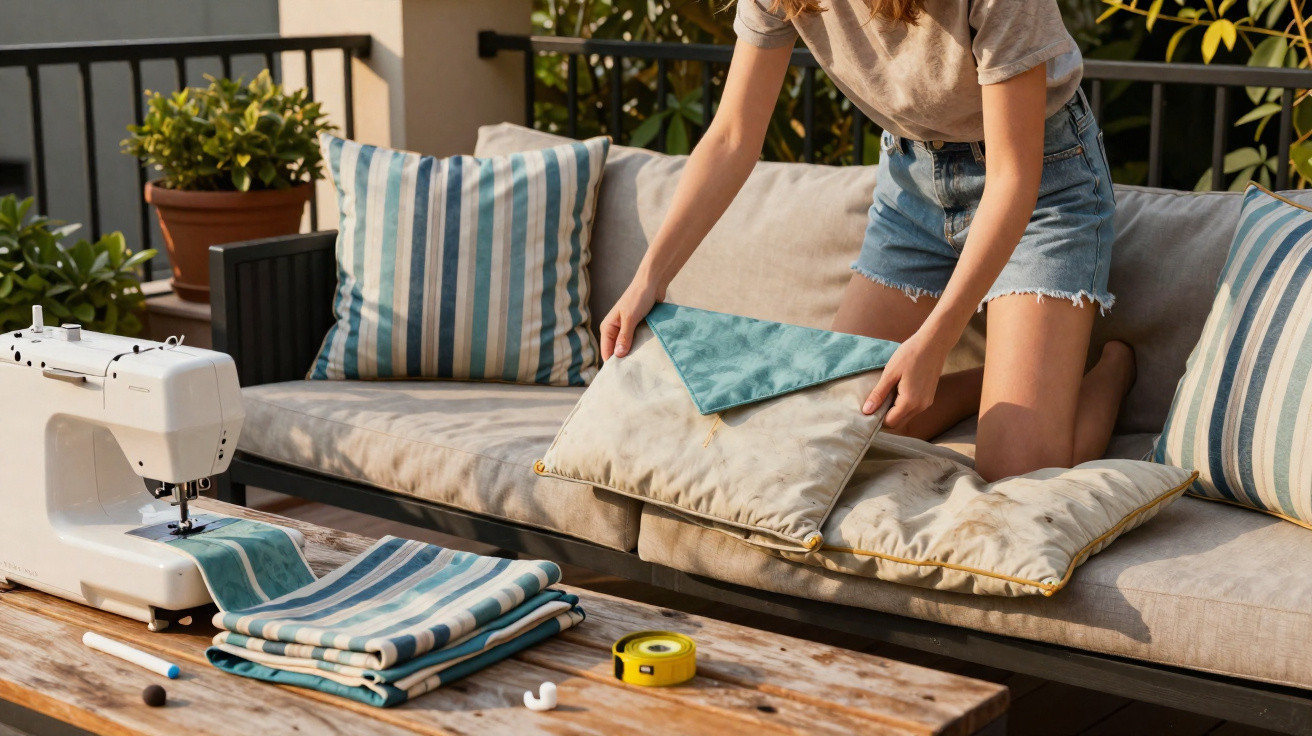
Many people throw away their old cushions as soon as the fabric fades or the seams split. Yet the real value is almost always in the foam filling, which is still intact. A smart approach saves real money, cuts waste and gives your outdoor space a fresh look in no time, using a simple sewing method that beginners can manage too.
Why you should not throw away old patio cushions
Stains from barbecues, faded colours and strained seams: after a few summers, many patio cushions look worn out. The obvious response may be to buy replacements, but that is where the mistake lies.
In most cases, the foam insert inside is still in excellent condition. It remains supportive and springy, with no cracks. Reaching for a bin bag at this point means throwing away one thing above all: money.
“Replacing old cushion covers instead of buying new cushions often saves €40 to €80 per cushion.”
There is another consideration too: every new purchase involves fresh production, transport and waste. Repairing, upcycling and reusing are increasingly popular choices, including for outdoor areas. Recovering old patio cushions fits this approach perfectly: you use what you already have and turn it into something that looks completely new.
The clever solution: an envelope-style cover
The key to this method is an envelope-style cover. Think of it as a cushion cover with an overlapping back, much like a traditional pillowcase without a zip.
Why this cut is so practical
- no zip that can jam or rust
- no buttons that can tear off or create pressure points
- tension is spread across the side seams rather than concentrated on one small component
- the cover can be removed and put back on extremely quickly
Zips and buttons are especially vulnerable outdoors. Sun, rain, changing temperatures and constant pressure from sitting and lying all take a serious toll on materials. An envelope-style cover avoids these weak points entirely. It requires only fabric and two straight seams.
“The envelope-style cover is one of the most rewarding sewing projects: a simple cut, excellent durability and ideal for the garden.”
Step by step: calculating fabric for patio cushions
You do not need complicated patterns. All you need is a tape measure, scissors, fabric and a sewing machine. Hand sewing will work if necessary, although it takes longer.
Basic pattern for a square cushion
Always begin with the dimensions of the foam insert. For example, 60 x 60 cm.
- Width of the fabric rectangle: cushion width + around 3 cm for seam allowance
→ for a 60 cm cushion, this is approximately 63 cm - Length of the fabric rectangle: 2 × cushion length + around 20 cm for the overlap
→ for a 60 cm cushion, this is approximately 140 cm
These measurements create an overlapping closure of roughly 15 cm. This keeps the foam securely inside the cover without the fabric opening when somebody drops into the seat.
Sew it in four simple steps
- Fold over and topstitch each of the short sides, which will later form the opening, to create neat finished edges.
- Lay the fabric on the table with the future outer side facing upwards.
- Fold both ends towards the centre so that they overlap by about 15 cm. This creates the envelope opening.
- Sew the side seams closed on the left and right, approximately 1.5 cm from the edge, then turn the cover right side out.
You can now simply slide the foam insert through the rear opening. The fabric pulls smooth, while the overlap keeps the filling in place.
Practical example: a complete lounge area in one afternoon
A common situation is a pallet lounge area on the patio with foam cushions that are still sound, while their old covers are scratched, faded and badly worn through in places.
Buying ready-made replacement covers can quickly push costs into a price range where half a new garden lounge set would be affordable. Buying fabric by the metre changes the calculation considerably:
- hard-wearing outdoor canvas by the metre: on average far cheaper than individual cushions
- time required: one afternoon, even for several seating areas
- result: a like-new appearance tailored to your own patio design
“An outdoor area with freshly covered seat cushions immediately looks tidier and more high-end – without any new furniture.”
What to look for in outdoor cushion fabric
Ordinary decorative fabric from a craft shop is usually not enough for patio cushions. It fades more quickly, frays more easily and does not cope well with continuous use. Special outdoor canvas or another outdoor fabric is the better option.
Signs of good outdoor fabrics
- a noticeably dense, firm feel rather than a limp drape
- as colourfast as possible, meaning UV-resistant
- abrasion-resistant for regular sitting and shifting around
- ideally water-repellent or quick-drying
The envelope-style cover already reduces the usual weak points because it works without metal components or press studs. Fabric with some structure helps the edges and seams remain neat even after several seasons.
A trick to stop damp rising from below: built-in protection
One major issue with many patio cushions is moisture coming up from underneath. Pallets, wooden slats and paving slabs often transfer cold and damp. The foam absorbs it and dries slowly, creating a risk of mould.
A simple addition that costs almost nothing can help: an inner protective layer on the underside of the cushion.
- an old tablecloth with a coated surface
- an unwanted shower curtain
- leftover pieces of oilcloth
You can sew or stitch these materials onto the underside of the cover. They form a barrier between the patio surface and the foam. Moisture takes much longer to penetrate, the core stays dry for longer and the cover is easier to dry again.
“An extra protective layer on the underside significantly extends the life of the cushions – and costs almost nothing.”
How inexperienced sewers can get started
If you are not yet confident using a sewing machine, start with one test cushion. Old bed linen is ideal for trying out the method without cutting into expensive fabric straight away.
Useful tips for beginners:
- always measure twice before cutting
- start with a basic straight stitch
- allow roughly 1.5 cm for seam allowance
- choose needles and thread suitable for thicker fabrics
After making the first few covers, you will soon develop a feel for proportions and tension. You can then recover your patio furniture piece by piece.
Mistakes best avoided
Common pitfalls are easy to prevent:
- Too little overlap: if the back panels barely overlap, the cover will open under pressure. At least 15 cm is a good measurement.
- Fabric that is too thin: it may save money initially, but it will tear sooner. Quality is worthwhile in the garden.
- Sewing without pre-washing: some cotton fabrics shrink in the wash. Wash them first, then cut them to size.
Benefits beyond the patio
The envelope-style cover principle is not limited to patio cushions. Kitchen bench pads, dog cushions, campervan seat pads and chair cushions can all benefit from this straightforward solution. Once you have mastered the technique, you can use leftover fabric, combine patterns and refresh the look to suit the season or your mood.
It also encourages a different relationship with your belongings. Rather than replacing them, you improve, adapt and reuse them. A stack of “old” patio cushions can become a modern, individual seating area with one afternoon of work, some fabric and a sewing idea that is surprisingly practical for everyday life.
Comments
No comments yet. Be the first to comment!
Leave a Comment