
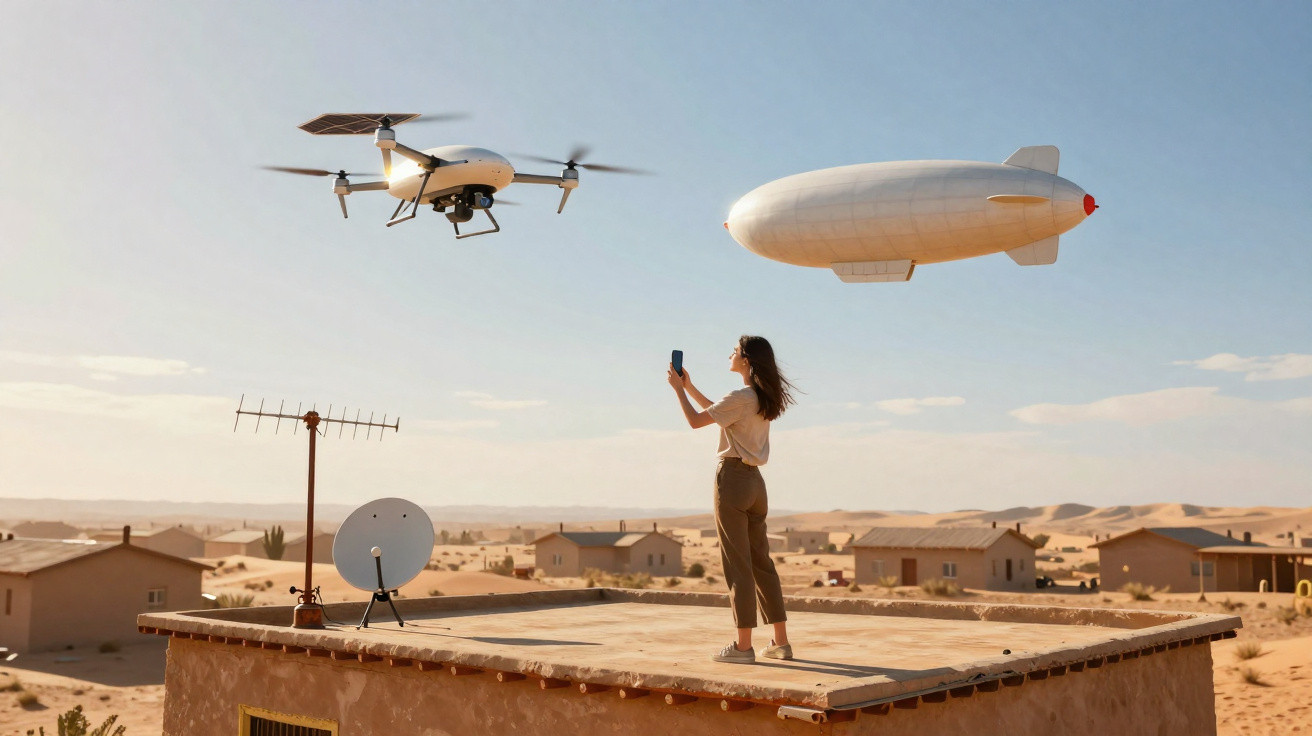
Millions of people still browse in a digital no-man’s-land – but an entirely new layer of internet infrastructure in the sky could now close the gap.
Around a quarter of the world’s population lacks dependable internet access, despite tens of thousands of satellites already orbiting above us. A different technology is now gaining momentum: stratospheric platforms, including solar-powered drones, airships and advanced balloons, could provide entire countries with affordable broadband internet – exploiting a weakness in Starlink and similar services.
Why satellites, including Starlink, cannot eliminate connectivity gaps
On paper, the idea of satellite internet sounds ideal: thousands of small satellites in low orbit, worldwide coverage and fast connections even in remote wilderness. Yet the digital divide remains vast. According to a report by the United Nations’ International Telecommunication Union, almost 2.2 billion people still have little or no internet access.
There are several reasons for this:
- Limited capacity in each area: If too many users in a densely populated area connect through the same satellites at once, the bandwidth available to each person falls sharply.
- High costs: Building an entire low-Earth-orbit satellite constellation is enormously expensive and technically highly complex.
- Costly consumer tariffs: In many emerging and developing countries, the recurring cost of a Starlink subscription is simply unaffordable.
“The gap is not only about coverage, but above all about price and capacity – and that is precisely where the stratosphere comes in.”
Between the ground and orbit is a largely untapped zone: the stratosphere, at roughly 18 to 25 kilometres above the Earth. A new generation of platforms is now moving into this space.
Internet from the stratosphere: how HAPS work
The technical term is HAPS, short for High Altitude Platform Station. It does not describe one specific type of device, but an entire family of aircraft: solar drones, uncrewed aircraft, helium airships and high-altitude balloons. Rather than orbiting in space, they effectively “park” high above a particular region.
Their usual operating altitude is between 18 and 25 kilometres. By comparison, commercial aircraft generally fly at 10 to 12 kilometres, while Starlink satellites operate at an altitude of around 500 kilometres.
These aircraft carry radio equipment and transmit downwards like enormous floating mobile phone masts. Large solar panels and batteries provide power, enabling some platforms to remain airborne continuously for weeks or even months.
Advantages over satellites and mobile phone masts
Their position between the ground and space delivers three important benefits:
- Lower latency: Signals travel only a few dozen kilometres rather than hundreds. This reduces delays when browsing and streaming.
- Wide area coverage: Depending on the technology used, one platform can serve hundreds of thousands of square kilometres, making it well suited to sparsely populated areas.
- Lower cost per resident: Far less ground infrastructure is needed, while deployment is cheaper than launching satellites by rocket.
“In the best-case scenario, stratospheric platforms create a vast virtual network of mobile phone masts in the sky – without having to dig fibre-optic cable into every metre of ground.”
Key projects: airships, solar drones and hydrogen drones
The concept itself is not entirely new. Initial trials took place as early as the 1990s. The best known was Loon, a project from Alphabet, Google’s parent company, which used balloons carried by high-altitude winds. It was shut down in 2021 because the technology was too expensive, too vulnerable to wind and harder to scale than satellite networks.
More capable solar cells, lighter materials and improved navigation systems are now available. Several companies are beginning a second attempt and aim to show that the business model can be financially viable.
Sceye: a huge solar airship above the desert
US start-up Sceye is developing a 65-metre-long airship filled with helium and covered in solar cells. Rather than merely drifting with the wind, it can hold its position accurately over a defined region.
From this “parking position” in the stratosphere, Sceye transmits broadband internet to the ground. Its aim is to create a full internet service that is as reliable as a conventional mobile network, while requiring substantially less infrastructure on the ground.
Aalto HAPS: the Zephyr drone from the Airbus group
Aerospace company Airbus is competing in the same sector through its subsidiary Aalto HAPS. Its flagship project is Zephyr, an extremely lightweight solar drone with a wingspan of just 25 metres.
During trials, Zephyr has already completed flights lasting up to 67 consecutive days. This is a significant milestone, as the longer a platform can remain aloft, the lower its maintenance and operating costs per connected user become.
World Mobile: a hydrogen drone with high-speed bandwidth
Another contender is UK company World Mobile. It is working with hydrogen-powered drones intended to combine high payload capacity with endurance. According to the company, a single platform can bring up to 200 megabits per second of bandwidth into the air.
A specific example calculation suggests that just nine such drones could theoretically provide fast internet to Scotland’s roughly 5.5 million residents. The stated price is around 0.80 euros per person per month, compared with the current equivalent of about £75 for an individual Starlink subscription.
“If these figures are even remotely accurate, stratospheric internet would be far more realistic than a dedicated satellite subscription for many regions.”
A building block for genuine global coverage – but with obstacles
This new technology is not intended to replace satellites, but to complement them. The vision shared by many providers is a three-layer network: fibre-optic and mobile networks on the ground, stratospheric platforms above them, and satellites as a global fallback layer.
For this to work, several requirements must be met:
- Frequencies (spectrum) must be coordinated with mobile and satellite networks.
- Aviation safety and airspace rules must not be breached.
- Rules governing data traffic and net neutrality must also apply to platforms in the stratosphere.
Without a clear legal framework, radio interference or clashes with existing services could arise. These devices do not sit outside all regulation simply because they operate higher than conventional aircraft.
What terms such as latency and bandwidth mean here
Anyone comparing stratospheric internet with fibre optics or satellite services will quickly encounter technical terms:
- Latency: This is the time needed for a data packet to travel from a device to a server and back again. Delays increase when the route is long, such as when signals must reach satellites in orbit. Calls and online gaming can then feel “sluggish”.
- Bandwidth: This describes how much data can be transmitted per second. High bandwidth supports crisp video streams and multiple users at the same time without performance drops.
- Broadband: In everyday terms, internet fast enough for video, video calls and cloud services.
Stratospheric platforms shorten the radio path considerably. This lowers latency compared with satellites, although it naturally remains slower than a direct fibre-optic connection. Their strength lies in combining range, acceptable delay and suitability for large numbers of users.
Opportunities and risks for users and governments
For remote villages in Africa, Asia or Latin America, a HAPS network could mean that schools, health centres and small businesses can get online reliably for the first time. This would change educational opportunities, access to markets and freedom of information.
Industrialised countries could also benefit. Offshore wind farms, shipping routes, disaster zones and mountainous regions could be connected quickly where ground infrastructure has been destroyed or is uneconomic.
Risks remain. Dependence on a small number of private operators could intensify political disputes. Stratospheric platforms may also be used for surveillance technology or military purposes. Transparent rules on data use and the role of public authorities will therefore be crucial.
How prices develop will be particularly important. If the cost advantages are confirmed, conventional satellite services will come under pressure in the mass market. Starlink and other providers will probably need to respond, whether through cheaper tariffs, new services or their own stratospheric projects.
For users in poorly connected areas, an entirely new option could emerge over the next few years: no costly satellite kit on the roof, but simply a standard router communicating almost unnoticed with a “mobile phone mast” high in the stratosphere.






Comments
No comments yet. Be the first to comment!
Leave a Comment