
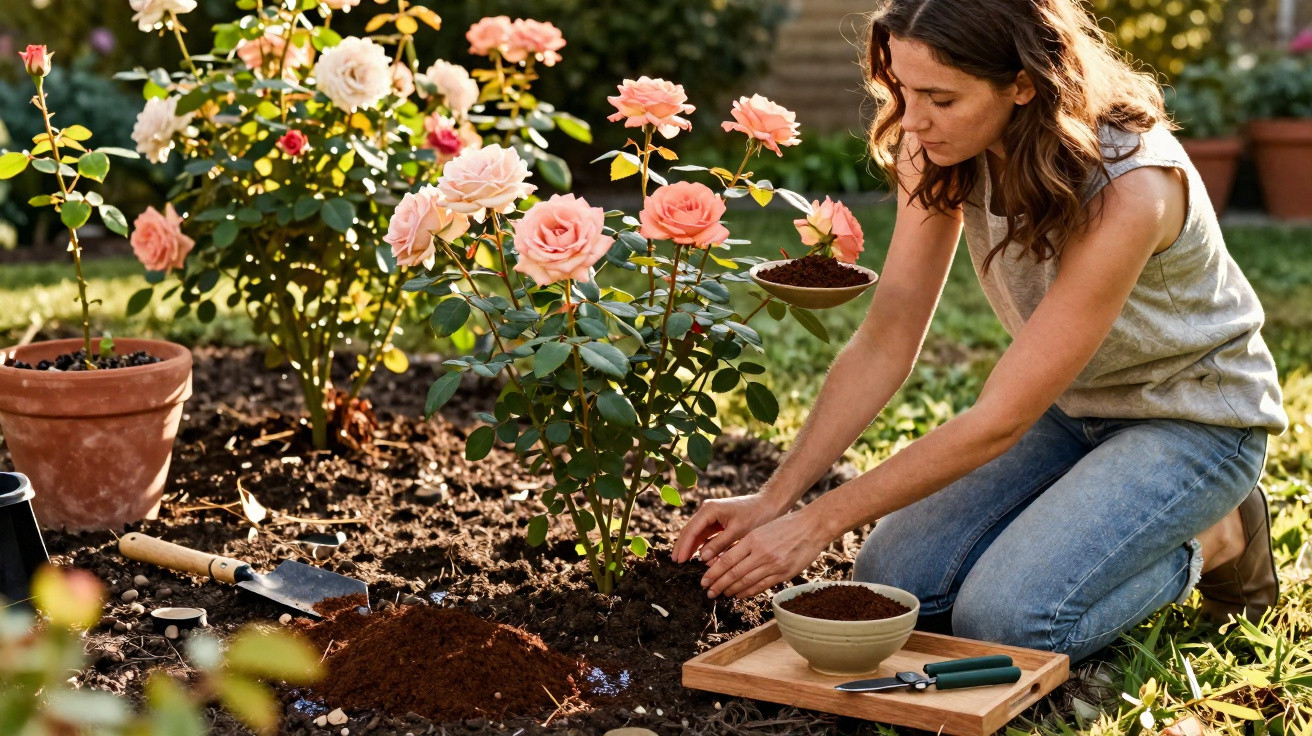
On 1 March, Claire adopted a habit that seemed almost obvious to her: tipping the still-warm coffee grounds from her coffee maker at the base of her rose bushes. Every morning, she repeated the small ritual between breakfast cups and leaving for work. She had read that coffee could feed the soil, deter certain unwelcome visitors and give plants worn out by winter a boost. At first, the bed even looked better: darker and tidier, as though that deep brown colour already promised beautiful blooms. Then June arrived. The leaves grew, certainly, but the buds were slow to appear, and two rose bushes developed a strangely limp look. Gardens can sometimes deliver surprises that are less photogenic than the tips seen online. She wanted to find out why.
Coffee grounds at the base of rose bushes do not always work miracles
Claire had not tipped a huge heap of grounds out in one go: just a small handful here and a teaspoon there, almost every day since early March. Yet by the first summer, her roses were less prolific than the previous year, producing plenty of foliage and long stems but few open flowers. We all know that moment when a well-meant gardening idea starts to feel like a puzzle. Coffee grounds have an excellent reputation among gardeners because they recycle an ordinary waste product and feel like a useful thing to do. In practice, however, they are organic matter to use sparingly, not a magical fertiliser to scatter without restraint.
In her suburban garden, Claire eventually noticed that the soil beneath the brown layer formed a crust after spring rain. When she scraped it with a small hand cultivator, she found soil that was less aerated than usual, sticky in the top few centimetres and marked with a few whitish traces. One old rose bush, which normally produced around twenty flowers between June and July, gave only eight that year. It was not a scientific figure, but it was enough to make her ease off. Her mistake was not using coffee grounds at all; it was applying them on their own, while fresh, too frequently and always in the same place.
Used coffee grounds do contain useful elements, including a little nitrogen, potassium and phosphorus, but how available these nutrients are depends on activity in the soil. Nor do they acidify the ground as strongly as is often imagined: after brewing, their pH is generally close to neutral. The real issue is their very fine, almost powdery texture, which can compact when repeatedly spread on the surface. Rose bush roots need air, freely moving water and balanced nutrition to produce flowers. Too many coffee grounds can disrupt this delicate balance.
The right approach: mix, dry and above all vary the additions
The easiest method is to let the grounds dry in a small dish, then add them to the compost rather than placing them at the base of plants. Claire now combines them with peelings, fallen leaves and torn brown cardboard, without filling the bin with coffee alone. For anyone who truly wants to use them in the garden, a light pinch worked into the soil once or twice during the season is more than enough around an established rose bush. A visible layer is not proof of effectiveness. It can even become a compact little barrier, especially in soil that is already heavy or clay-rich.
A common mistake is assuming that anything natural can be applied without limits. That is understandable: coffee grounds are free, available every morning and recycling them brings the pleasing sense that nothing is being wasted. Let us be honest: nobody really does this every day with kitchen scales and a monitoring notebook. The sensible approach is therefore straightforward: watch the soil, space out additions and supplement them with mature compost or plant-based mulch. Rose bushes respond better to a gentle routine than to a homemade treatment enthusiastically applied for several months.
After stopping direct applications, Claire carefully removed the crust of grounds, loosened the surface without damaging the roots and laid down a mulch of shredded leaves. Her rose bushes did not transform within forty-eight hours, which was rather reassuring: in a garden, genuine improvements take time. As an old gardening principle says, “feeding the soil is better than stuffing the plant”. A few guidelines prevent many disappointments:
“Coffee grounds are a compost ingredient, not a complete recipe for every plant in the garden.”
- Give priority to adding them to compost, mixed with dry materials.
- Never create a thick layer at the base of rose bushes.
- Check the leaves, flowering and soil moisture before adding more.
- Choose an airy mulch: fallen leaves, untreated wood chips or thoroughly dried grass clippings.
The following summer’s roses taught her to look before adding
The next summer, Claire did not give up coffee grounds; she simply stopped expecting miracles from them. Her richer, looser compost eventually returned to the garden in spring, spread in a thin layer around the rose bushes. The flowers came back in greater numbers, without suddenly becoming enormous or perfect, and that was probably what convinced her. A living garden does not respond like a machine to which one precise ingredient is added. It reacts to the weather, the soil, the age of the plants and those repeated small actions whose effects are difficult to judge at first.
This story also concerns our everyday habits. Coffee grounds seem modest, almost insignificant in the coffee maker filter, before becoming useful material when they join balanced compost. Recycling does not necessarily mean applying something immediately. Sometimes, drying it, mixing it, waiting a few weeks and accepting that less can be more changes everything. Rose enthusiasts know that spectacular flowering does not come solely from a product or a trick; it grows from regular attention. And if your rose bushes produce plenty of leaves but few buds this summer, perhaps the soil has something to tell you.
| Key point | Detail | Added value for the reader |
|---|---|---|
| Direct coffee grounds | A repeatedly applied layer can compact and restrict soil aeration. | Helps prevent rose bush roots from being suffocated. |
| Composting | Grounds work better when mixed with leaves, cardboard and plant waste. | Turns everyday waste into a more balanced soil improver. |
| Observation | Abundant foliage, crusted soil or poor flowering are signs to take into account. | Makes it possible to adjust gardening practices before weakening plants. |



Comments
No comments yet. Be the first to comment!
Leave a Comment