
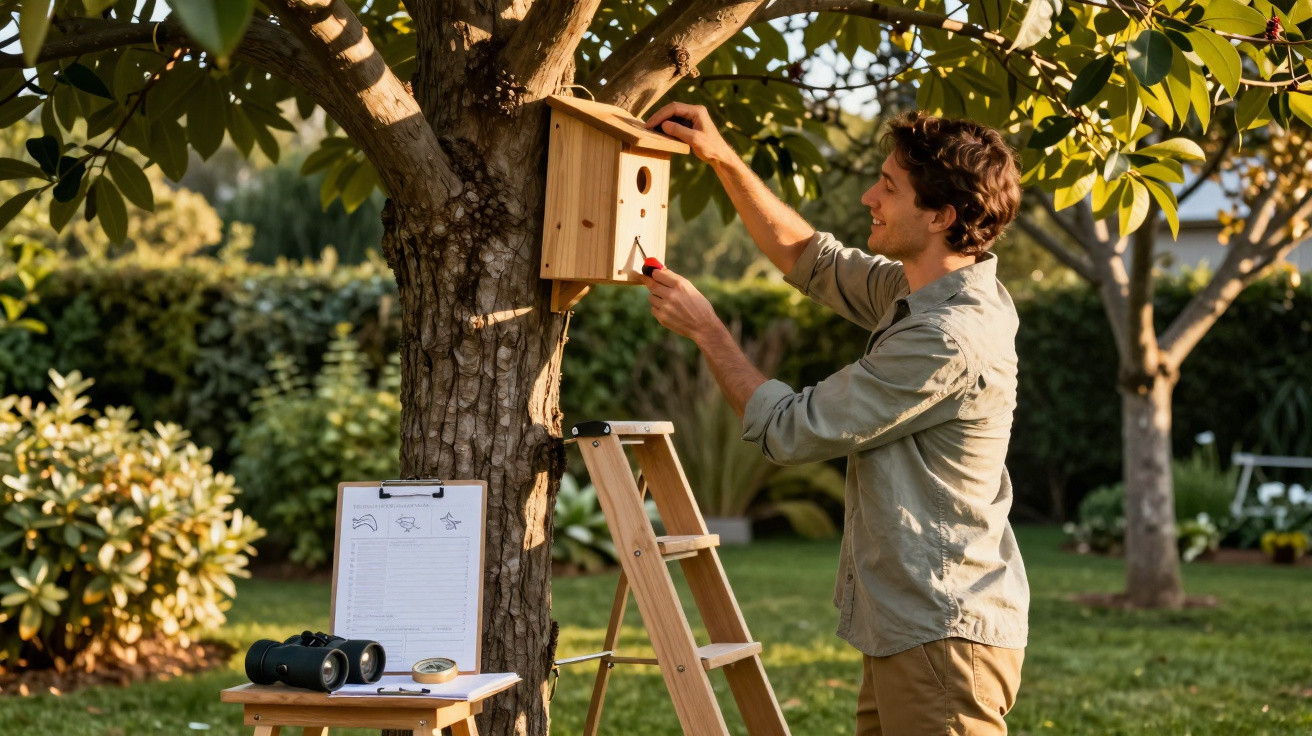
Your neighbours seem to be showing off new chicks every spring, while your nest box stays silent through gales, downpours and your best efforts. The uncomfortable reality is that birds are fussy about where they live, and the location you pick can make or break the whole thing.
At dawn one day, I stood in a small back garden with a mug in my hand as it cooled. A coal tit pinged along the fence, paused to look at a shiny box on the south-facing wall, then shot off as though it had brushed a hot pan. To me it looked ideal: spotless, charming, brand new. To a bird, it read as glare and danger. The garden went still. Meanwhile, across the way, my neighbour’s older, weathered box-tucked under the eaves and shaded by an apple branch-hummed with quiet activity. It wasn’t about paint or price. It was the microclimate, the sightlines, and the predators birds detect long before we do. One note kept repeating in my notebook: a small shift can change everything.
The sweet spot birds say yes to
In practice, birds look for a box that gets gentle morning light rather than a harsh midday bake, sits steady rather than swinging, and offers an uncluttered approach rather than a leafy slalom. If the entrance points somewhere between north and east, it catches soft dawn warmth and stays cooler when the afternoon sun bites. Place it so the wind can’t whistle straight through the hole. And if a cat can crouch underneath, or a magpie can sit above like a nightclub bouncer, most birds will simply pass. Face it between north and east. Everything else is fine-tuning.
I once watched a gardener called Claire shift a box only two metres-off a bright south-facing fence and onto an east-facing brick wall, just under a gutter elbow, 2.4 metres up. Same box design, same garden, same week. The first position never attracted a single visitor. The second had a blue tit checking it within 36 hours and building a nest within ten days. Monitoring by UK community schemes often shows occupancy rising beyond 50–60% when boxes point NE and sit in dependable shade with a clear approach. A tiny adjustment, a dramatic difference.
There’s nothing mystical about it: it’s heat and risk. Overheating can wipe out a brood, so midday shade matters. Wind funnels also carry scent and noise, and exposed placements feel unsafe. Birds need a runway too-room to arrive quickly and leave even faster. Keep branches out of the flight path for at least two metres. Match the height to the species: tits and sparrows at 2–4 m; robins and wrens (open-fronted) at 1.5–2 m in dense cover; swifts high under eaves; and owls much higher with a clear outlook. Shade beats sun. And safety beats everything.
Nest box angles, height, and microclimate: a practical blueprint
Choose a wall or robust trunk that gets half-light at dawn and shade around midday. In the northern hemisphere, set the entrance roughly towards NE (in the southern hemisphere, switch that to SE). Fix it at the right height for your target species, tip it forward by a few degrees so rain sheds off the roof, and secure it with two fixings so it never swings. If it’s going on a wall, leave a three-finger gap behind for airflow, and make sure the entrance isn’t sitting in the drip line. Keep a clear three‑metre runway. It can look strange to us; it reads as safe to them.
The most common mistakes happen when we’re in a hurry: mounting too low for cats to ignore; hanging it on a thin branch that sways like a bargain hammock; placing it right beside a feeder where constant commotion and crumbs attract attention. Many of us have proudly stepped back after driving in a screw, only to realise later that a streetlight shines straight into the entrance all night. Keep feeders at least five metres away. Move the box out of direct afternoon sun. And if a window near the flight line reflects the sky, use decals or choose another spot. Realistically, we don’t notice these things until birds do.
Birds teach you through their refusals. Treat the silence as feedback, then alter the shade, tweak the angle, or change the height.
“The box doesn’t need to be pretty. It needs to be predictable-stable shade, solid mount, and a clean line in and out,” said a volunteer ringer I met near the canal.
- Orientation: NE in the north, SE in the south; avoid full south in hot regions.
- Height guide: 2–4 m for tits/sparrows; 1.5–2 m in cover for robins/wrens; 4–8 m for owls/kestrels; high under eaves for swifts.
- Runway: open air for 2–3 m in front of the hole.
- Predators: no overhanging perches; prickly or open ground below helps.
- Distance: feeders and baths 5–10 m away, not right beside the nursery.
- Microclimate: shade at noon, low wind tunnel, no night lighting on the entrance.
What changes when you place one box right
When a nest box is positioned well, it changes how you read your garden. You start to spot where frost hangs on longest, where the breeze eddies, where the cat likes to wait, and where the first light lands. The “best” place is seldom the one that looks nicest in a photo. More often it’s the sheltered corner, the eaves with a soft shadow, or the trunk that doesn’t move.
Make one move, then give it a week. If birds still drift past without stopping, adjust the angle by a hand’s width, or go up by half a metre. Those small edits are most of the work.
Over time, the pattern repeats as the seasons shift. The spring sun climbs, trees come into leaf, a neighbour cuts back a hedge, and what used to be perfect shade becomes bright glare. That isn’t failure; it’s a living place changing. You can add a native shrub to create dappled shade in summer, or move the feeder’s “traffic” so the box isn’t a front-row seat to chaos. On a calm morning, you may hear a soft tapping from inside the wood, like a pencil on a desk. That’s when you know the site is doing its job.
People often try to turn nesting into a checklist, but birds keep voting with their wings. Compare notes with neighbours, trade observations with a local bird group, and map your microclimate with a cup of tea and ten quiet minutes at dawn. And when you get your first fledging video, send it to someone who’s convinced their garden is too small. The pleasure isn’t only in one box being used-it’s in learning to read the air together and finding the precise patch where life can begin safely.
| Key point | Detail | Why it matters to you |
|---|---|---|
| Orientation and shade | Entrance facing NE (or SE in the southern hemisphere), shade at midday | Lowers overheating risk and increases occupancy rates |
| Height by species | 2–4 m for tits/sparrows; 1.5–2 m in cover for robins; higher for birds of prey | Matches the site to the real needs of the birds you’re trying to attract |
| Clear flight corridor | 2–3 m with no branches or obstacles in front of the entrance | Reduces predation risk and makes landing easier |
FAQ:
- What direction should a nest box face? In the northern hemisphere, position it between north and east to catch mild morning light and avoid hotter afternoons. In the southern hemisphere, turn that to south–east.
- How high should I mount it? For most small hole-nesters, 2–4 m works well. Robins and wrens prefer 1.5–2 m with dense cover. Swifts favour high eaves; owls and kestrels need several metres plus open sightlines.
- Can I put a nest box next to a feeder? It’s best avoided. Leave 5–10 m between the box and any feeder to cut noise, traffic and predator interest around the nest.
- When’s the best time to put it up? Autumn to mid-winter is ideal so birds can check it early, but you can put one up whenever the weather is calm. In cold snaps, some species will even roost in boxes.
- Do I need to clean the box? Yes-once a year after breeding, when it’s cool and the box is empty. Clear out old nesting material, check drainage and tighten fixings. Wear gloves and keep it quick.




Comments
No comments yet. Be the first to comment!
Leave a Comment