
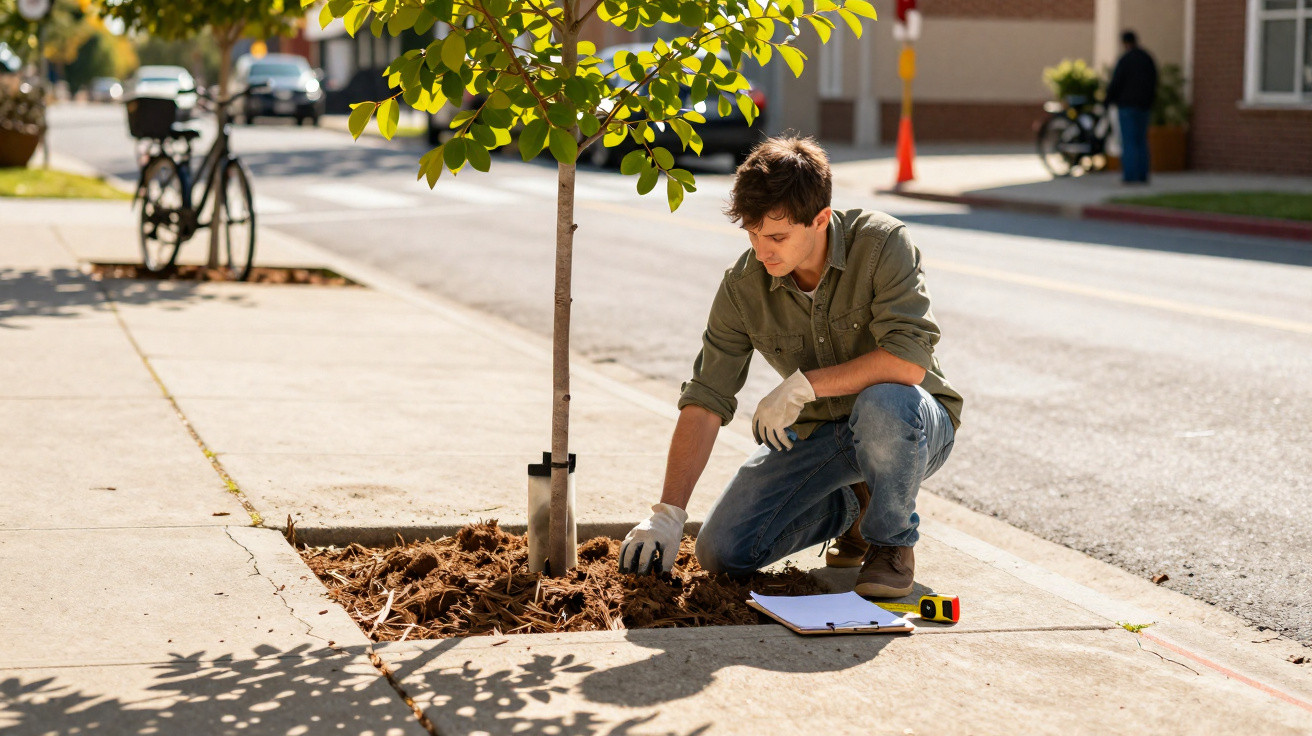
A man in a fluorescent vest swears under his breath on the pavement.
A concrete slab has buckled by a full ten centimetres, peeled up like a torn fingernail. Next to it, a street tree that was once slim now tilts at an angle, with roots as thick as wrists forcing their way through what used to be a neat urban edge. A mum steers her pushchair around the danger, the wheels jolting as she squints at the mess. Two teenagers snap photos of the disruption for Instagram. Council workers are already taking measurements, their minds on budgets, complaints and the threat of legal action.
Five streets away, the pavement could be on another planet. It’s the same city, the same heat and the same traffic, yet beneath a roof of pale green leaves the air feels cooler, the road surface less tacky, and the noise seems softened, as though wrapped in a muffling layer. Runners ease off here without noticing. Coffee tastes better when you sit on a shaded bench. Somewhere between these two streets sits a quiet, fierce argument: is the perfect pavement tree an eco‑hero, or a subtle invader that will eventually damage the whole neighbourhood?
The tree that cools your street… or cracks it wide open
On a well‑treed street, the first thing you register usually isn’t the trees themselves. It’s the atmosphere. The air feels gentler on your skin, carries a little less exhaust, and somehow seems fit for humans again. Urban foresters call this “green infrastructure”; most residents simply know it as the reason the walk to the bus in August doesn’t feel like a punishment.
Yet those same trees can also be why an older neighbour trips on a lifted paving slab and ends up in A&E. Roots take their time, but they push with steady, stubborn strength. Put the wrong species into the wrong pavement set‑up and the concrete will lose every time. That’s why the “perfect” city tree always has two sides: a life‑support system on one hand, and a concealed hazard on the other.
Look closely at Toronto, Melbourne, Paris or São Paulo and the pattern repeats. Mature plane trees or maples deliver heroic levels of shade, while beneath them the pavements become a patchwork-cracks, repairs, and temporary tarmac scars. A study in Los Angeles reported that streets with proper shade could reduce local surface temperatures by up to 5°C, and that property values rose by several per cent on tree‑lined blocks.
Those same streets, however, often produce a constant trickle of complaints: buckled paving, drains and sewer lines squeezed by roots, trips and falls, and emergency repairs carried out at night. In some places, whole rows of gorgeous but forceful ficus trees have been removed-prompting anger from residents who felt they were losing “their” shade-despite the fact those roots had been tearing into pipes for years. The same trunk can grow both progress and resentment.
City ecologists often describe street trees as living compromises. They’re expected to cope with pollution, road salt, limited soil, repeated pruning and human mistreatment. Historically, councils picked hard‑as‑nails species such as Norway maple, Callery pear or honey locust: survivors first, easy neighbours second. Many of those decisions now haunt planners. Some choices turned invasive and spread into nearby woods. Others thrived so well that their roots treated concrete as little more than a polite suggestion.
Today’s generation of “street‑smart” trees is meant to avoid those mistakes: smaller crowns, deeper roots, and better behaviour around overhead cables. On paper it sounds tidy, like updating an operating system. In practice, there are still storms, budget cycles, and residents who become attached to whatever is already growing outside their window. Trees, unlike lamp posts, come with emotions.
How cities quietly decide what grows under your window
From afar, planting a pavement tree looks straightforward: dig a hole, place the tree, add mulch, and move on. In reality, the approved species list often represents months of debate between ecologists, engineers, risk managers-and, at times, solicitors. The real question usually isn’t “do we like trees?” but “which tree is least likely to cause trouble over the next 40 years?”
Many municipal arborists now rely on detailed spreadsheets that score species for root behaviour, drought tolerance, allergy effects, storm resistance and invasiveness. A tree might be outstanding for shade yet lose marks for brittle limbs or surface‑running roots. Another could be almost ideal for narrow pavements but get overlooked because it doesn’t look dramatic on Instagram. That quiet scoring system heavily influences what ends up outside your front door.
You can see the trade‑offs in everyday neighbourhoods. In New York, older streets lined with huge London plane trees feel like leafy cathedrals, but maintenance teams spend vast sums grinding roots and relaying slabs. In newer schemes, you’re more likely to spot columnar oaks, ginkgos, zelkovas and smaller native trees planted in tight pits with metal grilles. They tend to be better behaved underground, but they take longer to form the full, enveloping canopy people imagine.
Melbourne learned this lesson the hard way. Years of depending on a small group of imported species left the city exposed when heatwaves, pests and new diseases began striking the same trees across thousands of streets. The response was a bold diversity plan: no single species should dominate again. That improves climate resilience and lowers the risk that one “wonder tree” quietly becomes invasive and slips into nearby wetlands or parkland. Monoculture is easy to design; genuine diversity is harder, messier, and more truthful.
Among urban foresters, the guiding principle is almost dull in its simplicity: “right tree, right place”. On a three‑metre‑wide pavement above shallow services, that rarely means a massive, fast‑growing tree with shallow roots. And yet those are often the very trees people remember fondly from the streets of their childhood. On a warming planet, nostalgia can be a dangerous landscape designer. The conflict isn’t only scientific-it’s emotional. Concrete is indifferent either way.
How to choose a tree that shades your street without wrecking it
If you’re in the fortunate position of having any say-whether you’re a homeowner, a tenant lobbying the council, or part of a residents’ group-start with something almost laughably practical: measure the space as if you were buying furniture. Check the pavement width, distance to the kerb, overhead wires, and the depth of service lines if your council shares that information. A tree that looks “small” in a nursery can easily double or triple its footprint over 20 years.
With the measurements in hand, focus on characteristics that work with the site rather than against it: roots that tend to go deeper instead of spreading near the surface; a moderate growth rate rather than a sprint; and shade that cools without plunging ground floors into gloom. Many councils publish recommended species lists with symbols indicating likely root impact and invasiveness risk. Begin there, rather than arriving at a garden centre armed only with the word “pretty”. Your ankles-and your neighbours’ pipes-will benefit.
Most people have felt the pull of a perfect leafy street and thought, “Why can’t our block look like that?” It’s tempting to copy the biggest, lushest specimen you can see. That copy‑and‑paste impulse is exactly how invasive trouble often begins. Species such as Callery pear or tree‑of‑heaven were once urban favourites because they grew quickly and tolerated neglect. Years later, they’re crowding out native plants at the edges of towns, changing soils, and carrying pests that use them like public transport.
A better approach is to ask which native-or well‑adapted, non‑invasive-species offers similar benefits without the drawbacks. In many places, smaller maples, hornbeams, hackberries or disease‑resistant elms suit tight pavements far better than the old giants. In hotter, drier climates, hardy but non‑spreading choices such as desert willow, pistache or certain oaks deliver more cooling per litre of water. Council foresters often know these quiet successes intimately; they’re simply not asked often enough.
The real bargaining happens below ground. When planting pits are narrow and the soil beneath is compacted, roots are effectively forced to travel close to the surface and under paving. Structural soil, root barriers, larger pits and shared planting zones allow roots to go deeper and spread where they do less damage. It’s technical and unglamorous, yet it’s what decides the whole “eco‑hero versus menace” story. A brilliant species planted badly can become a legal headache. An average species planted well can feel like a gift for decades.
Let’s be honest: hardly anyone keeps up perfect maintenance every day. Watering gets missed, mulch is forgotten, and no one rings to report a broken stake. That’s ordinary life. So the “perfect” pavement tree shouldn’t be chosen for a fantasy of constant care, but for the untidy reality of busy, distracted people.
One straightforward guideline helps: if a tree needs continual pruning just to keep the walkway clear, it’s likely the wrong species or the wrong place. If it drops heavy, slippery fruit onto a busy footway, complaints and furious WhatsApp groups are all but guaranteed. If pollen from one species triggers hay fever for half the street, opposition will appear quickly. Trees exist in a social ecosystem as well as a biological one.
Increasingly, residents are asking a deceptively simple question: “Can we love this tree for 30 years?” That means picturing the scent of blossom in spring, the litter in autumn, the shifting light in summer-and what the roots will do when no one is watching. It isn’t a scientific unit of measurement, but it’s closer to how streets actually come to terms with what grows outside their homes.
“The best street tree is the one your grandkids still argue about at family dinners – not because it broke their ankle, but because everyone remembers the shade on the day they learned to ride a bike,” says urban forester Lena Morales, who has spent two decades mediating between roots and residents.
- Ask your council’s urban forestry team which non‑invasive species they’re backing for the next 30 years.
- Walk your neighbourhood and note which trees still have healthy canopies and decent pavements after 20+ years.
- Push for root‑friendly design-bigger pits, shared soil, structural soils-rather than simply “more trees, anywhere”.
Living with imperfect trees in imperfect cities
Pavements keep their stories long after planners have logged off for the day. A smooth, unbroken surface beneath a thin, pole‑like tree tells one tale: efficient, low‑maintenance, slightly sterile. A lumpy, repeatedly patched pavement under a vast, cherished canopy tells another: an everyday negotiation between shade, safety and public money. Neither is purely eco‑hero nor purely menace. Real streets exist in the muddle between.
Climate change adds weight to every decision. As summers intensify, shade stops being a nice extra and becomes a survival tool-particularly in poorer neighbourhoods that often have fewer trees. Some councils now map “heat inequity”: streets that run several degrees hotter because they have more parking bays than leaves. The urgency to plant quickly can drive decision‑makers back towards the same fast‑growing, potentially invasive options that caused problems before.
It doesn’t have to come down to a choice between bare concrete and broken paving. The places that appear to be getting this right aren’t hunting for a single miracle species. They spread risk through diversity. They involve residents early. They trial more flexible paving, expand planting areas, and use native trees that tolerate harsh urban conditions without escaping into nearby woodlands. And they accept that even good decisions bring friction and compromise.
The next time you stumble over a raised slab, or step with relief into a pool of shade, you’re stepping into this debate. Every crack, every root and every pocket of cooler air is part of a shared decision about what sort of city we want to walk through. Some neighbours will always choose smooth paving and open sky. Others will defend the biggest tree on the street as if it were family.
Between those positions sits one stubborn question: can a tree be wild enough to survive the city, and gentle enough to live beside our front doors? There’s no final answer-only an evolving street map where we test it, one planting season at a time. That map is being drawn right now under your feet, root by hidden root.
| Key point | Details | Why it matters to readers |
|---|---|---|
| Root behaviour vs. pavement design | Species with shallow, spreading roots (like ficus or many large maples) will almost always lift narrow slabs when planted in tiny pits. Deeper‑rooting trees combined with structural soil or larger planting zones dramatically reduce heaving. | This directly affects trip hazards, pushchair access, and whether your block becomes a queue of orange cones and repair crews every few years. |
| Native vs. invasive potential | Some popular street trees-such as Callery pear or tree‑of‑heaven-spread aggressively into vacant lots and nearby woodlands, crowding out local species and altering soil chemistry. | Choosing non‑invasive or locally native trees protects nearby parks, reduces maintenance headaches, and keeps your region’s landscape from slowly turning into a single, boring monoculture. |
| Canopy size and local climate | Large‑crowned trees can drop midday temperatures by several degrees and slash energy use in adjacent buildings, but need generous root space and smart pruning plans to coexist with pavements and power lines. | If your street bakes in summer, canopy decisions will shape comfort, health risks for vulnerable residents, and even how often you feel like walking instead of driving. |
FAQ
How do I know if a tree near my pavement is becoming a problem? Watch for lifted slabs, cracks radiating from the trunk, frequently blocked drains, or roots visibly surfacing along the kerb. If branches are drooping below head height over the footway or blocking drivers’ sightlines, it’s also time to contact your council’s tree service or a certified arborist for an inspection.
Are there “safe” pavement trees that almost never damage paving? No species is completely risk‑free, but many smaller or columnar varieties-such as hornbeam, some hybrid elms, or certain ornamental cherries-tend to create fewer conflicts when paired with adequate soil volume. The key is matching the mature size to the available space, rather than choosing something that simply looks neat when young.
Can I plant my own tree in the verge outside my house? Rules vary enormously by council. Some areas encourage residents to adopt and plant street trees from an approved list, while others prohibit private planting near underground services. Before buying anything, check your council’s urban forestry or highways/public works page, or ring the non‑emergency number and ask about permits.
What makes a tree “invasive” in a city context? A tree is classed as invasive when it escapes cultivation, spreads quickly by seed or suckers, and forms dense stands in natural or semi‑natural areas. In urban settings, that often shows up as seedlings appearing in vacant lots, along rail corridors, or in nearby parks, displacing a wide range of native plants.
Is cutting tree roots a good way to save a cracked pavement? Root pruning can help in specific, carefully managed situations, but heavy cutting on one side can destabilise the tree or trigger decay. Any root work near a mature street tree should be planned and overseen by a qualified arborist who understands both the species and local soil conditions.
What should I ask council officials if my block is due for new trees? Ask which species they intend to plant, how large those trees will be at maturity, and what soil volume or root space will be provided. It’s also reasonable to ask how allergy impacts, storm resilience and long‑term maintenance were factored in so the trees don’t become the next generation of “problem” plantings.
Comments
No comments yet. Be the first to comment!
Leave a Comment