
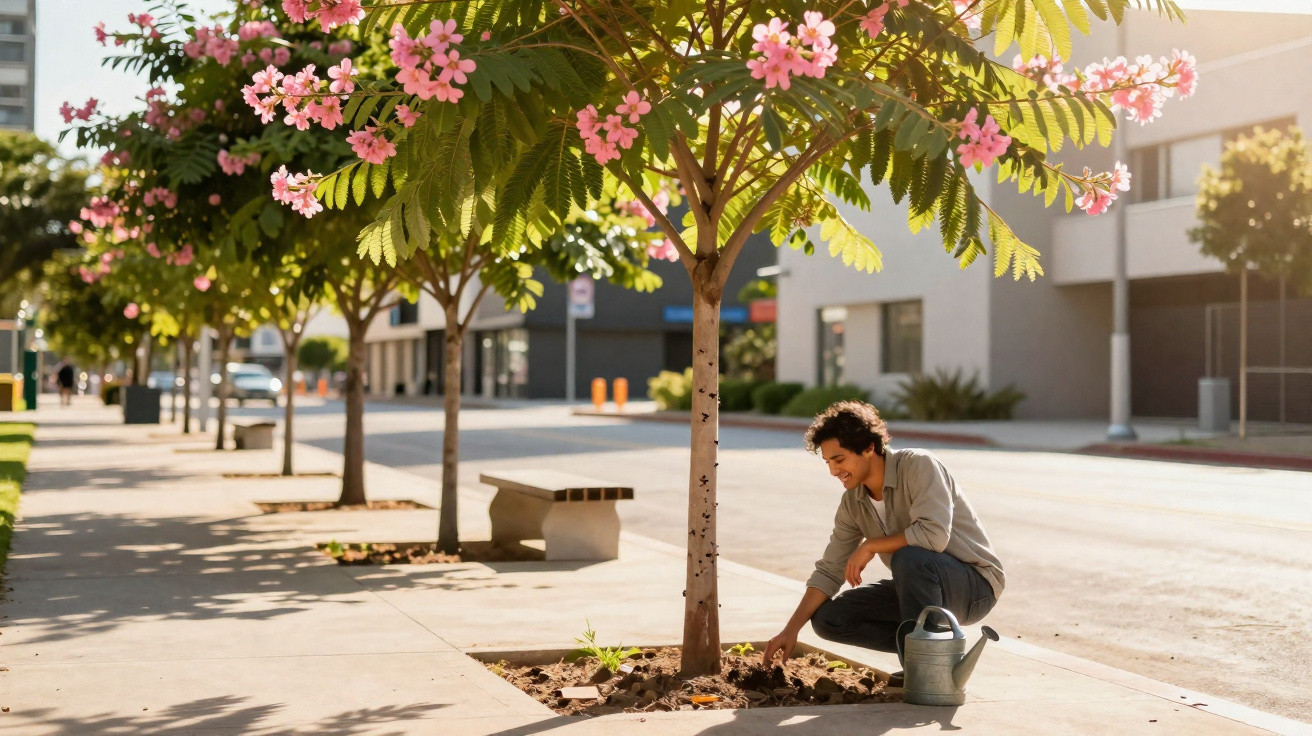
Among the most sought-after ornamental species, one in particular often tops the list for anyone wanting a fuss-free tree: the ant tree (Triplaris americana). Many landscape designers regard it as one of the strongest choices for urban settings and domestic gardens because it needs little upkeep, grows quickly, produces subtle blooms and can also support environmental restoration schemes.
Why is the ant tree considered low maintenance?
The ant tree earns its low-maintenance reputation thanks to how reliably it performs across a range of soil types and how little hands-on management it generally requires. With suitable light and good drainage, it typically thrives without regular pruning or heavy feeding, which helps keep long-term costs down.
In many situations, once it has established, care is largely limited to watering during extended dry spells and removing any dead branches. Because it copes well with nutrient-poor soils (provided they are not waterlogged), it is frequently planted on embankments and in environmental recovery areas, where it can help stabilise the ground while gradually providing shade.
How does the ant tree grow in urban areas?
Fast growth is one of the main reasons the ant tree is chosen for shading pavements, recreational spaces and housing developments. Given enough sunshine and moisture, it reaches a medium size within a few years, delivering shade and filling out the landscape quickly in newly built areas.
Its growth rate depends on rainfall patterns, soil condition and the amount of direct sun, which tends to encourage a straighter trunk and a denser crown. To make the most of this potential and reduce the risk of future issues, many planting plans follow a straightforward establishment and early-care routine:
- Prepare the planting hole with loosened soil and, where possible, well-rotted organic matter;
- Provide consistent watering for the first few months, especially in dry periods;
- Shield the young trunk from mechanical damage, such as strimmer cuts or knocks from equipment;
- Carry out light formative pruning in the early years to guide the structure.
How does the ant tree flower and what are the benefits?
The ant tree produces long, understated flower clusters that are most noticeable during its reproductive period. While its blooms are not as striking as those of some trumpet trees, flowering creates an appealing contrast against the deep green foliage, giving avenues and gardens a clear seasonal marker.
Beyond its ornamental role, the flowers supply nectar and pollen for bees and other insects, supporting biodiversity in both towns and the countryside. The resulting seeds can be used in reforestation initiatives and to enrich riparian woodland, making the species valuable for landscape projects as well as environmental work.
What are the main advantages of the ant tree in landscaping?
In landscaping, the ant tree brings together practicality, adaptability and ecological function. Its rapid development provides shade in a short time frame, and its modest maintenance needs mean fewer interventions along pavements, in squares and in leisure areas. Tolerance of moderate pollution and temperature fluctuations also makes it well suited to city centres.
When planning a planting site, it is advisable to allow adequate clearance from buildings, overhead cables and paved areas, as with any medium-sized tree. With correct placement and sensible management, the ant tree typically becomes a long-lasting feature, combining a hardy character with discreet flowering and environmental benefits that become more apparent over time.





Comments
No comments yet. Be the first to comment!
Leave a Comment