
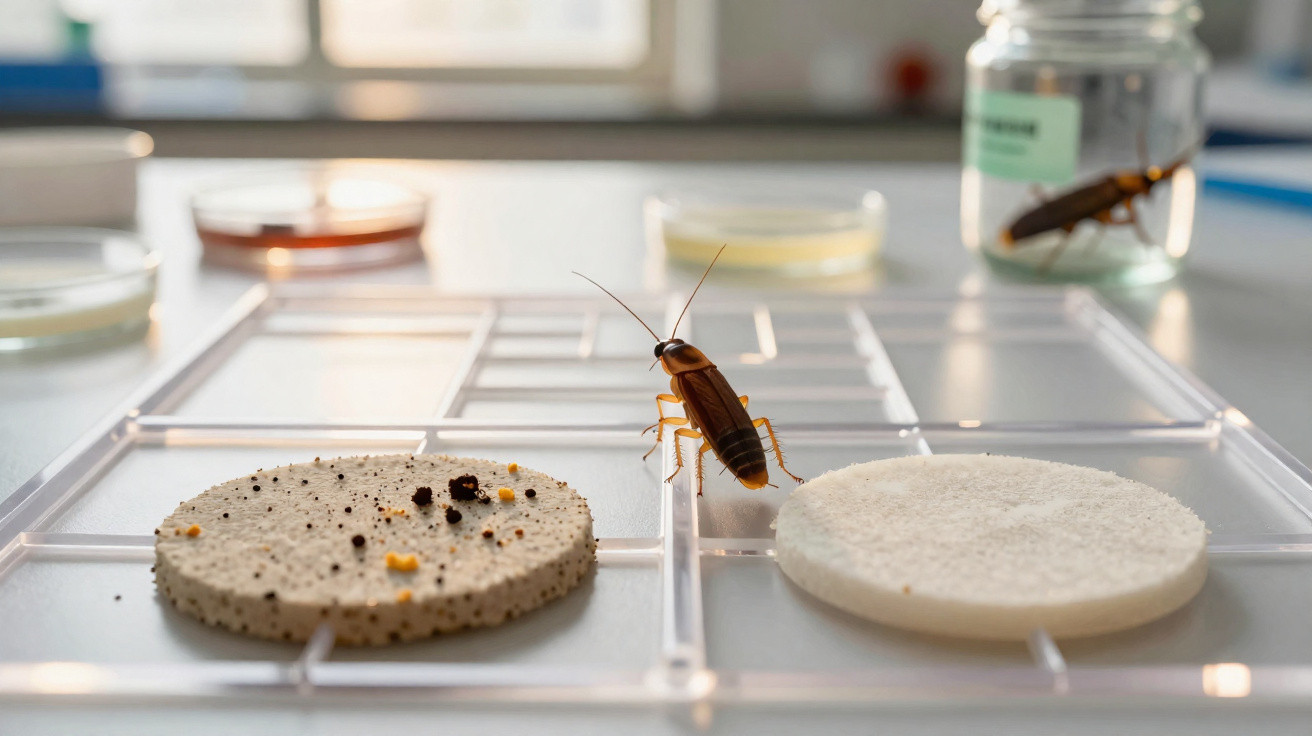
Cockroaches commonly cluster in dim hiding places with easy access to food, dampness and safety.
Fresh research suggests that newborn German cockroaches do not merely follow a general scent towards these gatherings.
Instead, they are able to learn the distinctive faecal odour of the colony in which they started life.
This early learning could help young cockroaches remain alongside familiar members of their group. It also points to a richer social existence than is usually attributed to this widespread domestic pest.
Faeces help young cockroaches flourish
German cockroaches emerge from their eggs with virtually no microbes in their digestive tracts. Collectively called the gut microbiome, these microbes make up a living community within the gut.
Soon after hatching, young cockroaches consume faeces deposited by older members of the group, a practice known as coprophagy. This initial food source provides nourishment and introduces bacteria capable of becoming established in the gut.
Faeces also give off chemicals that function as an aggregation pheromone: an odour signal that brings cockroaches together.
As diet and gut microbes can change these chemicals, individual groups may create distinct blends of scent.
Testing German cockroach colony odour preferences
Scientists at North Carolina State University reared newborn cockroaches in controlled settings.
They started with insects whose guts did not contain the usual microbes, then varied whether the cockroaches consumed faeces and the food they were given.
Certain groups received rodent, cat or rabbit food without first consuming faeces.
Other groups ate the same initial faeces before switching to one of those diets. A further group was given different faecal sources but later fed the same sterilised rodent food.
The cockroaches matured and produced their own faeces. Their offspring were then placed in choice experiments involving two small shelters, each containing either water or faecal odour from a specific group.
In general, newborns selected shelters carrying cockroach faecal odour rather than water. Their more precise preferences, however, were shaped by their experiences shortly after hatching.
Diet makes odours memorable
Newborn cockroaches that had never encountered faeces reacted to odours from each of the three diet groups.
They displayed a broad innate attraction to cockroach faecal scents, without preferring the odour of any one group.
After cockroaches ate faeces from a particular group, that response shifted. These newborns subsequently chose the corresponding odour, indicating that feeding may have enabled them to learn a colony-specific scent.
Food enables learning
To examine this explanation, the researchers separated odour from nourishment. Some newborns were given glucose, a simple sugar, alone; others were exposed to faecal odour without contact; and another group ate glucose while faecal odour filled the container.
Neither scent by itself nor glucose by itself produced a distinct preference, whereas the two together did.
The finding demonstrates associative learning, whereby an animal connects one signal to a beneficial reward.
For newborn cockroaches, one particular faecal scent gained significance when it was paired with food.
What German cockroaches eat is important
Diet strongly influenced odour preferences. Offspring preferred faecal odours from adults reared on the same parental diet rather than scents from adults raised on another diet.
When adults began with different faecal microbes but subsequently ate identical sterilised food, their offspring could not consistently distinguish between the groups. The common diet may have caused the eventual faecal odours to become more alike.
Food also influenced development. Cockroaches fed cat food generally matured more quickly, whereas those given rabbit food developed more slowly and reached adulthood at a smaller size.
Consuming faeces early in life did not remove the consequences of a low-quality diet.
In laboratory conditions, the gut microbiome likewise did not seem essential for the insects to become adults, although it could influence other elements of health and survival.
Cockroaches retain memories of their colony
“This finding could be used to help control cockroach infestations,” said Ayako Wada-Katsumata, lead author of the paper and a principal research scholar at North Carolina State University.
“What we’ve found is that aggregation pheromones are extremely important in how these cockroaches find each other and group together.”
Wada-Katsumata said that baby cockroaches obtain what they require from their group and therefore do not depart. This may reduce the effectiveness of traps and baits.
She added that an odour able to attract all German cockroaches might improve trap performance in homes, hospitals and restaurants.
German cockroach social behaviour may run deeper
“We think of cockroaches as being subsocial, in that they are not completely solitary but also do not exhibit the kinds of group behaviors that bees or ants do,” said Coby Schal, co-author of the paper.
“The use of fecal aggregation pheromones to recognize their natal group mirrors the behavior of social insects like bees, wasps, ants, and termites. Those insects typically use body odors instead of fecal odors to recognize nest-mates.”
Schal said that both types of insect learn and retain the scent of their colony, although the smells originate from different sources.
Remembering where they belong
“What we’re seeing here is a capacity for learning and memory retention that is often thought of as being above an insect as the cockroach,” said Coby Schal.
“Cockroaches have evolved their own twist on forming kin bonds.”
The newborn insects seem capable of retaining an odour memory from early life and applying it later when deciding where to gather.
What researchers will investigate next
The experiments assessed behaviour rather than the particular bacteria or airborne chemicals behind each odour, meaning the team cannot yet identify the signals involved.
They also did not evaluate a new trap or bait, so the suggested pest-control use remains an objective for future work.
The study relied on a long-established laboratory colony and small testing arenas. Wild populations may face a wider range of foods, chemicals, shelters and competing scents.
Despite these limitations, the results show that newborn German cockroaches combine a natural attraction with odour preferences acquired through learning.
Their earliest meals may influence both the microbes living in their bodies and the social group near which they choose to stay.

Comments
No comments yet. Be the first to comment!
Leave a Comment