
A simple, little-known trick can keep the blooms going for noticeably longer.
Anyone with a Phalaenopsis or another indoor orchid on the windowsill will recognise the pattern: months pass with nothing but green leaves, the flower spike has long since dried out, and the plant appears to be on a permanent holiday. Yet a few carefully chosen measures can significantly improve the flowering performance of these sensitive beauties – without costly specialist equipment.
Why orchids often stop flowering
Orchids have a reputation for being the divas of houseplants. In fact, they simply respond very consistently to care mistakes. In the wild, many species grow as epiphytes on trees, clinging to bark, where they receive:
- very few nutrients
- brief but regular bursts of water
- high humidity rather than waterlogged roots
- slight temperature changes between day and night
On a windowsill, the opposite usually happens: the plant sits in dense compost, is watered constantly and fed generously. This causes stress. Its leaves may still look perfectly respectable, but it will rarely produce flower spikes.
“Anyone who treats orchids like indoor geraniums will almost inevitably end up with green plants that are reluctant to flower.”
Fertilising orchids properly: less is more
The Royal Horticultural Society has pointed out for years that orchids need surprisingly few nutrients. Too much fertiliser causes more harm than good. Salts build up in the potting medium and can literally burn the delicate roots.
Gentle feeding instead of a nutrient shock
Rather than pouring a full dose of liquid fertiliser into the watering water every few weeks, a light and regular feed works far better. In practical terms, this means:
- dilute orchid fertiliser heavily, ideally to just one quarter of the manufacturer's stated dose
- feed every two to three weeks during the growing period from spring to autumn
- reduce feeding considerably in winter, or take a break altogether
Many amateur gardeners also use household remedies. Strongly diluted milk, for example, is popular. A small splash in plenty of water provides calcium and protein compounds which may support growth. Orchid enthusiasts' associations regularly mention such approaches as a gentle addition to conventional fertilising.
“A well-fed orchid does not show it through enormous leaves, but through strong, firm roots and new flower buds.”
The ideal watering trick: a short soak instead of constant watering
How you water is at least as important as fertiliser. Orchids do not like permanently wet pots. Their roots need air – otherwise they rot.
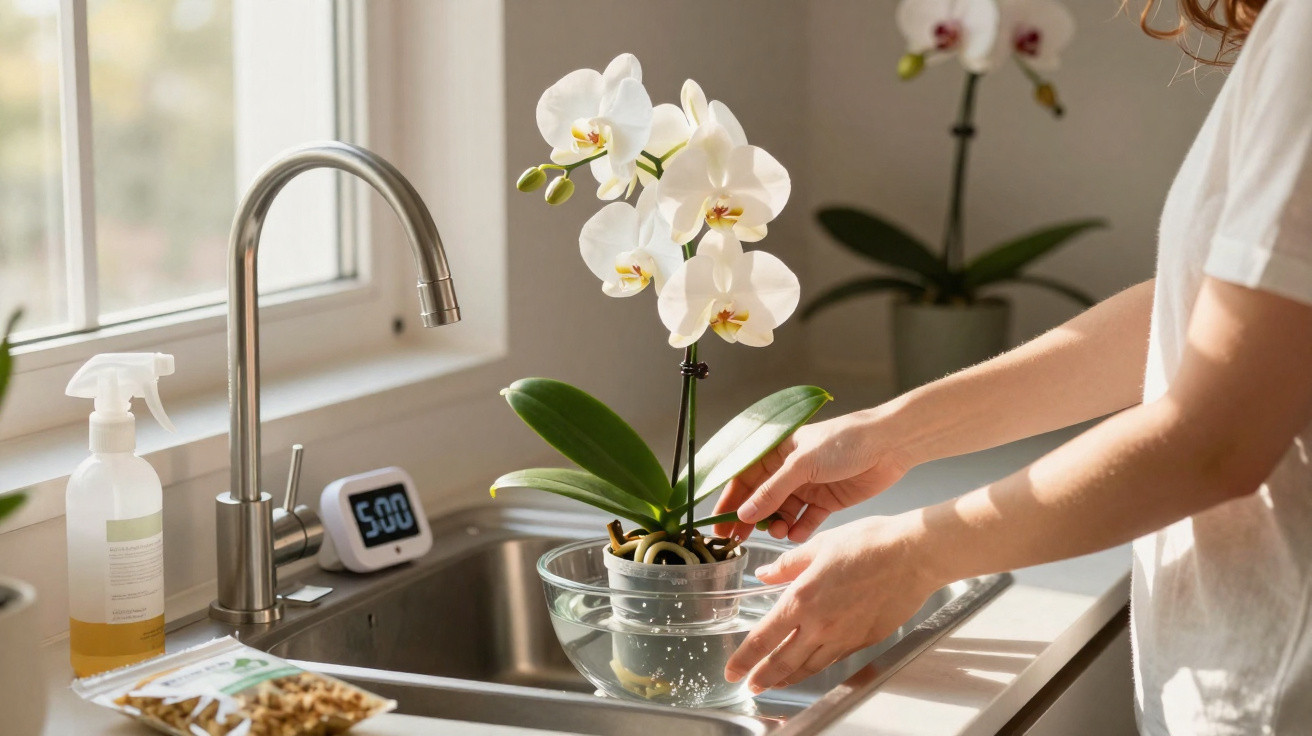
How the 5-minute soak works
Many successful orchid growers swear by this straightforward method:
- Remove the transparent growing pot from the outer pot.
- Fill a bowl or the kitchen sink with lukewarm water.
- Place the pot inside so that all roots are submerged.
- Wait around five minutes until the roots have absorbed enough water.
- Let the pot drain thoroughly before returning it to the outer pot.
This brief soak imitates a warm tropical rain shower. The plant absorbs precisely as much water as it needs. Excess moisture drains away again rather than remaining in the potting medium.
Many owners report that switching from “a splash from the watering can” to regular soaking alone has encouraged new flower spikes – particularly when fertilising was reduced at the same time.
The surprising dark-period method for new orchid flower spikes
Sometimes even perfect care has no effect and an orchid stubbornly remains green. Some experienced plant enthusiasts then turn to a trick that sounds paradoxical at first: they give the plant a spell in the shade.
Recreating a resting period from nature
Many orchid species experience a type of dormant period in their native habitats. During this time, they slow down before developing new flowers. This stimulus can be recreated at home:
- move the plant to a noticeably darker location
- leave it there for two to three weeks, depending on the species
- keep the temperature as steady as possible
- continue watering sparingly and never allow water to sit in the pot
Some owners even use a dimly lit hallway or place an opaque paper bag over the plant, allowing only a little air to circulate. The crucial points are:
- air must be able to move, otherwise mould may develop
- avoid extreme temperature fluctuations
- the potting medium may be slightly moist, but must never be soaking wet
“After two to three weeks in partial darkness, a healthy orchid will often surprise you with a new flower spike once it is returned to the light.”
What everyday care for a “continuous-flowering” orchid can look like
Anyone who finds their plant's natural rhythm can achieve a great deal with a fairly simple care routine. Here is one possible weekly schedule for a common Phalaenopsis on a warm windowsill:
| Day | Care |
|---|---|
| Monday | 5-minute soak, then allow to drain thoroughly |
| Wednesday | Remove dust from the leaves with a soft cloth |
| Friday | Lightly mist the aerial roots; do not allow water to collect in the centre of the leaves |
| Every 2–3 weeks | Add lightly diluted orchid fertiliser to the soaking water |
| If there has been no flowering for > 9 months | Try a two-week dark period, then return the plant to a bright position |
Those who broadly follow this plan while observing their plants will soon notice which stimuli their own orchid seems to appreciate most.
Common mistakes that can cost every orchid bloom
The same problems occur time and again in homes with orchids. It is worth taking a quick look at the usual culprits:
- Roots that are too wet: constant watering without drainage leads to rot.
- Ordinary potting compost: it is too dense and heavy, so the roots suffocate.
- Full midday sun: leaves scorch and buds dry out.
- Constant central-heating air: extremely dry air weakens the plant and flowers drop off.
- Fertiliser by guesswork: occasional high doses put the root system under stress.
Avoiding these pitfalls is already half the battle. The other half is patience. Orchids do not respond overnight. It can take weeks before a new flower spike becomes visible.
Why the dark period really works
The dark-period trick may sound like mysticism, but it follows an understandable principle. Orchids detect the amount of light, temperature and water supply. When these factors change significantly, the plant receives a signal that a new phase of the year has begun. Many species use precisely these stimuli to prepare flowers for the coming season.
Artificial shade tells the plant that the quiet period has arrived and that light will return afterwards. Once the orchid is placed back in a bright spot, it often begins the next cycle with renewed energy – producing flower spikes in order to reproduce.
Learning to read your own orchid properly
Over time, many owners develop a good instinct for their plants. A few signals can help with assessment:
- silvery-grey roots: thirsty, time for a soak
- deep-green, firm roots: water supply is right
- yellow, mushy roots: too wet, with a risk of rot
- very dark, soft leaves: insufficient light
- pale leaves with a slight reddish tint: probably close to the plant's light tolerance limit
Anyone who pays attention to these details can make fine adjustments to care and positioning. These small changes are ultimately what bring the spectacular flowers that lead so many people to buy orchids in the first place.


Comments
No comments yet. Be the first to comment!
Leave a Comment