
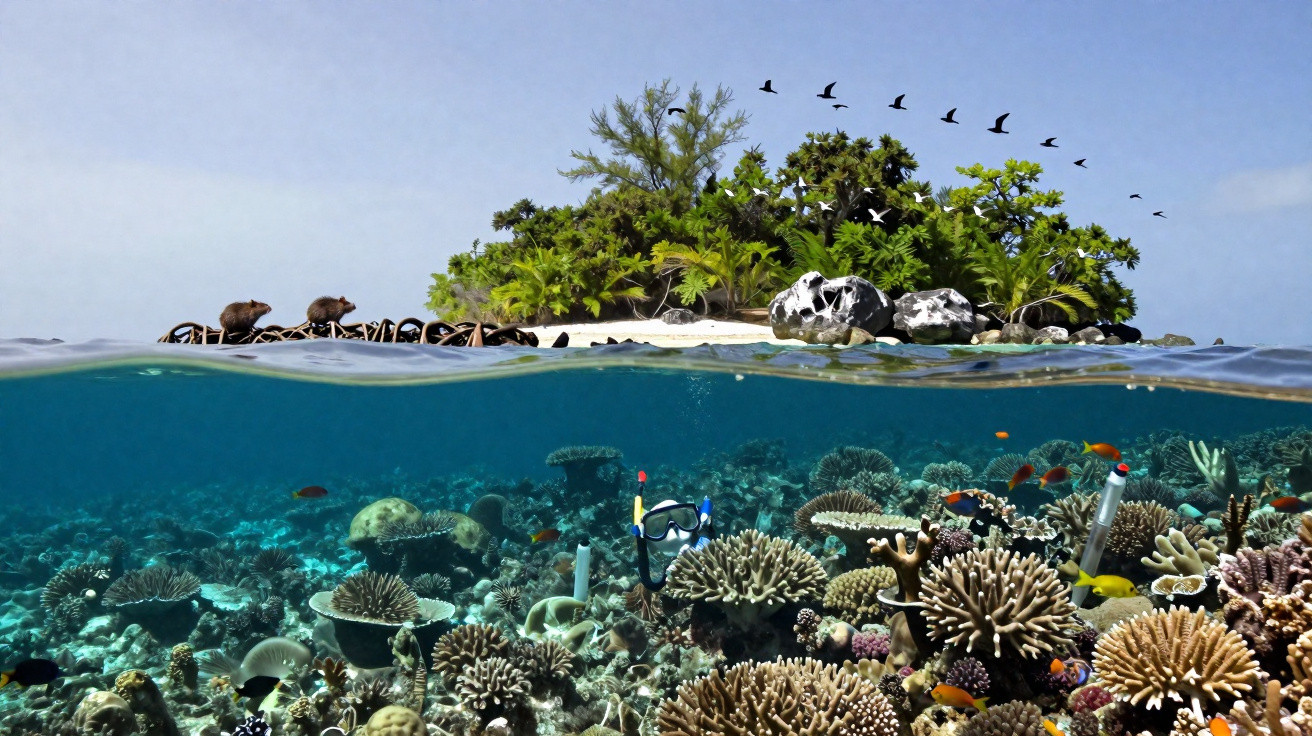
Rats can arrive on tropical islands as stowaways, after which the birds that once nested there begin to vanish. It would be logical to assume that nearby marine ecosystems also suffer, because fewer birds means less fertiliser being washed into the ocean.
That assumption, however, is only partly correct.
Researchers led by Laura-Li Jeannot, a Ph.D. researcher at Lancaster University, examined coral reefs in the Chagos Archipelago, a remote island chain in the Indian Ocean.
They compared reefs bordering islands free of rats with those next to rat-infested islands. The minute creatures inhabiting the reef floor responded in differing ways according to whether rats were present on the neighbouring land.
Rats reshape coral reefs, not just seabirds
Rat-free islands can support seabird colonies vastly larger than those on islands where rats are established. The researchers found that seabird density was 760 times higher on islands without rats.
Rats cut seabird populations by consuming eggs, chicks and, on occasion, adult birds.
Seabirds forage far offshore before returning to land to nest. Their droppings, known as guano, run off the islands and fertilise the reefs below. When the birds disappear, so does this supply of fertiliser.
Jeannot’s team set out to discover how nutrient-deprived reefs affect the small, often overlooked animals at their foundation, collectively called cryptofauna. The researchers did not expect every member of this group to respond alike, and they did not.
“Contrary to our expectations, the low-nutrient conditions that rats create do not negatively affect all reef organisms,” said Jeannot. “Nutrient-loss impacts are not uniform. There are winners and losers.”
Seabirds help determine which reef animals thrive
On reefs beside rat-free islands, small bottom-dwelling fish including gobies and triplefins had more than five times the biomass of the small invertebrates occupying the same habitat.
The team’s findings indicate that cryptobenthic fish biomass was approximately twice as high on these nutrient-rich reefs, while productivity among the larger fish-eating predators that consume them increased by around tenfold.
This benefit appears to stem from the rapid rate at which these tiny fish grow and reproduce.
Such a pace requires a consistent nutrient supply, which a reef fertilised by seabirds can offer but one depleted by rats cannot.
Removing rats could restore coral reefs
Reefs close to rat-infested islands showed another pattern. The biomass of cryptobenthic fish and small invertebrates, including coral crabs, porcelain crabs and snapping shrimp, became almost equal.
Jeannot explains that, once nutrients become scarce, the fish’s own success turns against them. Populations of fast-growing fish spread into habitat otherwise available to invertebrates, while also competing with them for food.
“Beyond chasing invertebrates away from their homes, they also outcompete them for food,” said Jeannot. “Our results show that cryptobenthic fish, when more abundant, likely drive invertebrates to seek alternate, less preferred resources.”
Without the fish’s advantage, invertebrates can close the gap. Because their metabolic demands are lower, they can remain on nutrient-poor reefs where rapidly growing fish find survival more difficult.
Predators respond to prey shifts
The effects extended beyond the reef floor. Cryptobenthic fish are thought to account for as much as 60% of the total biomass consumed on coral reefs, meaning a change in the animals that dominate has consequences further up the food web.
Near islands rich in seabirds, mixed carnivorous fish depended more on cryptobenthic fish as food, and fish-eating predators prospered alongside them. In the same areas, fish that feed on invertebrates performed slightly less well.
The data suggest roughly 18% lower biomass and 12% lower productivity in these fish, which the researchers characterise as a moderate effect rather than a dramatic one.
Simon Brandl, an assistant professor at the University of Texas and co-investigator on the study, says fish are the more nutritious prey.
“Cryptobenthic fish are a nutrient-dense, protein-packed, highly digestible resource for predators. On the other hand, much of invertebrates’ mass is represented by a tough outer shell,” said Brandl.
“In nutrient-rich environments, fish are also far more abundant than invertebrates, meaning predators likely spend less time foraging. As a result, they represent a more energetically efficient prey source near seabird islands for predators looking for a quick snack.”
Invasive rats reshape coral reefs
The research compares reefs as they currently exist, rather than testing them in a controlled experiment. Although the differences correspond with the presence or absence of rats, the study alone cannot establish that rats caused every change.
Previous work by the same research group has documented the nutrient connection between seabirds and reefs for several years.
Cryptofauna sit at one of the lowest stages of the reef food chain and provide food for almost everything above them. Consequently, changes in their abundance also affect the predators that rely on them.
The researchers say that safeguarding the seabirds that continue to nest on rat-free islands offers a direct means of protecting the small creatures below the waterline and the food webs dependent on them.
The complete study was published in the journal Ecology.




Comments
No comments yet. Be the first to comment!
Leave a Comment