
Many amateur gardeners blame the cold in spring when nothing germinates in the bed.
In reality, the harvest often fails because of just a few millimetres.
The seed packets are ready, the sun is appearing more often, and you are already picturing crisp carrots from your own vegetable bed. But then, weeks later, the soil is still bare where a dense green row ought to be. Not a single seed leaf in sight. The disappointment is considerable, and the mystery seems equally great – yet many of these failures can be traced back to one simple but crucial detail: precise sowing depth.
Why carrots so often “vanish without a trace” in the home garden
Carrots are a vegetable-garden staple, but they can also be rather temperamental. Many gardeners know the pattern: a few seedlings here and there, bare patches in between, and sometimes whole metres without one carrot. It is easy to question the seed quality, unpredictable weather or even “moon-phase rules”.
Usually, however, the real issue lies elsewhere: in the biology of the seed. Carrot seeds are tiny and light, with very limited nutrient reserves. Those reserves must be enough for germination, root formation and pushing the first delicate shoot up to the surface. If the journey is too long, the seed simply runs out of energy.
Carrot seeds have extremely little “fuel”. Every unnecessary millimetre of soil above them is like adding another weight to an already weak arm.
So many beds do not fail because of the weather at all, but because the seed has effectively been “buried” – placed too deeply in overly heavy soil, then covered with material that is too coarse.
The carrot’s true enemy: not frost, but the wrong conditions
In late winter and early spring, it is tempting to blame everything on frost. The soil is certainly still cool and can be wet and heavy. Yet early carrot varieties can cope with relatively low temperatures when grown beneath horticultural fleece, in a polytunnel or in a raised bed.
What matters far more is what happens immediately around the seed. Heavy, cloddy or compacted soil becomes a concrete block for the fragile emerging plant. The first root meets resistance, the shoot cannot break through the surface crust, and it dies unnoticed below ground.
Creating an overly deep drill quickly with a finger, hoe or spade also drastically reduces a carrot’s chances. The seedling uses all its energy trying to push the soil upwards. If that energy is insufficient, it simply remains trapped in the darkness.
The golden rule for carrot beds: no more than one centimetre
Professional vegetable growers agree that depth is the key factor in successful carrot sowing. The rule sounds straightforward, but it is regularly ignored in everyday gardening.
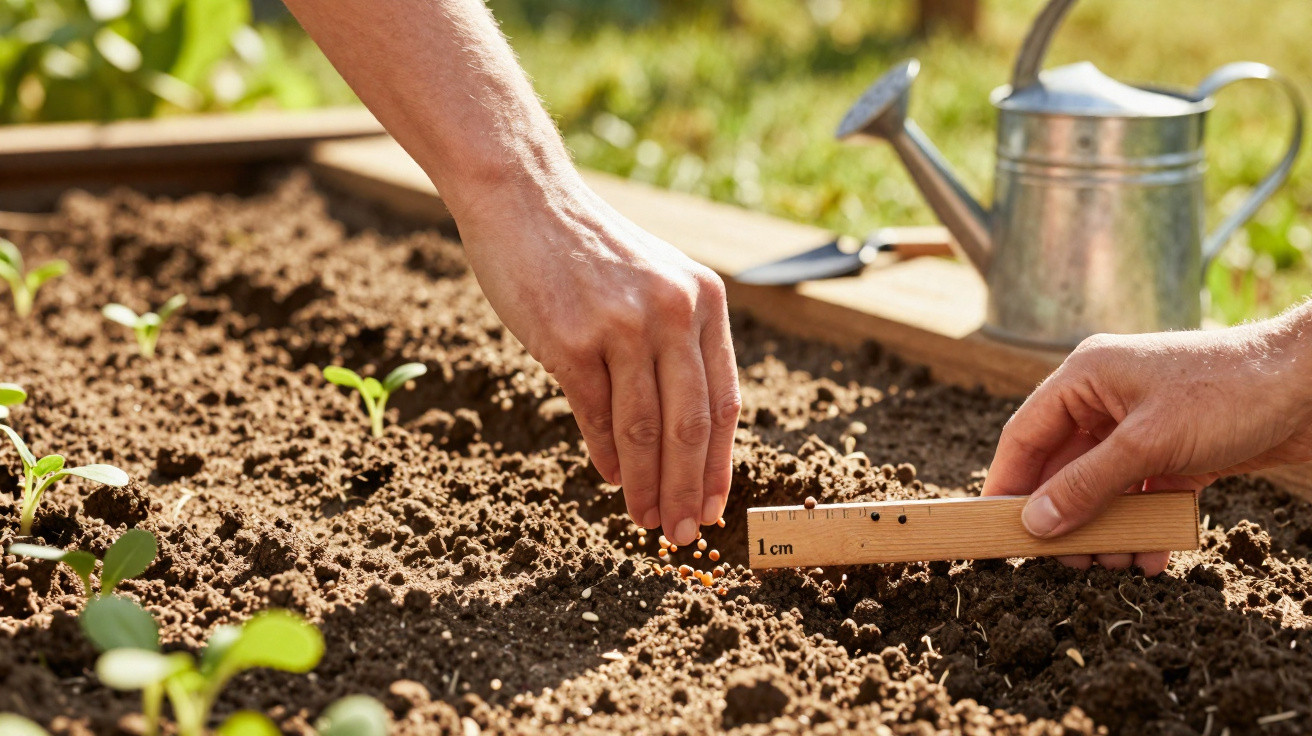
Always sow carrots only 0.5 to a maximum of 1 centimetre deep – never deeper. Every extra millimetre costs seedlings.
What does this mean in practice?
- Make only a shallow drill: Use a handle, a small board or the edge of a hand trowel to create a very shallow groove.
- Scatter seeds thinly: Do not pour them in heavily; let them fall evenly so that the plants do not all grow on top of one another later.
- Watch the depth: Once covered, the seed should sit no more than one centimetre beneath the surface; around 5 to 8 millimetres is ideal.
When seed is deeper than this, the delicate plant often cannot reach the air, even though germination itself has taken place. To the gardener, it then appears that nothing has happened, although the failure has already been decided invisibly.
Cover lightly rather than burying: why sand and fine soil work wonders
The material used to cover the seeds is at least as important as their depth. Heavy clay soil and large clumps are disastrous for carrots. Especially during damp periods, a hard surface can quickly form, drying into a crust that cracks.
A better approach is not to cover the seed with ordinary garden soil, but to use a much finer, looser material instead.
A thin layer of fine soil or sand is ideal – it protects without smothering the seed and allows the seedling to pass through easily.
A practical method for the bed:
- Draw a drill in prepared soil that is as fine and crumbly as possible.
- Sow the carrot seeds.
- Sieve fine compost or seed compost over them, or use a thin layer of washed sand.
- Build up the covering so that there is no more than one centimetre of material above the seed in total.
Sand offers another useful benefit: the seed rows are easier to spot later. Weeding becomes simpler because you can clearly see where the carrots should emerge and where unwanted seedlings can be removed.
Gentle watering rather than a downpour from the watering can
Even perfect soil and the right depth achieve little if the water flow destroys the work again. Coarse watering-can roses or a stream from a hose can disturb the seeds, wash them sideways or force them much deeper into the soil.
For carrot sowing, therefore:
- Use only gentle “rain” watering: Choose a fine watering-can rose, preferably held upwards so the water falls as a soft shower.
- An alternative for small areas: Use a spray bottle or a very fine hand sprayer.
- Keep the surface consistently moist: The top layer must not dry out until seedlings are visible.
Depending on soil temperature, this can take two to four weeks. During that period, patience is needed – along with a careful eye to ensure the surface never dries out completely, while also avoiding permanently waterlogged conditions.
What the centimetre rule means for other vegetables
Anyone who becomes used to strict centimetre discipline with carrots will benefit when sowing other crops too. Many fine seeds suffer from the same issues: being sown too deeply and covered too heavily. Typical examples include:
- Radishes
- Leaf lettuces and cut-and-come-again lettuce
- Lamb’s lettuce
- Dill, chives and other fine seeds
The same principle applies here: the smaller the seed, the shallower it should be sown. As a rough guide, place seeds no deeper than their own thickness – which for carrots means the well-known half to a maximum of one centimetre, and no more.
How to prepare soil ideally for carrots
For the millimetre rule to work, the soil must have the right structure. Carrots prefer loose, stone-free soil without large clumps. Anyone gardening on heavy clay soil should take action in good time:
- Loosen the soil deeply and remove stones and root debris.
- Improve the structure with sand and well-rotted compost.
- Allow the bed to settle for a few days before sowing, so it does not sink significantly straight after the seeds are planted.
In containers or raised beds, a special blend of garden soil, compost and sand is worthwhile. This creates an evenly loose growing medium in which the roots can later grow straight downwards, rather than branching or becoming bent.
Common mistakes – and easy ways to avoid them
| Mistake | Consequence | Better solution |
|---|---|---|
| Sowing too deeply | Seedlings die below the surface | Maximum 1 cm, ideally 0.5–0.8 cm |
| Heavy, cloddy soil | The seedling cannot break through the crust | Use fine soil or sand as a covering |
| Harsh watering | Seeds are displaced or washed away | Use a fine rose and gentle “rain” from above |
| Uneven moisture | Germination stops and seeds dry out | Keep the surface constantly lightly moist |
Why now is the ideal time to rethink your approach
Starting carrots early in the year means beds can be used again in summer or harvested for longer. More importantly, spring attempts reveal without mercy whether the technique is right. A failed sowing in February or March can easily be repeated in April – with an adjusted depth, better bed preparation and gentler watering.
The real message behind the “one-centimetre rule” is therefore less of a rigid law than an attitude: move away from rough, guesswork sowing and towards conscious, precise work on a small scale. Putting a little more care into depth prevents later disappointment, resowing and gaps in the bed.
This millimetre-focused approach pays off especially with crops that are staple vegetables for many households – carrots, radishes and lettuces. An evenly established crop is easier to care for, stays healthier and ultimately produces a greater yield from the same area. All because of one detail that can be checked with a glance and a finger’s breadth of soil.


Comments
No comments yet. Be the first to comment!
Leave a Comment