
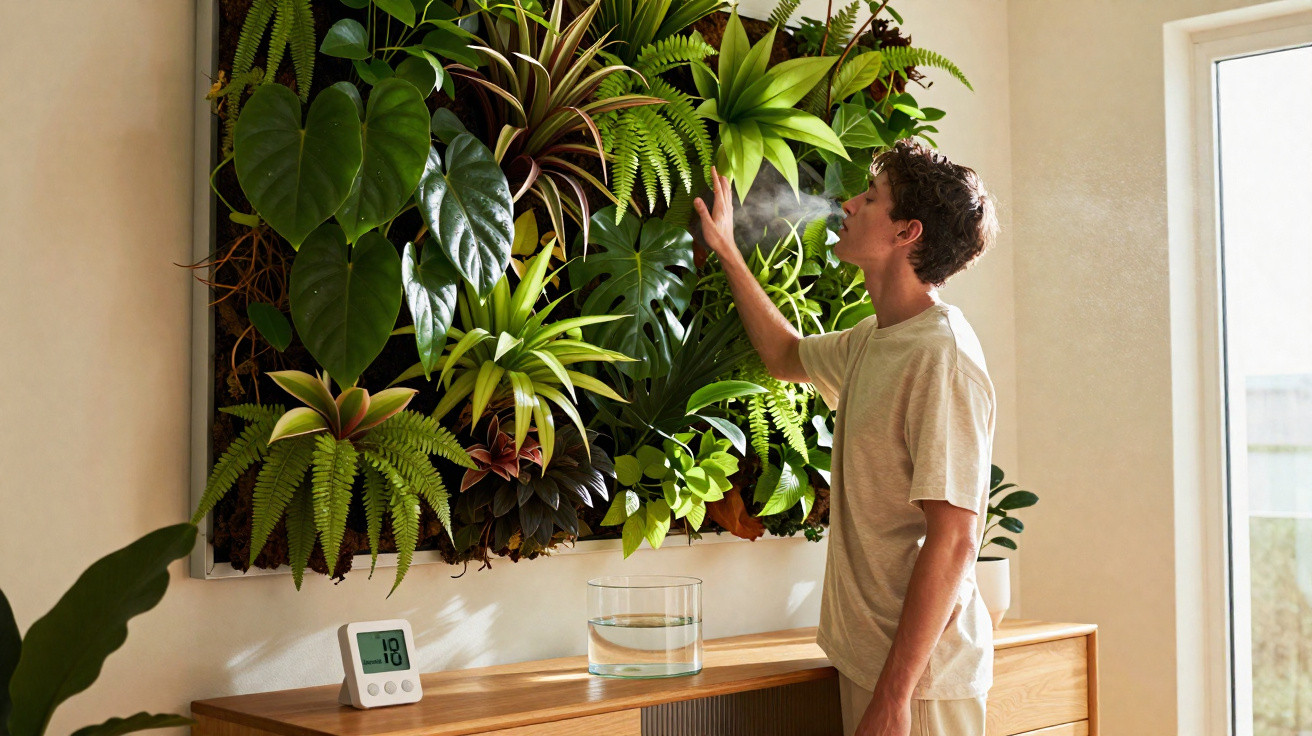
An experiment has now demonstrated just how strongly plant walls can alter the air indoors.
When people think about air pollution, they usually picture traffic-choked roads, factory chimneys or city smog. Yet a substantial share of the exposure actually builds up in living rooms, offices and classrooms. A research team in Seville has tested, under controlled conditions, how effectively planted interior walls can curb this invisible risk. The findings are strikingly clear - and could meaningfully influence how buildings are designed.
When your home makes you ill
Paints, varnishes, chipboard, carpets, air fresheners, cleaning products, wood-burning stoves, cigarette smoke - even cooking fumes: all of these can release substances we then breathe in. They are often odourless, but that does not make them safe. In enclosed spaces, many people report headaches, fatigue, irritated eyes or difficulty concentrating. Specialists group such complaints under the term “sick building syndrome” - the building that makes you unwell.
One group of triggers are so-called volatile organic compounds, or VOC (from the English “volatile organic compounds”). Formaldehyde is a well-known example: it is present in many engineered wood products and is regarded as carcinogenic. Added to that are gaseous pollutants such as nitrogen dioxide from combustion processes, or sulphur dioxide. Opening windows helps, but in tightly insulated homes it is often not enough.
Researchers test plant walls in a glass chamber
This is exactly where the Seville scientists’ approach begins. They set up a sealed glass habitat, fitted one wall with a vertical planting system, and then deliberately exposed the chamber to different air pollutants. Their aim was to quantify how quickly - and how much - a plant-wall configuration can reduce the concentration of these substances.
They used problem gases commonly associated with indoor air: nitrogen dioxide, sulphur dioxide, and several VOC including formaldehyde and acetone. The researchers introduced defined amounts into the air inside the test chamber, then tracked the readings over 24 hours.
"After one day, between 96 and 98 percent of the pollutants introduced had disappeared - solely due to the plant-covered wall."
Even the team involved did not expect an effect of this magnitude. In practical terms, after 24 hours only a small fraction of the original load remained. In indoor environments where people spend many hours every day, that could make a substantial difference.
The turbo effect: a clear drop after just 15 minutes
What matters is not only the end point, but also the pace of change. Measurements showed that just a quarter of an hour after the pollutants were added, concentrations had already fallen by roughly a quarter to almost half.
- after 15 minutes: down 24 to 40 percent
- after 1 hour: depending on the plant, in some cases an even stronger reduction
- after 24 hours: 96 to 98 percent fewer pollutants
In day-to-day terms, these systems are not merely a slow, long-range measure. They can also improve air quality relatively quickly during normal use - for instance after cooking, or over the course of a working day in an open-plan office.
Which plants remove the most from the air?
The researchers did not rely on a random assortment. Instead, they examined five specific species commonly sold as houseplants:
- Spathiphyllum wallisii (often sold as the peace lily)
- Tradescantia zebrina
- Philodendron scandens
- Ficus pumila
- Chlorophytum comosum (spider plant)
They observed clear differences in performance. Some species captured certain pollutants far more effectively than others. The peace lily, for example, proved particularly strong against nitrogen dioxide.
"The peace lily lowered the nitrogen dioxide concentration by around 60 percent within an hour."
For formaldehyde, other plants delivered the strongest results: here the spider plant stood out, reducing the hazardous substance especially quickly. That is what makes the approach so compelling: the most effective plant wall is not built around a single favourite plant, but around a deliberate mix tailored to the typical pollutants in a given room.
Why plants can do this at all
Plants absorb gases through their leaves and, to some extent, via their roots. Many pollutants are transformed inside the plant or converted into less problematic compounds. At the same time, the soil or substrate layer behind the green wall appears to be crucial: microorganisms there break down chemical compounds that have previously accumulated around root surfaces.
The larger the leaf area and the denser the greenery, the greater the contact surface with the room air. Vertical systems exploit this to the full: a wall provides far more active area than a handful of pots on a windowsill.
Not a miracle cure, but a powerful add-on to technology
Despite the strong figures, the study authors caution against unrealistic expectations. A plant wall does not replace a functioning ventilation system, an adequate supply of fresh air, or filtration in heavily contaminated settings. Instead, it works as a natural supplement that runs continuously without anyone needing to switch anything on.
Such systems can be particularly useful in:
- open-plan offices and call centres with many people
- schools and nurseries where children spend long periods indoors
- flats with limited ventilation options (for example on noisy roads)
- waiting areas in surgeries or public buildings
Alongside measurable pollutant removal, indoor greenery can offer visual and psychological benefits: many people find plant-filled rooms more pleasant, which can reduce stress and improve attention. In learning and work environments, that added value should not be underestimated.
How a plant wall can be put into practice
Creating a plant wall at home does not necessarily require an expensive specialist installation. There are modular systems with integrated irrigation, as well as simpler options using planting pockets or shelving. Key factors include:
- enough plants within as small a footprint as possible
- a substrate that gives roots and microorganisms sufficient space
- a combination of species with different “specialisms”
- regular care so the plants remain healthy
If you are especially concerned about pollutants such as formaldehyde, it makes sense to lean more heavily on established “air cleaners” such as the spider plant, ivy species, or certain philodendrons. For nitrogen dioxide and other combustion-related gases, the peace lily or trailing species can be a worthwhile addition.
What the study doesn’t show – and what still matters
The Seville experiment was carried out under laboratory conditions in a sealed glass chamber. In real life, new polluted air is constantly introduced, doors open, and people move around. That means the measured percentages cannot be transferred one-to-one to every home.
Even so, the study sends a strong signal: planted interior walls are not merely decorative, but a practical tool for reducing air pollutants. When combined with modern ventilation and more mindful choices about emission-heavy products (fewer solvents, low-emission furniture, avoiding strong air fresheners), they form a set of measures that can noticeably improve indoor air.
This opens up interesting options for architects, building-services engineers and employers. Rather than relying only on more filters and sensors, living elements can be built directly into space planning. Investing early may reduce the need to deal with symptoms later - and people, after all, spend most of their day indoors.
In the longer term, further studies could clarify how different plant combinations perform in real offices, schools or homes. The better we understand which species binds which substances particularly well, the more precisely green walls can be specified. One thing is already evident: indoor greening is far more than an interior-design trend - it tackles a serious health issue at its source.




Comments
No comments yet. Be the first to comment!
Leave a Comment