
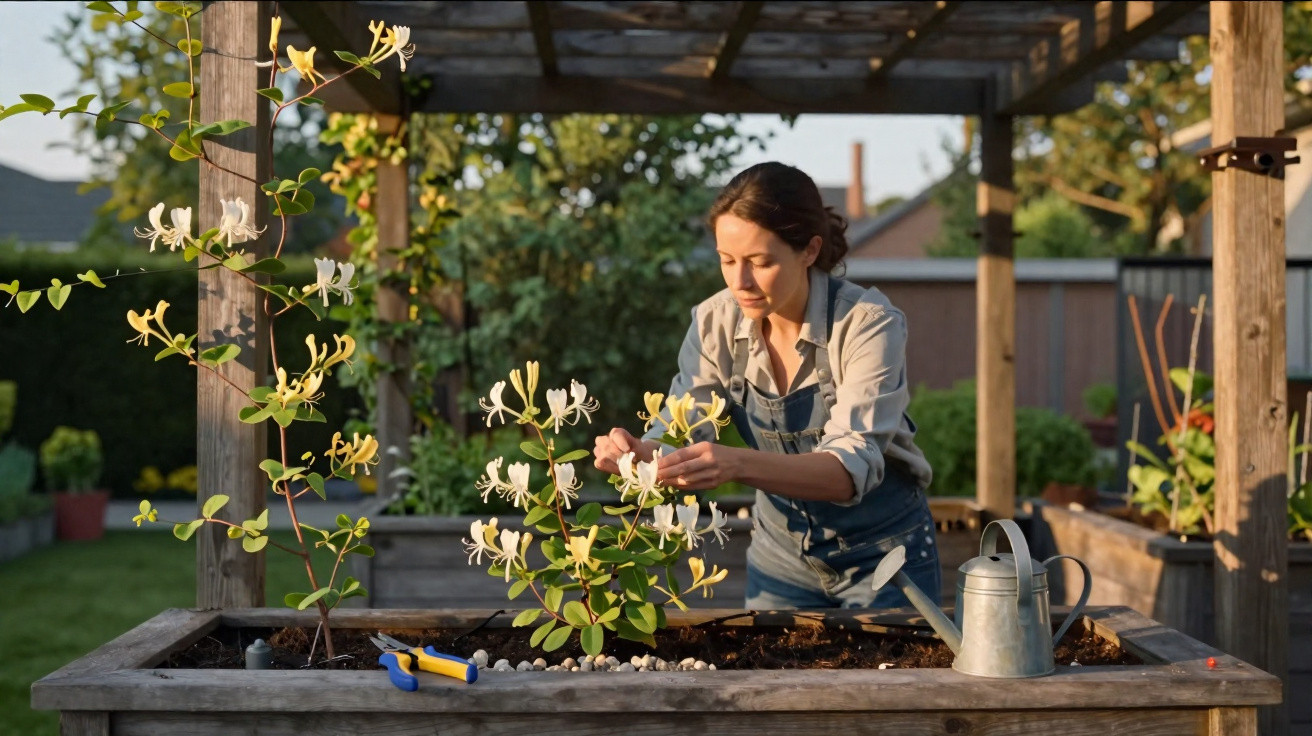
Japanese honeysuckle can turn pergolas and trellises into a curtain of white flowers that gradually mellow to a creamy yellow, all while releasing a sweet, lingering scent. In a deep planter, this climber has room to establish its roots and can form an aromatic cover, provided it has support and is kept in check with regular pruning.
Why does honeysuckle scent a pergola so strongly?
Lonicera japonica grows vigorously and can extend its shoots quickly, covering garden structures in a short time. Its tubular flowers open pale and then shift in colour, and the fragrance is usually most noticeable at dusk and on mild evenings.
That fast, forceful growth needs forethought, because the plant can push onto roofs, gutters, trees and neighbouring plants. When grown in planters, frequent pruning helps keep the size appropriate, encourages fresh growth and supports the structure of the pergola.
Key characteristics include:
- Flowers: start white and become yellowish as they mature.
- Fragrance: becomes especially pronounced towards evening.
- Shoots: grow quickly and need training.
- Planter: should be deep, sturdy and free-draining.
- Pruning: limits bulk and protects the pergola.
What is Lonicera japonica and why does it need controlling?
Lonicera japonica is an Asian climbing plant in the Caprifoliaceae family. It can reach several metres in length and produces flowers ranging from white to yellow. It is valued as an ornamental plant, provides nectar, and can behave as an invasive species in various regions, including Brazil.
Because it grows so strongly, it should be monitored so it does not escape the planter and spread into natural areas or adjoining gardens. Removing fruit and excess growth helps limit dispersal, while training it neatly along the trellis keeps everything more organised.
How to grow Japanese honeysuckle in a deep planter
Use a deep, durable planter with clear drainage holes, and fill it with a fertile, well-draining compost mix. Set the plant close to a robust trellis, leaving room for air circulation and for the roots to develop without waterlogging.
Deep roots and well-trained shoots
Drainage prevents root problems
Keep the drainage holes unblocked and choose a mix that holds some moisture but does not stay saturated.
As the plant establishes, tie new shoots gently to the trellis.
Japanese honeysuckle does best in full sun or bright partial shade, with regular watering whenever the compost surface begins to dry. Water should reach the root ball, but any excess must drain away, reducing the risk of rot, fungal issues and loss of vigour.
Basic care includes:
- choosing a deep planter with drainage holes kept clear;
- filling it with fertile, light compost rich in organic matter;
- placing it in full sun or bright partial shade;
- watering regularly without letting water pool in the container;
- fitting a sturdy trellis to guide new growth.
How to encourage flowers and control growth
The nectar-rich, scented flowers can attract hummingbirds, butterflies and other garden visitors, bringing more activity around the pergola. To support flowering, provide strong light, balanced feeding, and avoid very hard pruning while buds are forming.
After the main flush of flowering, cut back dead, crossing or overly long shoots with clean, sharp tools. This routine limits how far the plant travels, improves light penetration and reduces the weight resting on the trellis or pergola.
To keep the plant balanced:
- start training new shoots along the trellis early;
- remove dead, damaged or crossing growth;
- shorten shoots heading towards roofs and gutters;
- avoid heavy pruning while flowers are developing;
- collect fruit to reduce seed spread.
What care is needed with the plant’s fruit?
If you want a fragrant climber that also draws butterflies, safety matters too. The fruit of Lonicera japonica should not be eaten and may cause poisoning, so extra caution is needed in homes with children or pets.
Place the planter where fruit can be picked off before it drops, helping prevent accidental ingestion and limiting seed dispersal. With a firm support, controlled watering, regular pruning and ongoing supervision, Japanese honeysuckle can provide scented shade without losing control of its growth.
Comments
No comments yet. Be the first to comment!
Leave a Comment