
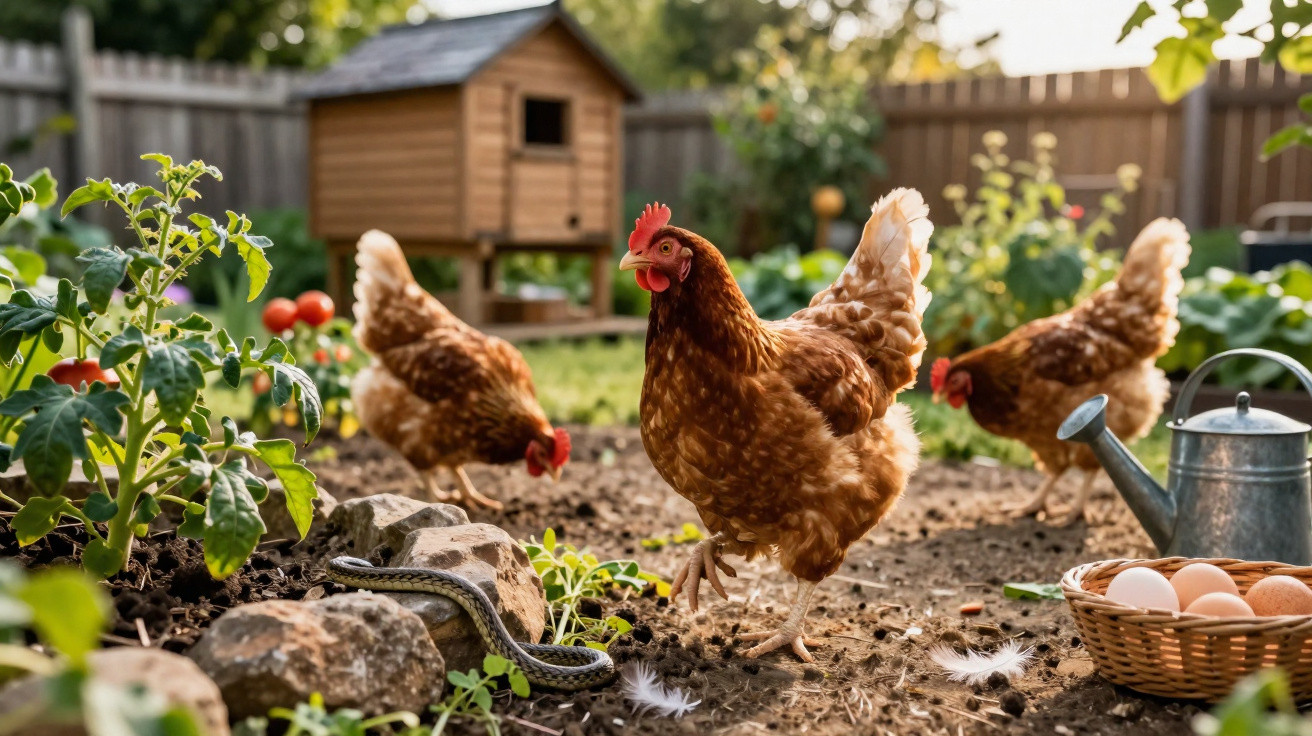
As soon as temperatures rise, many people in rural areas know the feeling: snakes suddenly begin appearing in the garden. Concerns about children, pets and personal safety quickly grow. Rather than relying on poison, traps or drastic clearing, some families now use an animal task force: hardy chickens that make the garden less appealing to snakes while also providing eggs.
Why snakes come near homes
From April through to October, the likelihood of encountering a snake in the garden increases. Particularly in warmer areas, these animals look for:
- sun-warmed stone walls and patios for basking
- cool spots beneath boards, pallets or garden furniture
- shelter in piles of wood or stones
- plentiful prey, such as mice and other small rodents
In many instances, these are not venomous animals at all, but harmless grass snakes that eat mice and can therefore be beneficial. Even so, the fear remains, particularly in places where venomous species occur. Families understandably want to avoid snake encounters close to their homes without immediately taking extreme measures.
There is also a legal aspect to consider: many reptile species are protected across Europe. Killing or capturing them, or destroying their eggs, is prohibited. A better solution is to arrange your property so that snakes prefer to stay away – and this is where chickens can help.
How chickens disrupt snakes in the garden
“Chickens make life so uncomfortable for snakes in the garden that the reptiles eventually seek out different territories.”
Conservation organisations and field observations identify chickens as natural enemies of small snakes. They have an effect in several ways:
- Constant disturbance: Chickens scratch, walk and peck. Their movements create vibrations in the ground, which snakes detect through their sensory organs and tend to avoid.
- A precise beak: A swift strike from a beak can injure or kill small snakes. Younger chickens with a strong hunting instinct are particularly likely to pursue them actively.
- Hardy legs: Their scale-covered legs are relatively insensitive to brief bites from small snakes.
- Less prey for vipers: Chickens disturb mouse nests and eat leftover food, insects and larvae. Where there are fewer rodents, there is little reason for snakes to remain.
The main benefit is that chickens work every day, without chemicals or dangerous poisons entering the soil. The result develops gradually but can often be noticeable: after several months with an active flock, snake sightings around the house decline.
How many chickens a typical garden needs
Even a small number of birds can be enough for a standard home garden. Broad guidance from specialists is as follows:
| Garden size | Recommended number of chickens |
|---|---|
| up to around 500 m² | 2–3 birds |
| 500–1,000 m² | 3–5 birds |
| larger than 1,000 m² | as required, often 5 or more |
In day-to-day terms, the total number matters less than how active the chickens are and how well their run covers the critical areas. A small, lively group of three can achieve more than a sluggish, heavy flock that stays by the feeder.
Chicken breeds suited to deterring snakes
Not every breed is equally suitable for this role. In broad terms, there are two groups.
Hardy working birds with a strong hunting instinct
For a garden where chickens are intended to drive snakes away, robust and inquisitive breeds are particularly suitable. Examples include:
- Sussex: medium-sized, lively birds with excellent scratching ability; considered alert and watchful.
- Marans: strong chickens that enjoy digging in the soil and show good territorial behaviour.
- New Hampshire or similar traditional breeds: straightforward, active birds with a strong instinct to forage outdoors.
These chickens cover their run thoroughly, inspect corners and react quickly to movement in the grass – precisely the sort of activity that deters snakes.
Breeds that are less suitable
Purely ornamental chickens with heavy feathering, very short legs or an exceptionally calm nature tend to show far less hunting instinct. They may look decorative, but they do little to discourage snakes. Anyone primarily seeking a functional “snake protection belt” should not make these breeds their priority.
Organising the chicken run strategically
For chickens to keep snakes away effectively, it is not enough simply to let them roam somewhere in the garden. What matters is the route they cover each day.
Typical risk areas include:
- dry-stone walls and natural stone walls
- wood stacks, pallets and old boards
- compost edges and untidy corners
- transitions between lawn and shrubs or hedges
- areas around patios and seating spaces
Along these boundaries, it is worthwhile creating a wide grassy strip that the chickens can patrol regularly. A simple fence or movable poultry netting can direct the run towards these areas. Letting the birds into these sections daily or several times a week creates a kind of living protective ring around the house and patio.
“Several hours of free ranging in the key locations achieve far more in practice than a permanent run positioned in the wrong place.”
In high summer, mornings and late afternoons are especially suitable. Snakes are also particularly active during these periods, making encounters between chickens and reptiles more likely and strengthening the deterrent effect.
How reliably chickens keep vipers away
Keeping chickens cannot guarantee complete safety. Large, determined snakes in particular may still pose a potential risk. Nevertheless, many reports from owners show a clear pattern: once a few active chickens patrol regularly, encounters become noticeably less frequent.
Owners of homes with old stone walls or large natural gardens report that, after introducing a small flock, they have scarcely seen snakes close to the house for years. Where sightings had previously occurred every few weeks, snakes now tend to appear only occasionally at the edge of the property.
Chickens should therefore be viewed as one element of a wider approach. Maintaining the grounds without making them completely sterile reinforces their effect:
- keep long grass short around patios and play areas
- do not store wood piles, stone piles or old boards directly next to the house
- position compost so that chickens can “work” it from the outside
- use artificial lighting sparingly at night to avoid attracting wildlife unnecessarily
Legal and practical challenges of keeping chickens
Anyone acquiring chickens takes on responsibility. This includes providing enough space, a secure coop, regular feeding and protection from foxes, martens and birds of prey. A coop with fine wire mesh, enclosed overnight accommodation and dry ground provides the foundation.
Additional rules may apply depending on the local authority: notification requirements can begin above a certain number of birds, while neighbours in densely built-up residential areas may be disturbed by noise – particularly a crowing cockerel. Those who keep hens only are generally on safer ground; they are quieter and are accepted without difficulty in many neighbourhoods.
From a health perspective, it is worthwhile deworming chickens regularly and keeping the coop clean. Dirty ground attracts flies and other pests, which may in turn interest wildlife. A well-maintained flock is more stable and resilient.
Risks and limits when chickens encounter snakes
Although chickens disturb snakes, they are not invincible. Very large or particularly venomous animals can endanger individual birds, especially if the chickens are caught by surprise. In areas known to have a high presence of dangerous species, it is sensible to consult local conservation bodies or gamekeepers in order to assess the situation realistically.
There is another consideration: chickens may kill and eat young snakes or grass snakes. Anyone who places particular importance on comprehensive species protection must weigh this against their own need for safety. Many property owners recognise the benefit close to the home but deliberately create refuge areas for wildlife at the edge of the garden.
Practical tips for starting with “anti-snake chickens”
Those who want to protect their garden with chickens can proceed in stages:
- Check whether neighbours and the landlord agree.
- Plan and install a sturdy, predator-proof coop.
- Lay out the future run so the chickens can access all critical areas.
- Obtain active, hardy young hens from suitable breeds.
- Accustom the birds to a fixed daily routine: out in the morning, in during the evening.
Over time, a routine develops: the chickens learn their routes, while you become familiar with their preferences and limits. Alongside the practical advantage, there is often an emotional bonus. Many families report that the birds soon become little personalities in everyday life, with distinct characters, firm preferences and a surprising amount of humour.
For anyone who values this combination of garden protection, eggs and a living “early-warning system”, chickens can become a central part of keeping snakes away from patios and play areas over the long term, without reaching for a bottle of poison.



Comments
No comments yet. Be the first to comment!
Leave a Comment