
Nutgrass, botanically known as Cyperus rotundus, is regarded worldwide as one of the most troublesome garden weeds. At first glance it resembles harmless grass, but below ground it develops an exceptionally persistent network of tubers and runners. Simply pulling off the top growth can leave you with twice as much within a few weeks. It can nevertheless be brought under substantial control with the right approach – although this demands planning, patience and consistency.
How to identify nutgrass reliably
Before taking action against nutgrass, it is important to establish that this is genuinely the weed involved. It is often mistaken for ordinary lawn grass or other grasses.
- The stem test: Nutgrass has triangular stems. Roll one between your fingers and the distinct edges are easy to feel.
- Leaves in groups of three: Its leaves usually emerge in threes from the base and grow noticeably upright.
- Flower heads: Yellowish-brown, umbrella-shaped clusters of flowers appear at the stem tips in summer.
- Growth habit: Within days of mowing, it grows back clearly above the height of the lawn.
Its appearance in turf is also characteristic: isolated, much taller clumps that protrude like “aerials” shortly after mowing. Beneath the turf lies a network of rhizomes and small tubers. Each tuber can produce fresh shoots – even after the visible growth has long been removed.
Nutgrass mainly becomes active from late spring onwards, once the soil remains consistently warm. During hot summer spells, the weed grows vigorously and produces large numbers of new tubers. This is precisely the best period to take effective countermeasures.
Nutgrass is not defeated by a single action, but by consistent weakening – over weeks and months.
Mechanical methods: digging out, cultivating and exhausting it
Digging out properly rather than pulling frantically
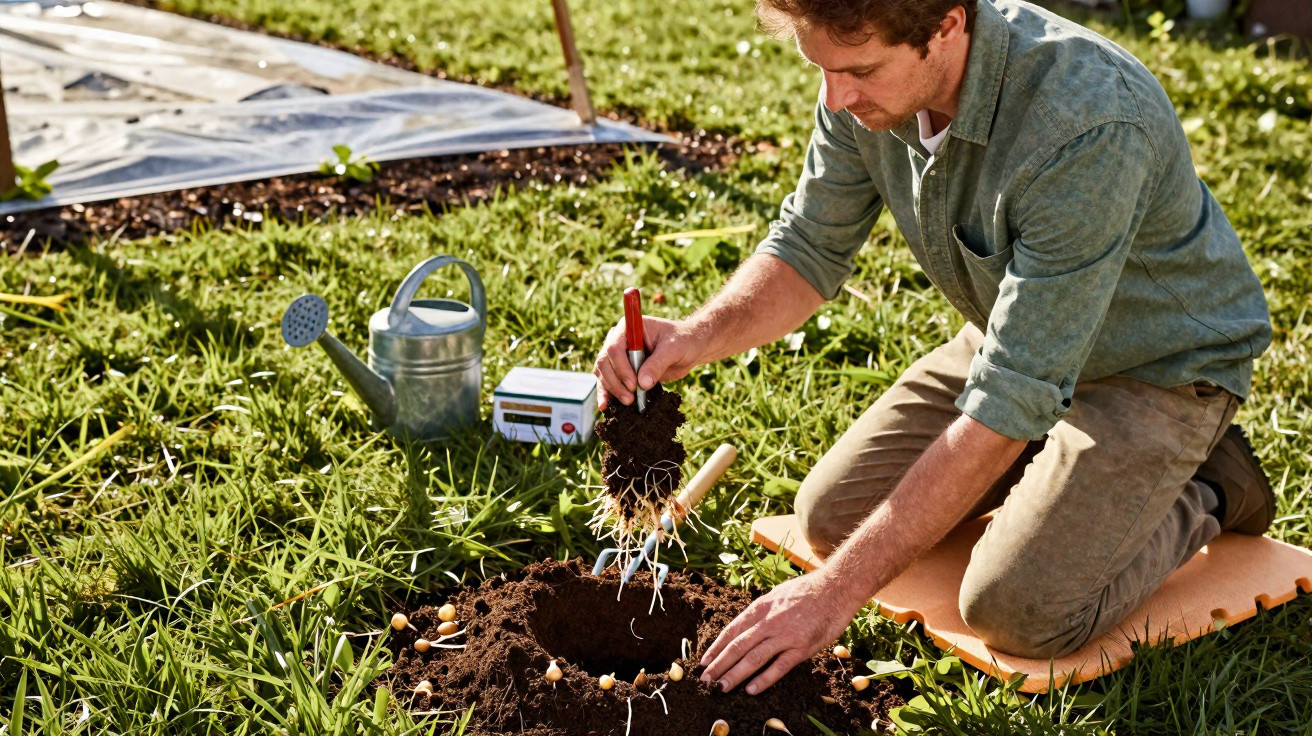
Anyone avoiding chemical treatments will inevitably need to do some manual work. Merely pulling off the visible growth achieves virtually nothing. A systematic approach is far more effective when tackling nutgrass:
- Water the affected area thoroughly the day before, so the soil softens.
- Use a weeding tool or garden fork to loosen the soil deeply around each clump.
- Grip the plant as close to its base as possible and pull it out slowly and evenly.
- Follow the root trail with the fork or by hand, removing entire chains of tubers.
- Put all plant material into bags and dispose of it with general waste; do not add it to the compost heap.
- Inspect the spot closely over the following weeks and remove new shoots immediately.
Depth is crucial: nutgrass tubers are often located 15 to 30 centimetres beneath the surface. Working too shallowly leaves sufficient material in the ground for fresh growth to emerge shortly afterwards.
Rotavating – benefit or risk?
A motor hoe or rotavator may sound tempting: one pass and everything is chopped up. With nutgrass, however, this can be counterproductive. Every divided tuber can form new plants. Anyone who does rotavate must be highly consistent, repeating the process every two weeks throughout the growing season to gradually deplete the tubers’ reserves. This method takes considerable time, but avoids chemical treatments.
Soil solarisation: using heat beneath plastic sheeting
For beds that are currently empty, soil solarisation is a thermal option. Water the area heavily, then cover the soil airtight with clear plastic sheeting, weighing down the edges with soil or stones. Summer heat builds up beneath the sheet, and temperatures in the upper soil layer can rise well above 60 degrees Celsius.
If the covering remains in place for four to six weeks, many tubers will die. Bright, hot periods are ideal for this method. Its drawback is that the bed cannot be used for vegetables or flowers during that time, so it needs to be planned in advance.
Chemical treatments: when they can be useful
In heavily infested areas, manual removal and solarisation soon reach their limits. Many gardeners then turn to herbicides. Their use requires careful consideration, but can provide targeted help.
| Herbicide type | Active ingredient | Best time to apply | Repeat interval |
|---|---|---|---|
| Selective, post-emergence | Halosulfuron-methyl | Active growth phase | 6–8 weeks |
| Non-selective, systemic | Glyphosate | Before the dormant period begins | Usually once |
| Pre-emergence inhibitor | Sulfentrazone | Early spring | Once per season |
Selective treatments for lawns
Products containing halosulfuron-methyl primarily target nutgrass without destroying the entire lawn. They move from the leaves into the tubers, weakening the plant from within. Application is best when every shoot has already developed several leaves and is growing strongly – generally between late spring and early autumn. A follow-up treatment is often needed after six to eight weeks, as the first application rarely reaches every tuber.
Glyphosate for complete renovation
Where an area consists almost entirely of nutgrass, some people opt for a radical solution. Non-selective glyphosate-based products kill all green growth, including lawn grass. They are suited to situations where the area is due to be reseeded or completely redesigned anyway.
Treat the ground only when the nutgrass is growing vigorously but has not yet set seed. Once it has died back, clear away the dead vegetation, loosen the soil and wait around two weeks before starting the new planting or lawn. This reduces the likelihood of surviving tubers immediately producing new growth.
Preventative soil treatments
Herbicides containing sulfentrazone work preventatively. They inhibit seedlings in the uppermost soil layer, but have little effect on tubers that are already present. They are therefore best used as an additional measure, for example after a successful main treatment or in areas where nutgrass has so far appeared only sporadically.
Prevention: remove the conditions nutgrass needs
A dense lawn instead of bare gaps
A healthy, dense lawn leaves less room for nutgrass to establish itself. Regularly mowing too short, by contrast, creates ideal starting points for weeds. The rule of thumb is never to remove more than one third of the grass blade length at once. Keeping the mowing height slightly higher shades the soil, making germination more difficult and reducing nutgrass’s ability to compete.
Managing water correctly
Nutgrass thrives in damp areas with poor drainage. Permanently wet parts of the garden are a warning sign. Useful measures include:
- watering less often but deeply, rather than giving a light spray every day;
- aerating compacted lawns to improve soil ventilation;
- installing drainage solutions, such as drainage pipes or gravel trenches in problem areas.
Adjusting irrigation strengthens the lawn and significantly reduces the conditions that favour nutgrass.
Soil testing and fertilising
Many amateur gardeners fertilise by instinct. Having a soil test carried out every few years is more useful, as it reveals the pH level and nutrient status. Fertiliser can then be tailored to the grass type. Balanced nutrient applications encourage strong roots and dense turf. Excessive nitrogen may create plenty of green growth, but can also encourage a range of weeds.
Mulch layers in beds
In perennial and shrub beds, an unbroken mulch layer acts like a natural protective barrier. Three to four centimetres of bark mulch, woodchip or other organic material suppress seedlings and keeps soil moisture more even. Where nutgrass has appeared repeatedly, placing weed-control fabric or a membrane beneath the mulch is worthwhile, particularly in vegetable beds that are used regularly.
Why nutgrass is so persistent – and what this means for your strategy
The tubers are the reason for its persistence. They store nutrients like small batteries. When the top growth is cut off, the plant simply regrows from these reserves. Any measure that affects only the above-ground growth is therefore incomplete. Long-term success requires targeting these energy stores or gradually exhausting them through digging, repeated disturbance or systemic treatments.
Timing matters just as much: spotting isolated patches of nutgrass early in the year and responding straight away can prevent years of frustration. It pays to be particularly watchful in newly created gardens, on freshly imported soil or in areas that are frequently watered. Removing established tuber colonies is considerably more demanding than acting quickly when the first one or two plants appear.




Comments
No comments yet. Be the first to comment!
Leave a Comment