
Many garden owners swear by peppermint oil to keep troublesome squirrels away – but how much truth is there in this home remedy?
Anyone with a garden will know the issue: squirrels may look charming, yet they dig up bulbs, raid feeding stations and gnaw at wood and plastic. As few people want to harm them, one supposedly gentle solution repeatedly comes into focus: peppermint oil. Its powerful scent is said to drive the rodents away – at least, that is the claim made in many gardening guides and online forums.
How peppermint oil affects squirrels
Peppermint oil is an essential oil extracted from the peppermint plant. Its principal components include menthol and menthone, two strongly scented compounds responsible for its familiar cool, minty aroma. Most people find that smell fresh, but small mammals such as squirrels can find it rather overpowering.
Squirrels rely heavily on their sense of smell. They use it to find food, identify danger and mark their territory. When this sensitive sense encounters an intensely dominant cloud of scent from concentrated peppermint oil, many animals initially retreat. The area seems unfamiliar and potentially unsafe, so they avoid it – at least for a while.
The mint scent can temporarily disrupt squirrels’ behaviour – but it does not create an invisible wall.
Studies of scent deterrents for rodents indicate that powerful aromas can genuinely interfere with their normal routines. Animals pause, become more cautious and move elsewhere. However, the result is not consistent and depends on several factors:
- Concentration: If the oil is diluted too much, it will barely be detectable outdoors.
- Weather: Rain washes away the scent, while sunshine and warmth make it evaporate more quickly.
- Location: Sheltered corners retain the smell much longer than exposed areas.
- Individual animal behaviour: Some squirrels are timid, while others are curious and persistent.
This is exactly why many gardeners report a familiar pattern: the animals stay away at first, but after a few weeks some begin returning and gradually become accustomed to the scent.
How long peppermint oil works outdoors
In real garden conditions, peppermint oil is not a long-lasting solution. Rain, wind and sunlight all work against the scent, although its approximate lifespan can be broadly estimated.
| Influencing factor | Effect on performance | Typical duration |
|---|---|---|
| Rain | Quickly washes the oil from soil and surfaces | 1–2 days |
| Direct sunlight | Volatile components disperse rapidly | 2–4 days |
| Temperatures above around 27 °C | Significantly speeds up evaporation | 3–5 days |
| Sheltered areas, such as under canopies or in corners | The scent remains noticeably longer | 7–10 days |
Anyone relying on peppermint oil must therefore be prepared to reapply it regularly, particularly during wet or very warm weather.
Using peppermint oil effectively against squirrels
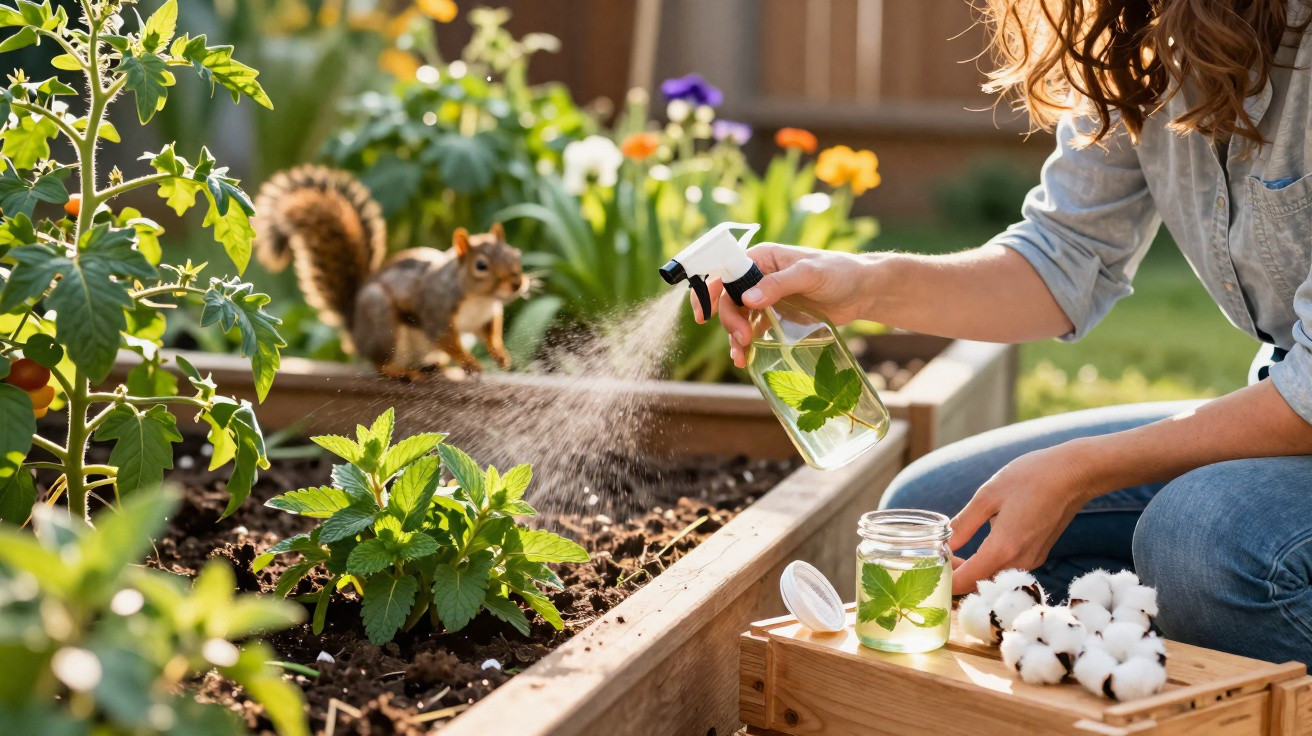
Spraying it around indiscriminately achieves little. A considered approach gets much more from the remedy. The standard method is a water-based spray solution.
Spray mixture for beds and feeding areas
For a straightforward garden spray, the following is sufficient in many cases:
- 1 cup of water
- 10–15 drops of pure peppermint oil
- A splash of washing-up liquid as an emulsifier
Put everything into a spray bottle, shake it thoroughly, then shake it once more immediately before use. The washing-up liquid helps the oil disperse more finely rather than floating on the surface of the water.
Then spray precisely where squirrels regularly cause damage:
- Around newly planted flower bulbs
- Along fences and frequently used routes
- Around bird tables and feeders
- At the base of wooden posts, raised beds or sheds
During quieter periods, one application per week is often enough. At times of high activity – such as spring and autumn – applying it twice a week keeps the scent more noticeable.
More intensive spot treatment with cotton wool and sachets
For particularly sensitive spots that are difficult to reach with a spray mist, more concentrated options are suitable:
- Soak cotton-wool balls in undiluted peppermint oil and place them in breathable containers.
- Fill fabric or tea-filter bags with dried mint, then reinforce them with a few drops of oil.
- Position the containers in protected places, such as beneath patios, under roof overhangs or near concealed entry points.
If you use mulch, a few drops of oil can be mixed into the material before spreading it around vulnerable plants. This creates a kind of scented layer around the root area.
Combining peppermint oil with other deterrents
Peppermint oil is most effective when used as part of a wider package of measures. Commonly suggested additions include:
- Motion-activated water sprinklers
- Fine-mesh wire baskets over flower bulbs
- Special feeders that close when too much weight is placed on them
- Alternating scents, such as garlic, vinegar or other herb oils
Peppermint oil slows them down – fences, wire and smart feeders stop them.
The limits of this home remedy
Peppermint oil is not a miracle cure. It can influence behaviour, but it cannot replace proper barriers. A hungry squirrel with a well-established food source will often eventually tolerate the unpleasant smell. The situation is especially difficult in gardens where several animals have already lived for years.
Once these rodents have learned that food is reliably available in a particular location, they can be remarkably persistent. Their motivation also increases during dry periods when food is scarce. In these circumstances, the scent functions more as a temporary obstacle than a permanent block.
There are also practical considerations:
- Cost: Pure essential oils are expensive, while cheaper blends are often much weaker.
- Work involved: Protecting a large garden requires regular mixing and spraying.
- Surroundings: Near parks or woodland, new animals will repeatedly arrive and test the area.
The more natural and varied a garden is, the more species of animal it attracts. This benefits insects and birds, but it also increases pressure from rodents. In these cases, a scent-only strategy is rarely enough.
When peppermint oil faces the greatest challenge
Squirrels do not behave in the same way throughout the year. In spring, they search for nesting material and energy-rich food for their young. In autumn, they build winter stores, bury nuts and seeds in the soil, and dig particularly often.
During these periods, beds and flower bulbs face the greatest pressure. Even well-applied scent barriers will not deter every animal then. Gardeners often notice this because visible damage increases despite regular spraying.
Those who prepare for this can take additional action:
- Increase the frequency of scent treatments during peak periods
- Protect critical areas with wire as well
- Set up feeding spots away from sensitive beds, using simpler food
Risks, side effects and sensible combinations
Peppermint oil is considered comparatively gentle, but it is not harmless scented water. In concentrated form, it can irritate skin, including human skin. When spraying in windy conditions, the mist can easily reach eyes and mucous membranes. Gardeners should therefore wear gloves, pay attention to wind direction and ensure that children do not play with the oil.
The scent can also be unpleasant for pets. Cats and dogs likewise have highly sensitive noses and may avoid strongly scented surfaces. Anyone with household pets should first test a small area to see how their animals respond.
In the garden, peppermint oil works best as one part of a broader approach: fewer open food sources, sturdy plants in exposed locations, physical obstacles and scent barriers only where they are genuinely needed. Used in this combination, the oil has a greater effect than when it is sprayed alone across large areas.
For a longer-term approach, it is also worth considering how to make the surroundings a little less appealing to squirrels: fewer freely available grains, protected feeding places for birds, and structured beds with wire in the soil to make digging harder. Peppermint oil then serves more as a signal: “It is not worth it here,” while the real deterrence comes from structure and planning.
Comments
No comments yet. Be the first to comment!
Leave a Comment