
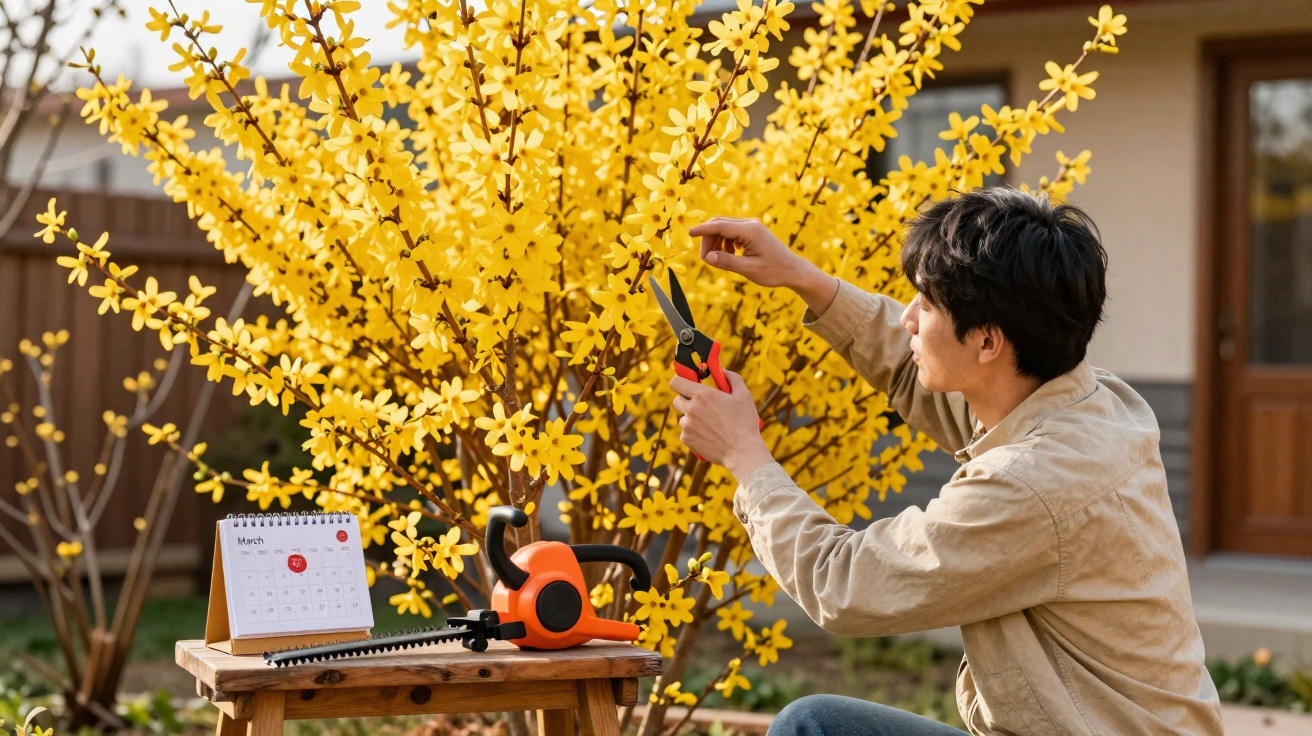
As the days lengthen and the first buds burst open, gardeners are eager to get started: everything should look neat, hedges trimmed into shape and shrubs kept compact. Yet this is precisely when a spring-garden favourite often ends up under the blades – with consequences that may only become apparent weeks later, when the anticipated blaze of flowers amounts to little more than a few scattered yellow stars.
Why pruning Forsythia in March destroys its flowers
The shrub so often cut at the wrong time is Forsythia. Its vivid yellow flowers are seen in many gardens as the signal that spring has begun. What is less widely understood is that cutting it back in March removes almost all of that year's display.
The reason is the way Forsythia produces its flowers. Like other traditional spring-flowering shrubs, it does not form flower buds in the same year that it blooms; instead, it creates them during the previous summer. From June to August, the tiny beginnings of the following spring's flowers develop beneath the bark.
Pruning in March, shortly before or even during flowering, therefore removes the very shoots carrying those blooms. Experts estimate that a hard cut at this stage can eliminate 80 to 100 per cent of the buds.
“In practice, trimming Forsythia in March cuts away almost an entire year's flowers.”
The plant then goes into recovery mode, producing long green shoots to replace the lost wood. This uses considerable energy but results in very few fresh flowers. Many gardeners will recognise the outcome: a scruffy green shrub with sparse blooms and tired-looking growth.
The right time: when Forsythia should actually be pruned
The best time to reach for the secateurs is not before flowering, but immediately afterwards. Once the yellow petals have faded and begun to fall, there is a short window for a useful maintenance prune.
Depending on the region, this usually falls between mid-April and mid-May. In cooler areas where spring arrives later, it may be delayed by several weeks. A simple rule is to wait until the shrub is clearly finished and shows far more green than yellow.
This timing offers two benefits: the plant has been able to flower without interruption, and there is still enough of the growing season left after pruning to produce new shoots – including the buds for the following spring.
Three simple pruning rules for a freely flowering shrub
The good news is that a healthy Forsythia shrub covered in blooms does not require complicated horticultural training. Three straightforward measures are enough when carried out every year, or at least every other year.
- Use the one-third rule: Remove roughly one third of the oldest stems at their base. These are generally the thickest, greyish and slightly woody canes. They produce few flowers but take up a great deal of space and light.
- Thin the centre: Over time, the middle of the shrub fills with thin, weak and dead branches. Remove these selectively so that light and air can once again reach the centre.
- Shorten spent flowering shoots: After flowering, cut the young branches that have bloomed back by around 20 to 30 centimetres, always just above a pair of outward-facing buds. This keeps the shrub open and preserves its elegant, gently arching shape.
Importantly, use sharp secateurs rather than a conventional hedge trimmer. Forsythia copes far better with individual clean cuts than with a severe motorised ‘haircut’.
Why hedge trimmers damage Forsythia over time
The same scene can be found in many gardens: Forsythias standing by a fence or driveway, clipped into yellow balls or cubes. It may look tidy, but from a horticultural perspective it causes problems.
An electric hedge trimmer cuts every shoot back to the same line. Numerous short side shoots and dense foliage develop around the outside. Very little light reaches the interior, where stems gradually become bare and eventually die.
“From a distance, the rounded shape looks neat, but inside there is often dead wood – a haven for fungi and pests.”
Over time, this creates several risks:
- flowers shift ever further towards the outer surface, leaving the centre bare
- the plant becomes old and unproductive because mature stems are never completely removed
- a damp, shaded interior encourages fungal diseases
- the Forsythia loses its characteristic loose, natural habit
A shrub that has already been clipped into a ‘ball’ can be rejuvenated over two to three years. Each year, remove some of the old canes close to ground level, and favour pruning individual stems rather than cutting the entire surface.
Other spring-flowering shrubs that should not be pruned in March
Forsythia is simply the most obvious example. Many popular spring shrubs also form their flowers on the previous year's wood. Cutting them back harshly in March will likewise sacrifice the entire flowering season.
The plants most commonly affected include:
- common lilac (Syringa vulgaris)
- flowering currants
- snowball shrubs with spherical flowers
- weigelas
- deutzias
- certain hydrangea varieties, especially mophead hydrangeas
- rhododendrons and azaleas
Broadly speaking, the same rule applies to all of these woody plants: prune only once flowering has finished. If in doubt, observe the shrub closely for a year; it soon becomes clear whether its buds form on new growth or old wood.
Practical guide: when to prune different shrubs
| Shrub | Flowering period | Flowering wood | Recommended pruning time |
|---|---|---|---|
| Forsythia | February to April | Previous year's wood | Immediately after flowering |
| Lilac | April to May | Previous year's wood | After flowering, no later than June |
| Mophead hydrangea | July to September | Previous year's wood | Late winter, tidy only, no hard pruning |
| Butterfly bush (Buddleja) | July to October | New season's growth | Late winter to very early spring |
The table makes clear that not every shrub follows the same pattern. Summer-flowering plants such as butterfly bush tolerate a hard prune in late winter, whereas spring-flowering shrubs respond with a loss of flowers.
How to tell whether a shrub flowers on old or new wood
Anyone wishing to understand their garden better can use two questions as a guide:
- Does the shrub flower early in the year, by May, or later in summer?
- Where are the buds located: on older woody sections or on fresh green shoots?
Early flowering combined with buds on older stems almost always indicates that flowers are formed on the previous year's wood. These shrubs should only be cut back after flowering. Later-flowering plants whose buds develop on fresh shoots are generally pruned in late winter to encourage strong new growth.
Why gentle pruning means less work in the long run
Many amateur gardeners prune hard because they believe it will save time. With Forsythia and similar shrubs, the opposite is usually true: drastic cuts trigger many long replacement shoots that need cutting back again the following year.
Regular, moderate thinning may initially take a little more time, but it produces a more stable and healthier shrub. Less dead wood, fewer fungal problems, improved airflow and a more natural shape ultimately mean less effort – both for the gardener and the plant.
Anyone who adopts this rhythm – clearing the beds in March and leaving Forsythia until after its main display – will be rewarded with a garden that looks a little more harmonious each year. They will also have a shrub that does exactly what it should: welcome spring with a burst of yellow rather than disappearing into a featureless green ball along the boundary.


Comments
No comments yet. Be the first to comment!
Leave a Comment