
Many Japanese maple owners will recognise the problem: brown leaf edges, dried-up shoot tips and very little new growth, despite regular watering. Particularly in early spring, this otherwise elegant tree can look distressed. One simple but carefully timed care measure at the root zone now determines whether it later produces dense foliage and vivid colour – or once again continues to struggle.
Why the Japanese maple needs particular help in March
Japanese maples (botanical name Acer palmatum) originate from open, cool woodland areas. There, they grow beneath a loose layer of leaves, pieces of bark and humus. In UK gardens, however, they are often planted in comparatively compacted soil without a protective covering. This is where the issue begins.
The tree develops very shallow roots just below the soil surface. These fine roots are highly sensitive to changes in temperature, excessive moisture and drought. March is especially changeable: late frosts alternate with the first mild days, while wind can dry the soil out rapidly.
Without protection, the Japanese maple’s surface roots remain under constant stress in spring – with visible effects on leaves and shoots.
Typical signs of this stress include:
- Brown, dried leaf margins as early as early summer
- A thin, sparse crown with little fresh growth
- Small shoot tips that simply dry out
- Slow growth despite generous watering
In its natural habitat, the woodland floor cushions all these stresses. In the garden, you need to recreate this protective function artificially – and March is the ideal time to do so.
The key step: create a protective soil layer for the Japanese maple
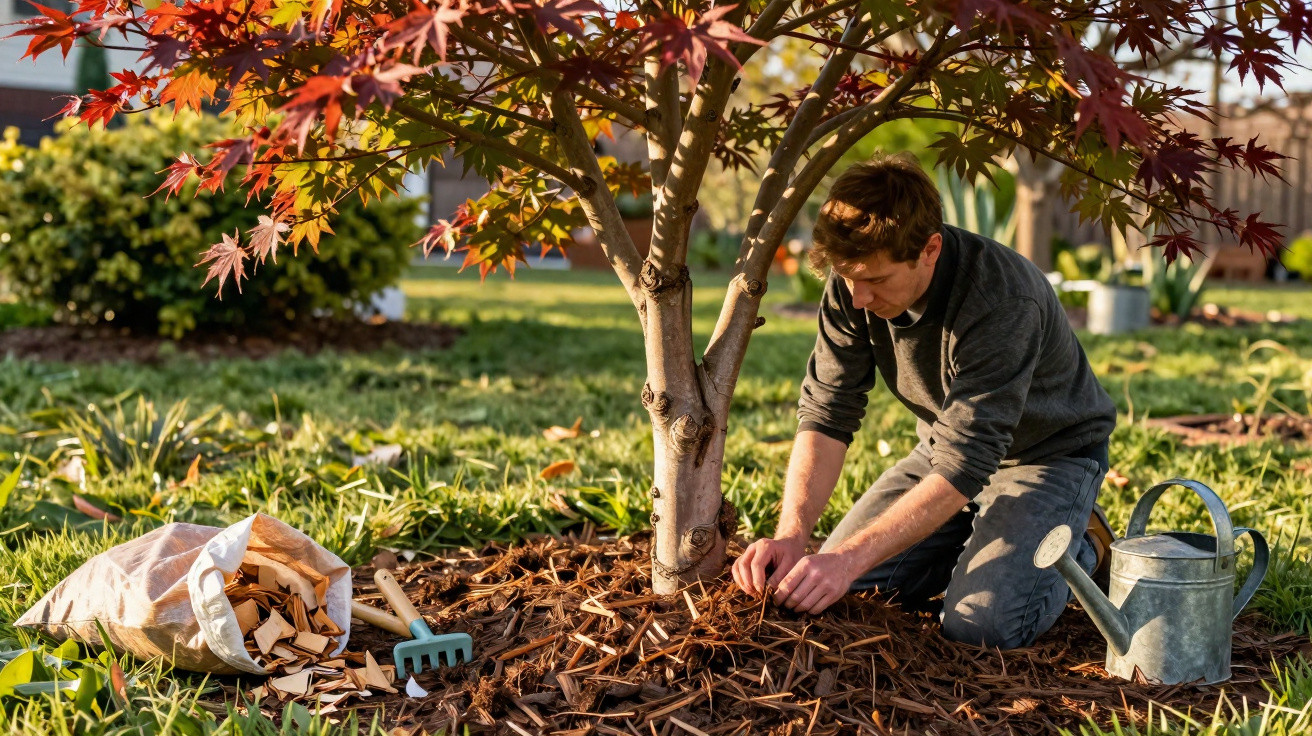
Garden experts recommend giving Japanese maples an organic layer over the soil as soon as the growing season begins. This protective blanket performs several jobs at once: it moderates temperature fluctuations, retains soil moisture for longer, suppresses weeds and gradually supplies nutrients.
Many trees in UK gardens lack precisely this kind of “woodland cushion”. As a result, they are effectively growing on bare soil, which dries quickly in spring or becomes waterlogged during heavy rain.
Giving your Japanese maple an organic layer around its base in March artificially creates a small woodland environment – and therefore substantially better growing conditions.
Step by step: caring for the root area in March
Prepare the soil without damaging roots
Start as soon as the soil has thawed in March:
- Remove weeds: Carefully pull out any weeds around the trunk by hand; do not use a hoe.
- Loosen the soil lightly: Gently work over only the top 2–3 centimetres with your fingers or a small hand cultivator. Do not go deeper, as this could harm the fine roots.
- Check old, matted layers: Carefully thin out hard, water-repellent pieces of bark or moss pads so that water can penetrate the soil again.
The aim is to leave a loose, breathable surface on which the fresh layer can sit properly.
The correct layer depth and distance from the trunk
Next comes the most important stage – applying the new protective covering:
- Area: Extend it at least as far as the canopy spread, and preferably a little beyond it.
- Depth in garden soil: Around 5 to 8 centimetres.
- Depth in a pot: 3 to 5 centimetres is sufficient, so that the container does not become overly full.
- Distance from the trunk: Leave a clear ring of approximately 10 centimetres around the trunk.
This open ring prevents the trunk from staying damp for extended periods, which can lead to fungal disease or rot. The trunk base, known as the root flare, should remain clearly visible rather than being buried beneath the material.
Materials that genuinely suit a Japanese maple
Japanese maples prefer a mildly acidic, humus-rich environment, much like that found in a natural woodland understorey. Some materials are especially suitable, whereas others are more likely to cause harm.
| Suitable materials | Better avoided |
|---|---|
| Composted pine bark | Dark decorative gravel in full sun |
| Well-rotted leaves, for example from the previous year | Freshly applied heaps of grass cuttings |
| Woodchip from fine branches, well-aged | Plastic sheeting or landscape fabric placed directly on the soil |
| Mature garden compost applied in a thin layer | Thick bark layers that barely allow water through |
The best guide is the image of a deciduous woodland: nothing sterile and nothing airtight, but loose organic materials that decompose slowly.
The best option is a mix of well-rotted leaves, compost and fine bark – it combines protection, nutrients and a stable soil climate.
Watering correctly: the tree responds differently with the new layer
Once the fresh soil layer is in place, the soil behaves much more consistently. It loses moisture more slowly, while also being less likely to remain completely saturated. This directly affects how you should water.
Japanese maple planted in the ground
For a tree growing freely in a border, the following approach is generally suitable in spring and summer:
- Normal conditions: Give roughly two thorough waterings per week, depending on the weather.
- Dry spells: Water deeply three to four times weekly.
More important than fixed intervals is watering when the top layer has dried slightly but the soil beneath still feels moist. The new covering helps water soak in gradually and remain available for longer. It therefore greatly reduces sharp swings between soaking wet and dust dry conditions.
Japanese maple in a pot
In a container, the plant is more sensitive because the volume of compost is limited:
- Keep the layer in the pot thinner, otherwise the growing medium may remain too wet.
- Empty water from the saucer after every watering so the roots are not left standing in a “foot bath”.
- In high summer, water smaller amounts more often instead of watering extremely heavily but rarely.
Towards the end of summer, slightly less water is usually enough. Modestly reducing watering can often encourage more intense autumn colour – but the root ball must never be allowed to dry out.
Common mistakes that weaken Japanese maples
Many issues are not caused by disease but by care mistakes. Avoiding these pitfalls makes life considerably easier for the tree:
- Working the soil too deeply: Hoeing or digging within the root area damages the fine roots.
- Waterlogging: Permanently wet soil or saucers filled with water encourage root rot.
- Full-sun positions without protection: Varieties with particularly delicate foliage can scorch easily in these locations.
- Dense, non-breathable coverings: Plastic sheets or heavy stones interfere with soil aeration.
By contrast, the unobtrusive protective soil layer brings the tree closer to its natural growing conditions. Many Japanese maples respond in the very first year with stronger growth and fewer scorched leaves.
Why this simple care has such a lasting effect
Applying a carefully chosen soil layer in March is an investment in the tree’s entire year. The root zone remains more balanced, the plant has to respond to less stress and can put more energy into growth, leaf mass and autumn colour.
As the material gradually breaks down, it also improves soil structure. Earthworms and other soil organisms incorporate the organic matter, making the soil looser and easier for roots to grow through. This effect is particularly noticeable in heavy clay soils.
If you have several Japanese maples in the garden, it is easy to compare the results: trees with a consistently protected root area generally grow more steadily, produce new shoots more evenly and recover faster after hot periods. The measure may seem unremarkable – but for the tree it is a real gamechanger.

Comments
No comments yet. Be the first to comment!
Leave a Comment