
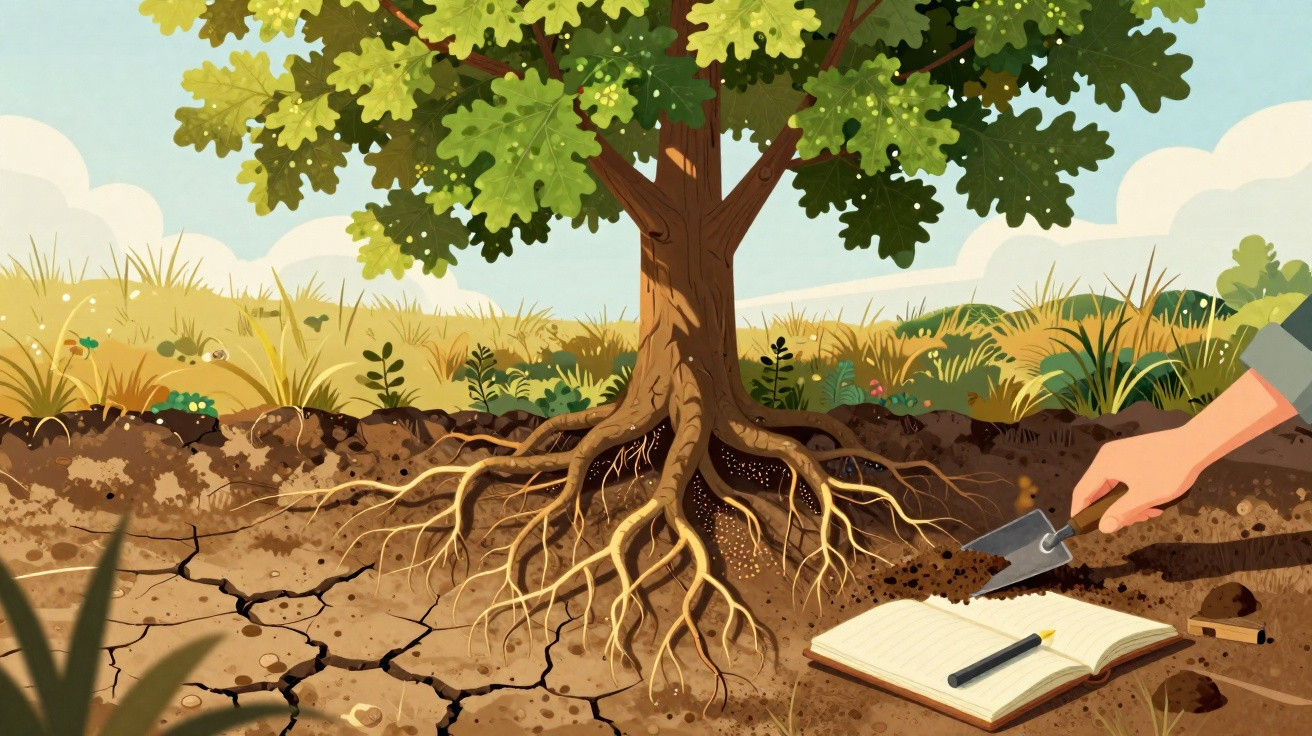
Oak trees are capable of surviving for centuries, but climate change is bringing drought, degraded soils and disease far more quickly. Researchers increasingly think that minute microbes living on and within oaks could help shield them from these pressures.
A recent woodland investigation examined sessile oak (Quercus petraea). It found that the microbial communities associated with leaves, stems and roots stay notably consistent, even when the trees are exposed to substantial environmental stress.
Microbes living in oak trees
Each oak hosts vast numbers of bacteria and fungi, and different parts of the tree support their own characteristic communities. The microbes found on leaves, within the inner bark, and around the roots and neighbouring soil are distinct from one another.
Leaf bacteria are dominated by a group known as Proteobacteria. In stems, Proteobacteria are joined by sizeable numbers of Actinobacteriota. Below ground the picture changes again, with Actinobacteriota particularly prevalent in root-associated zones.
Fungal composition also depends on the tissue. Leaves and stems are largely populated by Ascomycota, whereas the root zone contains more Basidiomycota. A large share of root-zone fungi form ectomycorrhizal partnerships, helping trees take up nutrients and water from the soil.
Some bacterial families may be especially important. Beijerinckiaceae are frequently detected on leaves and in stems; members of this family can fix nitrogen, which may help support leaf development and metabolic function.
In the root environment, Acidothermaceae are well suited to acidic soils and contribute to the breakdown of organic matter. Because oak roots often grow in acidic conditions, these microbes may enhance nutrient cycling.
Trees tested under stress
The team examined 144 oak trees in a woodland in Norfolk, UK, each approximately 35 to 40 years old. To impose stress, they used three separate approaches.
First, rain shelters were installed to lower soil moisture and mimic drought. Secondly, ring-barking was carried out by removing a narrow band of bark to interrupt the movement of nutrients. Thirdly, some trees were inoculated with bacteria and beetle larvae associated with acute oak decline.
Soil moisture sensors showed the drought treatment had a strong effect: during certain periods, water levels beneath the shelters fell by more than half. Humidity within the stems also dropped, indicating genuine physiological strain.
Even with these clear physical impacts, the microbiomes linked to the different tissues were, in most cases, largely unchanged.
Why stability matters
Mature trees are often associated with comparatively stable microbiomes, possibly because long-lived plants can develop durable partnerships over time. In this study, microbial diversity changed little following drought or ring-barking.
Moreover, trees displaying early signs of acute oak decline still did not show substantial microbiome disturbance in otherwise healthy tissues.
“As environmental stressors are increasing, one of the key adaptations that trees have is their microbiome,” said study senior author James McDonald of the University of Birmingham.
“If we can get a more mechanistic understanding of how host-microbe interactions help trees navigate and tolerate drought, it might open up the opportunity to improve tolerance, for example by inoculating trees with beneficial microbes.”
“Climate change is happening really quite rapidly, but trees are long-lived, sessile organisms that take a long time to adapt to changes, and many of our trees are not well equipped,” added Sandra Denman of Forest Research, Forestry Commission UK.
Drought changes root microbes
While the overall community structure was generally steady, extended drought produced small shifts in roots. After prolonged exclusion of rainfall, Actinobacteriota became more abundant in root-associated areas.
Actinobacteriota are commonly found in dry soils. Many have thick cell walls and can produce spores, features that can improve survival in challenging conditions. Work in crop systems has also linked this group with improved drought tolerance.
Other bacterial groups rose in the roots during drought as well, including Acidobacteriota. Some of these bacteria produce sticky substances that can help soil retain water and remain attached to roots.
At the genus level, drought conditions favoured bacteria such as Nocardia, Actinomycetospora, Acidothermus, and Acidocella.
Many of these microbes are associated with plant growth-promoting characteristics. Some help release nutrients, while others can produce hormones such as indole 3 acetic acid, which supports root development.
Fungi respond to drought
Fungal partners shifted too. In drought-affected roots, Penicillium and Aureobasidium increased, and both groups include species known to support plant growth.
“Even as the trees were showing physiological changes and the soil was becoming a lot drier, their microbiome remained quite stable,” said study first author Usman Hussain of Bangor University and the University of the West of England (UWE).
“This highlights a potential role for oak-associated microbial communities in maintaining forest ecosystem stability.”
Oak stem microbes under stress
Microbes in stems were more responsive than those on leaves. Under drought or after ring-barking, some fungal genera associated with decay or disease became more common, while certain beneficial endophytes declined.
This pattern implies that sustained stress could reduce internal protection within woody tissues. Nonetheless, the wider microbial structure did not break down.
Overall, semi-mature oaks support complex, tissue-specific microbial networks that are resistant to major disturbance. Prolonged drought led to modest but potentially important changes, particularly around the roots.
Next steps include investigating the molecular signals involved in recruiting helpful microbes, and comparing trees across different ages and locations.
Forests lock up carbon and sustain biodiversity. If microbial partners remain stable, they may help oak trees endure climate-related stress and continue to underpin ecosystems for decades.



Comments
No comments yet. Be the first to comment!
Leave a Comment