
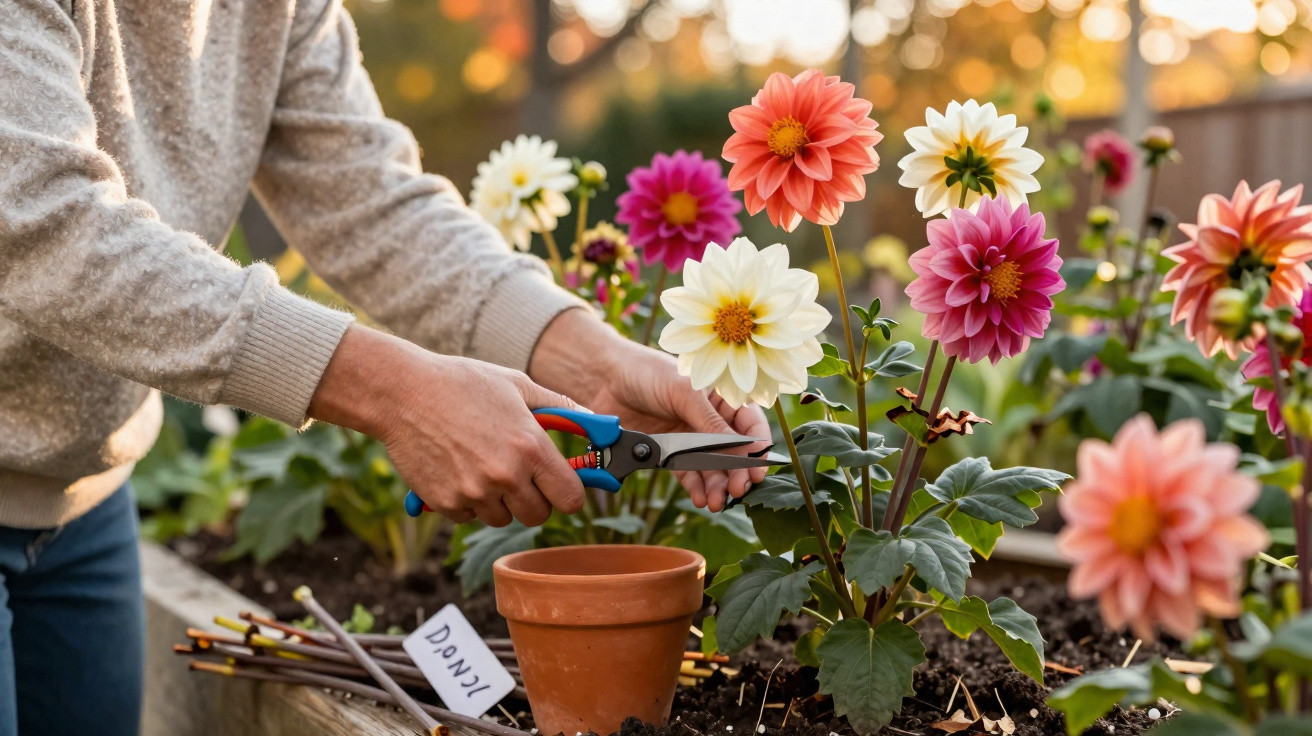
Stems sag, buds fail to open, and the display fades far too soon.
But a handful of well-judged, almost unnoticed cuts can transform the result.
When dahlias flop or bloom in one brief, frantic burst, gardeners often blame poor weather or “weak stock”. More often, the cause lies in how growth is pruned and managed, from the first spring shoots until foliage is blackened by the first hard frost. French publication Airzen and US blog Backyard Garden Lover highlight three targeted pruning actions that discreetly influence dahlia performance throughout the year.
Why pruning can determine your dahlia season
Native to the mild upland regions of Central America, dahlias need a lengthy spell of warmth to perform well. In many gardens, they need 90 to 100 days between planting and their first flowers. Because their establishment period is so long, early choices about watering, staking, feeding and pruning can have consequences months later.
Without intervention, many cultivars grow into tall, slender plants dominated by one main stem. Their flowers form high above the ground, where wind can catch them and snap the stems close to the base. The plant also directs energy into making seed rather than fresh buds. By the middle of the season, it can already appear exhausted just as neighbouring borders reach their best.
A dahlia that gets the right cut at the right week becomes shorter, sturdier and far more generous with its blooms.
Airzen focuses on thorough summer deadheading rather than superficial tidying. Backyard Garden Lover stresses the importance of cutting plants back at the right point after frost, allowing tubers to store energy rather than expend it on growth that will not survive. Add one important early task - pinching - and you have a straightforward three-step approach that many gardeners still overlook.
Pinching young dahlias for stronger, stockier plants
When and how to pinch confidently
The first essential cut is made early, once a plant is 20–30 cm tall and its stems remain pliable. New dahlia growers can be reluctant to remove the growing tip because they fear losing flowers. In practice, it produces the reverse effect.
Pinching involves taking off the soft stem tip immediately above a healthy pair of leaves. Use either clean fingertips or sharp, disinfected snips.
- Allow four to six pairs of leaves to develop first.
- Find a sturdy leaf pair roughly halfway up the plant.
- Snip or pinch away the stem above that leaf pair.
After pinching, the plant diverts its growth hormones towards side buds. Rather than developing as one tall, cane-like stem, it makes two or three new stems that become thicker, branch more freely and eventually support more flower stems.
A single pinch can turn a wind‑prone, top‑heavy dahlia into a compact, multi‑stemmed plant that rarely needs emergency staking.
How pinching changes dahlia growth
Following a successful pinch, gardeners commonly see three clear changes:
| Without pinching | With early pinching |
|---|---|
| Tall, whippy main stem | Several shorter, thicker stems |
| Fewer blooms, higher up | More blooms spread across the plant |
| Greater risk of wind damage | Better balance, less flopping |
| Plant tires quickly | Energy spread over many shoots |
There is a compromise: the earliest flowers may arrive a week or two later. In return, the display continues more evenly for longer, through late summer and into early autumn. For cut-flower growers, this bushier plant structure also provides more long, straight stems at a convenient cutting height, rather than flowers sitting awkwardly at head height.
Deadheading deeply rather than lightly to encourage repeat flowering
The usual error: removing only the faded flower
Once blooming begins, many gardeners merely twist away each spent flower head. Although this improves appearances, the short stub that remains acts as a dead end. It leaves the plant with clusters of short stems that seldom lengthen or branch again.
Airzen recommends a firmer approach to deadheading, sometimes known in UK and US gardening as “cutting back to a junction”. Rather than snipping directly beneath the faded bloom, trace the stem down until it reaches a thicker main stem or a strong side shoot.
The most effective way to remove spent dahlia blooms
Use this method to promote more vigorous repeat flowering:
- Run your fingers down the flower stem.
- Stop at the point where it meets a thicker stem or a leaf pair.
- Make a clean cut at that junction, angling the blade slightly so water runs off.
Removing the whole flowering stem stops the plant wasting energy on seed and forces it to send up fresh, vigorous growth from lower down.
Gardeners using this technique often find that replacement stems grow longer and straighter, producing larger buds at their tips. This benefits both border planting and buckets of cut flowers. Pair it with the deep, occasional watering advocated by Airzen, and plants can keep generating fresh growth instead of merely struggling on.
Combining pruning with watering and feeding
Deadheading is most successful when supported by several simple growing practices:
- Water thoroughly once or twice weekly instead of applying small amounts frequently.
- Mulch with compost or shredded bark to keep the roots cool.
- Apply a low-nitrogen fertiliser sparingly to support flowers rather than foliage.
This routine helps each dahlia recover promptly after pruning. Stored water and nutrients can then be used to make new stems rather than to cope with drought stress.
Cutting dahlias back after frost to strengthen the tubers
Why the first hard frost determines the timing
Backyard Garden Lover identifies a dependable cue: the first genuine frost that turns foliage black and limp, generally after several hours at around -2°C (28°F) or lower. Until this happens, the stems continue feeding the tubers. Cutting plants back too soon can prompt a new flush of growth that the next cold spell will destroy, needlessly using stored energy.
Once hard frost has visibly affected the plant, its green growth has completed its purpose. This is the time to take out the secateurs.
How to cut dahlias back for stronger growth next year
Late-autumn cutting is about storage rather than appearance. The aim is to concentrate the plant’s reserves in the tubers that must survive winter.
- Wait for foliage and stems to be visibly blackened by frost.
- Reduce every stem to 10–15 cm (4–6 inches) above soil level.
- Label every clump by variety when growing several types.
That last cut channels the final flow of nutrients into the underground tubers, which act like a battery for next spring’s growth.
In mild regions, some gardeners keep tubers in the soil beneath a thick mulch. In colder places where repeated freezes are likely, lifting and storing them offers much better chances of survival.
Lifting and storing tubers without causing damage
Backyard Garden Lover advises leaving plants for roughly a week after cutting before lifting them. This gives the soil a chance to dry slightly and lets the crown firm up. Work with a garden fork, beginning well clear of the central clump so you do not spear the tubers.
Lift the clump carefully, remove loose soil with a gentle shake, then leave it to dry somewhere airy and frost-free. When the skin is dry and papery, the clumps can be put into storage. Dry compost, sawdust and sand are all commonly used in a crate or box.
- Ideal storage temperature: roughly 4–10°C (39–50°F).
- Keep the storage space dark and frost-free.
- Inspect tubers every month, removing any that become soft or mouldy.
Together with the earlier pruning steps, this process prepares tubers to produce strong shoots when the soil becomes warm again.
Reading dahlias like a professional grower
These three cuts - early pinching, deep deadheading and post-frost cutting back - may seem simple. However, observation and timing separate a theoretical plan from a border packed with colour. Commercial growers seldom follow fixed calendar dates; they assess each individual plant.
Short, compact cultivars may require no more than a gentle pinch. Tall dinner-plate dahlias can respond well to stronger early shaping and more substantial staking. When a plant produces thin, feeble stems in mid-season, deeper deadheading and more restrained feeding can still improve its performance.
Some gardeners carry out small trials over successive years, such as pinching only half their plants or deadheading separate clumps at different heights. These practical tests reveal which mix of pruning, watering and feeding is best suited to a particular garden, soil and climate.
Other factors: pests, weather changes and contingency measures
Pruning cannot be treated in isolation. Heavy rainfall, slugs, earwigs and sudden heatwaves may all alter a dahlia’s response. Cutting back storm-damaged growth, for example, can stimulate unexpectedly vigorous shoots from lower buds, following the same principle as hard deadheading.
There is a safety consideration too. In strong winds, especially in exposed coastal gardens in the UK and US, a tall dahlia carrying unpinched and overloaded stems may break at the base. Early pinching, a robust stake and several soft ties reduce this risk while preserving the plant’s natural movement.
Gardeners who prefer to work with figures sometimes note their first flowering date, first frost, height before and after pinching, and the number of stems on each plant. Across two or three seasons, those records become a personal reference for deciding how firmly to pinch and how deeply to deadhead every variety.
Ultimately, these three “quiet” cuts demand very little: thumb and forefinger in spring, closer attention when clearing faded blooms in summer, and a firm trim when frost arrives. Used together, they can turn dahlias from mildly troublesome prima donnas into dependable, season-long plants that justify every square foot of bed space.

Comments
No comments yet. Be the first to comment!
Leave a Comment