
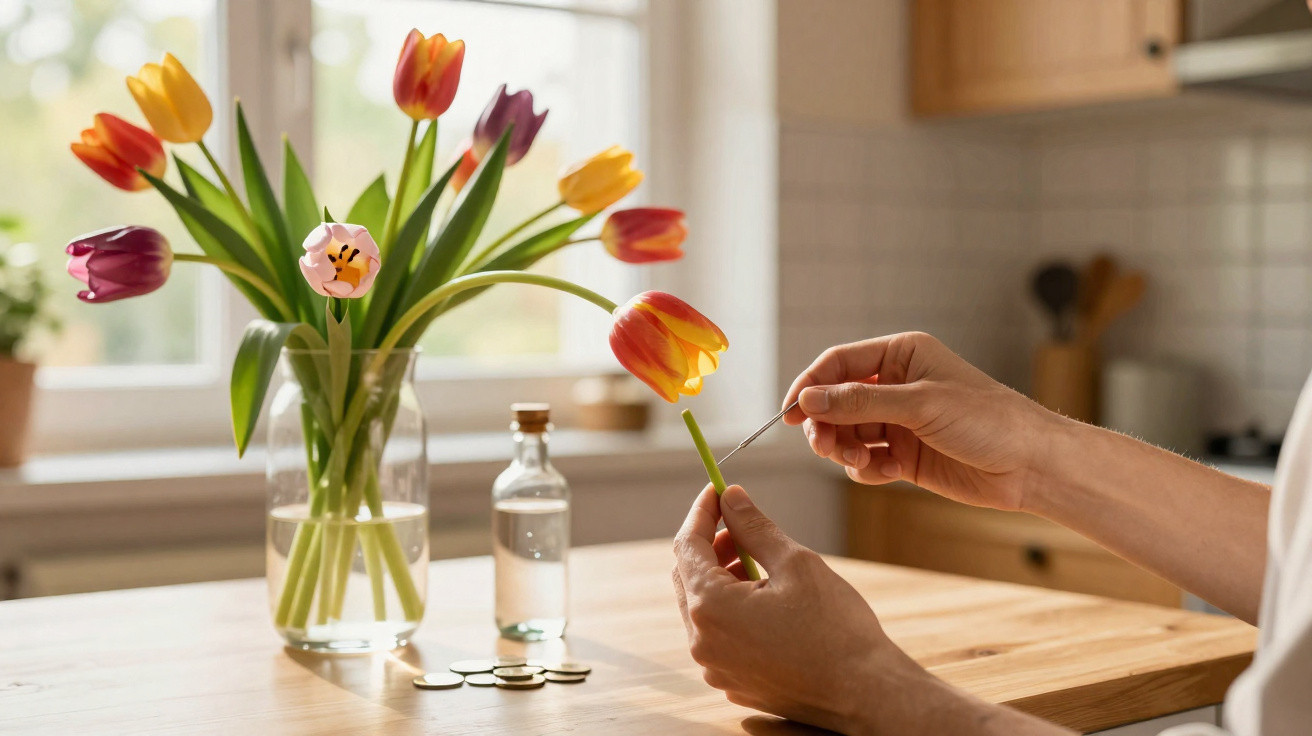
They may look flawless on the journey home, yet by breakfast every stem has slumped as though it has given up.
If your tulips tend to collapse overnight, you are certainly not the only one. Gardeners across Britain have been discreetly trying every remedy imaginable – from vodka to loose coins – but one exceptionally quick, almost absurd-sounding technique is proving the most popular.
Why tulips flop so suddenly in a warm home
Tulips remain surprisingly active after being cut. They continue to grow while in a vase, reaching towards the light and turning as the day goes on.
Their stems are hollow as well as relatively soft. When the flower head becomes heavier and leans towards a window or lamp, the stem begins to curve before eventually bending over the vase edge.
Central heating creates another problem. Heated indoor air draws moisture from the flowers and foliage. In homes with the heating on, a slight bend can turn into a complete overnight collapse.
Where you put the vase matters as well. Tulips on a bright, warm windowsill, or beside a bowl of ripening apples or bananas, face further strain. These fruits give off ethylene gas, which accelerates flower ageing.
Florists also point to a less obvious cause: trapped air. Air pockets or bacteria can become lodged inside the hollow stems. This small “air lock” prevents water moving freely towards the flower head, leaving the tulip drooping even when the vase appears full.
Drooping tulips are usually a mix of soft stems, fast indoor growth, trapped air and too much warmth, not just “old” flowers.
A kitchen test of popular tulip remedies
One British gardening Instagrammer chose to stop speculating and carried out a small practical experiment on her kitchen counter.
She purchased a bunch of tulips, dividing it between four small vases with two stems in each. Every stem received a fresh angled cut under water, while all four vases were positioned in the same area of kitchen light.
Each vase was then given a different supposed miracle treatment:
- Vase 1: Water with a splash of vodka
- Vase 2: A few coins placed in the bottom
- Vase 3: Cool, plain water only
- Vase 4: Plain water with a tiny pin prick near the top of every stem
She monitored and filmed the flowers over six days.
Vodka and coins: widely used, but largely hype
The vodka treatment performed particularly poorly. Its stems became limp first, and even the leaves struggled to stay upright. Any claimed preserving or disinfecting benefit was outweighed by flowers that looked stressed and saggy.
The vase containing coins and the one with plain water produced slightly better results. Although the blooms opened and remained appealing for a time, their stems still bent over the rim instead of standing tall.
None of these three methods fixed the familiar “floppy tulip” appearance that frustrates so many households.
The 3-second pin trick gardeners swear by
The fourth vase, which used the pin trick, was noticeably different straight away. On day six, its stems were still holding their form and the flower heads remained high above the glass.
The technique could hardly be simpler:
- Put cool, fresh water into a clean vase.
- Cut 1–3 cm from each tulip stem at an angle while it is under water.
- Carefully hold the tulip, then make one smooth pass with a clean pin straight through the green stem just beneath the petals.
- Return the tulips to the vase and keep them somewhere cool, away from intense sun and heat.
The tiny pin hole releases trapped air inside the hollow stem, letting water rise properly and helping the tulip stand tall again.
By puncturing the stem beneath the flower head, the gardener created a small route through which the air lock could escape. Once the bubble had gone, water was able to travel to the head more easily.
She said the contrast with every other method was “big and very clear”.
Will a pin damage the tulip?
Making a hole in a flower may sound rather harsh, but it causes very little harm. Tulip stems already contain natural internal channels. Rather than crushing the structure, the pin makes a brief passage for trapped air to leave.
Provided that the pin is narrow, sharp and clean, the tulip will generally perk up instead of wilting.
Simple vase-care changes to keep tulips upright
The pin trick is most effective when paired with straightforward, low-maintenance vase care. Treat it as a rapid reset, rather than a solution that works by itself.
| Problem | Simple fix |
|---|---|
| Stems drooping by morning | Re-cut stems under water and use the pin hole just below the petals |
| Water turns cloudy quickly | Wash the vase, change water every 1–2 days, remove fallen leaves |
| Flowers fading too fast | Move vase away from radiators, heaters and direct sun |
| Heads bending towards one side | Rotate the vase daily so each stem meets similar light |
A handful of additional routines can make a clear difference:
- Choose a thoroughly clean vase, leaving bacteria with fewer surfaces to cling to.
- Take off any leaves that would sit below the waterline, reducing slime and rot.
- Refill with cool rather than hot water, and avoid heavily limescale-filled water where possible.
- Use the flower-food sachet supplied with the bouquet, if you have it.
How often should the tulip pin trick be repeated?
In most cases, each stem only needs piercing once. Air pockets usually develop when a stem dries out and is initially put into water. Once the air has escaped, the same type of blockage seldom returns.
Should the tulips droop again after several days, age-related exhaustion, warmer room conditions or water carrying bacteria are more likely explanations. A fresh cut and clean water might gain you another day or two, but no method can restore them to fresh buds.
A quick tulip-care checklist for beginners
People who are new to cut flowers can easily feel overwhelmed by the advice available. It is useful to divide tulip care into three stages: arrival, rescue and prevention.
- On arrival: Remove the wrapping, cut the stems under water and place the flowers in a cool room for several hours before putting them on display.
- If they flop: Cut the stems again, wash the vase, replace the water and use the pin trick immediately below the petals.
- For longer life: Refresh the water regularly, keep flowers away from heat and bowls of ripe fruit, and do not force too many stems into a narrow vase neck.
Why this tiny tulip tweak works for busy households
Many households do not have the time for complicated flower-maintenance routines. A three-second action with a pin suits everyday life far better than elaborate homemade “flower food” formulas.
It costs nothing, requires an item that most people already have at home and avoids putting unusual ingredients in the vase water. For families balancing school runs, work calls and laundry, that is more valuable than promises attached to elaborate hacks.
For those interested in the science, the pin trick provides a straightforward illustration of how plants transport water. The stem acts somewhat like a straw: puncturing the trapped air allows the water column to rise more freely. Watching a bunch of tulips straighten within hours is a simple visual demonstration for children of how living tissue responds, even once cut.
Combined with fresh water, cooler locations and regular re-cutting, one pin prick can make a dramatic difference to whether tulips look fit for a florist’s window or end up slumped across the kitchen table.



Comments
No comments yet. Be the first to comment!
Leave a Comment