
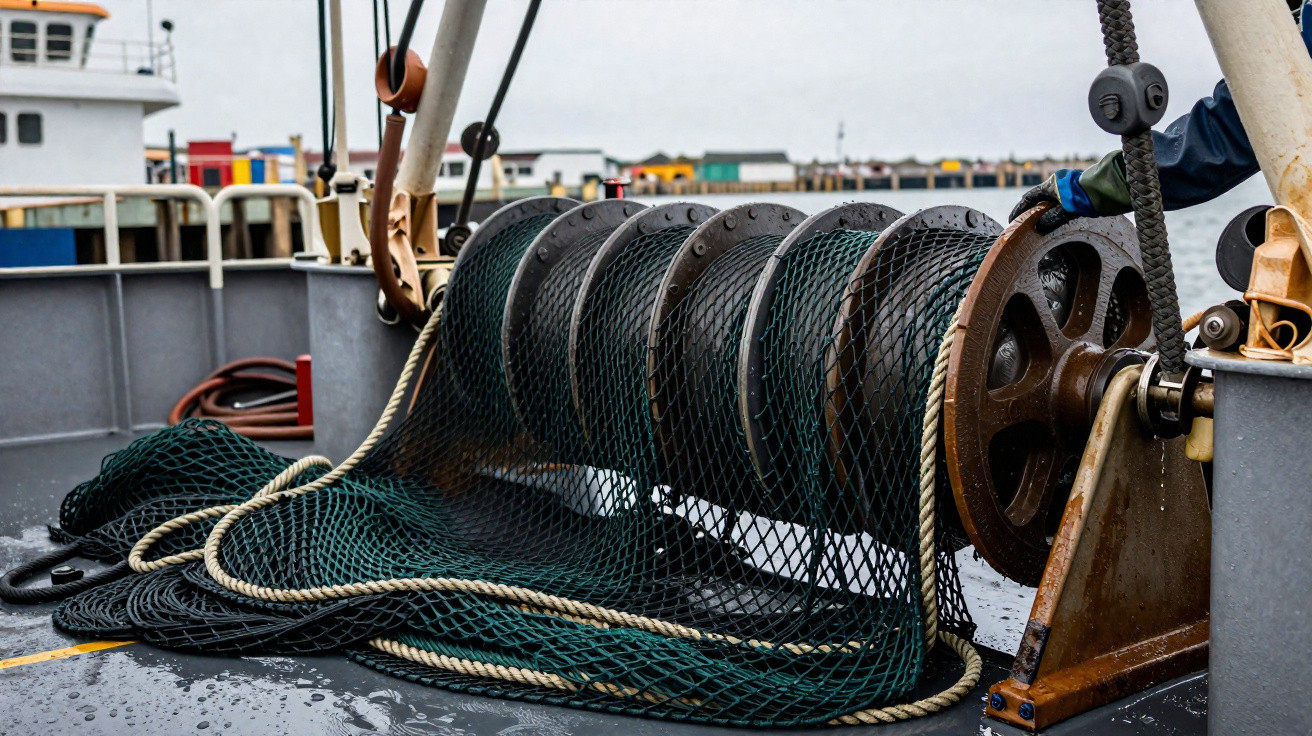
Hauling a full fishing net used to demand a large crew, exhausting physical effort and careful timing on a wet, moving deck. Mario Puratić, a fisherman from the Croatian island of Brač, helped change that work with the Power Block: a powered device that draws netting aboard continuously.
The invention did not make fishing safe or simple, and it did not remove the need for skilled crews. But it transformed one of the most punishing parts of purse-seine fishing and became influential on commercial vessels far beyond the Adriatic and the United States.
A fisherman from Sumartin
Mario Puratić was born in Sumartin on Brač on 23 June 1904, when the island was part of the Austro-Hungarian Empire. Today, Brač is part of Croatia.
He grew up in a community closely connected to farming, boats and fishing. That practical background is central to his story: the Power Block was not a laboratory concept later applied to fishing, but a response to a problem encountered by people working at sea.
Puratić emigrated to the United States in 1925. Like many migrants from the Dalmatian coast, he found work linked to maritime life and eventually worked in the west-coast fishing industry. Southern California’s fishing ports had sizeable communities of Croatian and Dalmatian migrants, and fishing knowledge travelled through those networks as well as through formal businesses.
The most useful inventions often begin with a simple question: which repeated job is making work harder than it needs to be?
Why hauling nets was so difficult
Purse-seine fishing uses a large net to surround a shoal of fish. The lower edge of the net is then drawn closed, rather like a drawstring, before the catch and netting are recovered.
Before powered hauling equipment was widely adopted, bringing a heavy wet net aboard could take a great deal of manual labour. Crews had to work around ropes, shifting loads, slippery decks and the movement of the vessel. A delay could also damage gear or disrupt the rest of the operation.
The challenge was not merely one of speed. Manual net recovery could mean:
- sustained strain for deck crew;
- greater exposure to ropes and moving loads;
- uneven handling of expensive netting;
- more time spent recovering gear before the vessel could continue fishing.
Puratić’s idea was to give crews a reliable powered grip on the net, allowing it to be brought aboard in a continuous flow rather than through repeated manual pulling.
The idea behind the Power Block
Puratić developed the early Power Block in the early 1950s. The device is broadly a powered hauling wheel or drum, mounted in a sturdy frame and positioned above the working deck. Its gripping surface pulls netting over the wheel while crew guide the net and stack it safely on board.
The principle sounds straightforward, but the equipment had to cope with wet, abrasive netting, salt water, heavy loads and constant use. A successful design also had to fit the practical realities of a fishing vessel, including lifting arrangements, deck space and maintenance.
How a powered net block operates
- The block is suspended above the deck from a boom or other suitable lifting arrangement.
- The net is fed over the powered wheel by trained crew.
- The wheel grips and draws in the netting at a controlled rate.
- Crew guide, arrange and inspect the net as it comes aboard.
The machine reduces the most repetitive hauling effort, but it does not make the crew unnecessary. Nets still need to be set, monitored, repaired, handled and stowed properly.
From working prototype to commercial equipment
Puratić’s invention became associated with the name Puretic Power Block, though “Power Block” became the familiar generic term for this kind of net-hauling equipment.
Marine-equipment manufacturers helped adapt and produce the idea for fishing fleets. The design spread through purse-seine fisheries because it addressed a common operational problem: how to recover large nets more steadily and with less reliance on manual hauling alone.
Modern systems vary widely. They may use hydraulic power, different wheel materials, improved controls and more comprehensive guarding. However, the central approach remains recognisable: a powered gripping surface moves the net aboard while a crew manages the gear.
Puratić did not eliminate hard work at sea; he changed how one particularly demanding task could be done.
Recognition in the United States
Puratić was named Inventor of the Year in the United States in 1975, recognition linked to the impact of his fishing technology. The award is frequently mentioned in accounts of his life, alongside his patents for fishing-related equipment.
His best-known invention also became a visible symbol of mechanised fishing. A fishing vessel using this type of net-hauling technology appeared on the reverse of Canada’s five-dollar banknote in the 1969 series. The note did not depict Puratić himself, but it reflected the importance of commercial fishing to Canada and the familiarity of the equipment by that period.
Claims about individual inventors can become simplified over time. Puratić’s achievement should be understood as an important practical development within a wider history of fishing machinery, vessel design and crew knowledge.
What the Power Block changed - and what it did not
Powered hauling equipment could alter the organisation of work on a vessel. In suitable operations, it could:
- reduce the number of people needed solely for manual hauling;
- speed up net recovery;
- make the hauling process more consistent;
- reduce some of the heaviest physical handling;
- support the use of larger purse-seine nets.
However, greater efficiency is not automatically environmentally beneficial. Fishing pressure, catch limits, bycatch, monitoring, enforcement and the health of fish stocks all remain important. Better machinery can increase a vessel’s capability, which makes responsible fisheries management more rather than less necessary.
Safety lessons from powered net gear
A Power Block can reduce physical strain, but it introduces serious entanglement, crushing and falling-load risks. Fishing machinery should be installed and maintained by competent people, and crews must follow the vessel’s procedures and applicable maritime safety rules.
Basic precautions around net-hauling machinery
- Keep hands, loose clothing and tools clear of moving netting and rotating parts.
- Use clear communication between the machinery operator and deck crew.
- Never reach into a running block or attempt to free a snag while equipment is operating.
- Inspect lifting points, hydraulic hoses, ropes, guards and emergency-stop arrangements before use.
- Keep the working deck as clear as practicable to reduce slips and trip hazards.
- Consider weather, vessel movement, visibility and fatigue before starting a haul.
Common mistakes when telling Puratić’s story
Several details in short online accounts deserve care.
- Treating the Power Block as a one-person miracle: Puratić’s contribution was significant, but commercial adoption also depended on manufacturers, boat owners and fishing crews.
- Assuming it made fishing safe: Powered machinery reduces some manual effort while creating new hazards around moving gear.
- Confusing the banknote image with a portrait: Canada’s five-dollar note showed a fishing scene, not Puratić.
- Ignoring the environmental context: The technology improved fishing operations, but sustainability depends on how fisheries are managed.
A practical legacy from Brač
Puratić died in California in 1993, but his connection with Sumartin remains an important part of how his life is remembered. His career is a useful example of innovation rooted in experience: he noticed a repeated hardship, understood the conditions in which a solution had to work, and developed a tool that crews could use at sea.
For anyone interested in engineering, fishing or working equipment, that is the enduring point of the Power Block. The best practical ideas are not always the most complicated ones. Often, they are the ones that make a difficult everyday job more manageable without losing sight of the people who must use the machine.






Comments
No comments yet. Be the first to comment!
Leave a Comment