
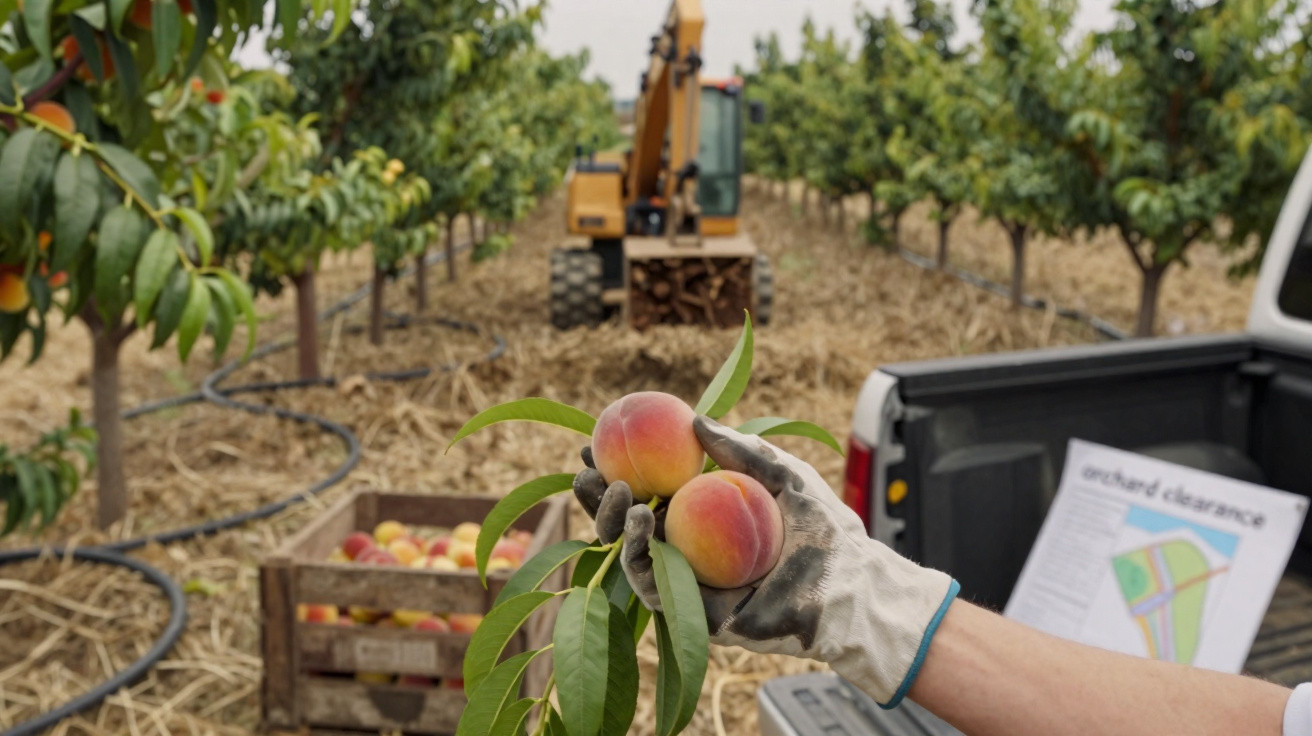
For a fruit grower, losing a major buyer is not like missing one order. Peaches ripen on the tree regardless, and the harvesting window is short. If there is no cannery ready to receive the fruit, growers can be left with a crop that is expensive to pick but difficult to sell.
That is why some California growers may consider removing peach orchards after cannery closures. It can look shocking to see healthy trees pulled out, but the decision is usually about a sudden loss of processing capacity, rising costs and the lack of a realistic market for a specialised crop.
What changed for California peach growers
Del Monte Foods announced plans to close processing plants in Modesto and Hanford, in California’s Central Valley, during its 2025 bankruptcy proceedings. For growers who had supplied those facilities, the news created immediate uncertainty over where future crops could be processed.
The Central Valley is an important growing area for canning peaches, often known as clingstone peaches because the flesh clings firmly to the stone. That characteristic is useful for tinned fruit, but it also means the crop is not always a straightforward substitute for peaches sold fresh.
A cannery needs to be ready at precisely the right time. It requires staff, delivery arrangements, sorting lines, cooking equipment, tins, storage and buyers for the finished product. Replacing that infrastructure is far more difficult than simply finding another customer.
A cannery closure does not only remove a buyer. It removes a time-sensitive route from orchard to shelf.
Why canning peaches cannot simply be sold fresh
It is understandable to ask why surplus fruit cannot be redirected to supermarkets, frozen-food businesses or food banks. In practice, those outlets have their own limits.
Fresh peaches are usually grown, picked and packed to different standards. Buyers may require particular varieties, sizes, colours, firmness and presentation. They also need packing houses, cold storage, transport contracts and established retail demand.
Other options can help at the margins, but they cannot necessarily absorb the volume formerly handled by a large processor:
- Freezing requires available factory space and suitable contracts.
- Juicing or puréeing depends on local processing capacity and product specifications.
- Exporting needs buyers, shipping arrangements and commercially viable prices.
- Food donation can support communities, but harvesting, packing and delivery still cost money.
- Leaving fruit unpicked may reduce harvesting costs in the short term, but it does not solve the longer-term problem of an orchard without a market.
For a crop bred around a particular industrial use, the loss of a processor can leave growers with few alternatives in the same season.
Why growers may remove productive trees
Removing a healthy orchard is not usually an impulsive choice. Peach trees take years to establish, and growers may have invested heavily in irrigation, pruning, pest management, machinery and skilled workers.
However, an orchard also has continuing costs. Trees need water, care and maintenance even when returns are poor. If a grower cannot secure a dependable buyer for future seasons, keeping the orchard may become harder to justify.
Tree removal can reduce the amount of fruit entering an already constrained processing market. It can also give the grower a chance to reconsider how the land is used, although planting an alternative crop brings its own costs and risks.
The decision usually follows three pressures
- Processing capacity falls. A closed cannery means fewer places able to receive and preserve fruit during harvest.
- Competition for remaining buyers increases. Other processors may have limited space, fixed supplier arrangements or insufficient demand for extra production.
- Future orchard costs remain. Growers must decide whether maintaining trees without a reliable outlet is viable.
The result is not necessarily that peaches are unwanted. It is that there may be too much fruit for the available local processing capacity.
An orchard can take years to establish, while a factory can disappear from the supply chain far more quickly.
What financial support can and cannot do
Public bodies and industry groups sometimes seek emergency assistance when a major buyer closes. Support proposals may include help with orchard removal, retraining, land preparation or other measures intended to reduce the immediate impact on affected farms.
But growers should not assume that an announcement means money is automatically available. The details matter: eligibility rules, funding limits, deadlines, environmental conditions and evidence of previous production can all affect whether a farm qualifies.
Any grower considering orchard removal should check the formal guidance from the relevant administering authority before booking work or changing land use. A scheme designed to contribute towards removal costs is also not the same as compensation for every lost contract, unsold crop or future loss of income.
The financial choice can be particularly difficult for family farms. Removing trees may reduce future costs, but replacement crops need capital, time, water and a credible route to market.
A cannery supports more than the orchard
The effects of closure can extend well beyond growers who delivered peaches directly to a site. Canneries support a wider chain of seasonal work and local businesses.
That network can include:
- hauliers moving fruit from farms during harvest;
- packing and maintenance workers;
- suppliers of tins, labels, machinery parts and farm inputs;
- irrigation and agricultural contractors;
- local shops and services that depend on seasonal employment.
This is why processing plants matter so much in agricultural regions. They turn a perishable crop into food that can be stored and sold over many months, while giving growers a planned destination for their harvest.
A change of ownership may preserve some activity, but it does not automatically mean that every former supplier, crop type or processing line will continue. Growers need clear contracts and delivery arrangements rather than assumptions based on a sale announcement.
Safety and environmental considerations in orchard clearance
Commercial orchard clearance is not a domestic gardening job. It may involve chainsaws, excavators, loaders, chippers and lorries, as well as irrigation infrastructure and overhead or underground services.
Before work begins, landowners should consider:
- locating irrigation lines, drains, cables and other buried services;
- checking for overhead power lines and maintaining appropriate exclusion zones;
- using competent, properly insured contractors and machinery operators;
- keeping workers, visitors and animals away from felling and loading areas;
- following local rules on burning, waste disposal, dust and air quality;
- assessing soil condition, pests and water needs before planting anything new.
Burning woody material can be restricted by local air-quality rules and weather conditions. It should never be treated as an easy disposal method without checking the applicable requirements. Machinery work can also compact soil, so the land may need careful restoration before a new crop is planted.
Common mistakes when discussing orchard removal
“The trees are being removed because nobody wants peaches.” Not necessarily. The issue is often a shortage of processing capacity for a particular type of peach in a particular region.
“Any buyer can take canning peaches.” No. Fresh, frozen and processed fruit markets have different varieties, quality requirements, equipment and supply arrangements.
“A new owner means the disruption is over.” A business sale may protect some operations, but growers still need confirmation of contracts, volumes, prices and delivery schedules.
“Removing trees fixes the problem straight away.” It may reduce future production, but it cannot replace income already lost or guarantee that a replacement crop will be profitable.
“Financial support covers every loss.” Assistance programmes usually have specific purposes and conditions. Growers should read the official terms carefully.
What happens next for affected farms
For growers, the immediate priorities are likely to be securing the best available outlet for fruit, reviewing contracts and understanding whether any assistance applies to their orchard. Decisions about removing trees should be based on realistic production costs, water availability, soil suitability and evidence of demand for any replacement crop.
For the wider food system, the closures underline a simple lesson: successful farming relies on more than a good harvest. It also depends on enough capacity to collect, process, store and sell what is grown.
Clearing an orchard can be a painful decision, especially after years of investment. Yet where a specialised crop has lost its main route to market, reducing production may be the least damaging option for some farms while they plan what comes next.




Comments
No comments yet. Be the first to comment!
Leave a Comment