
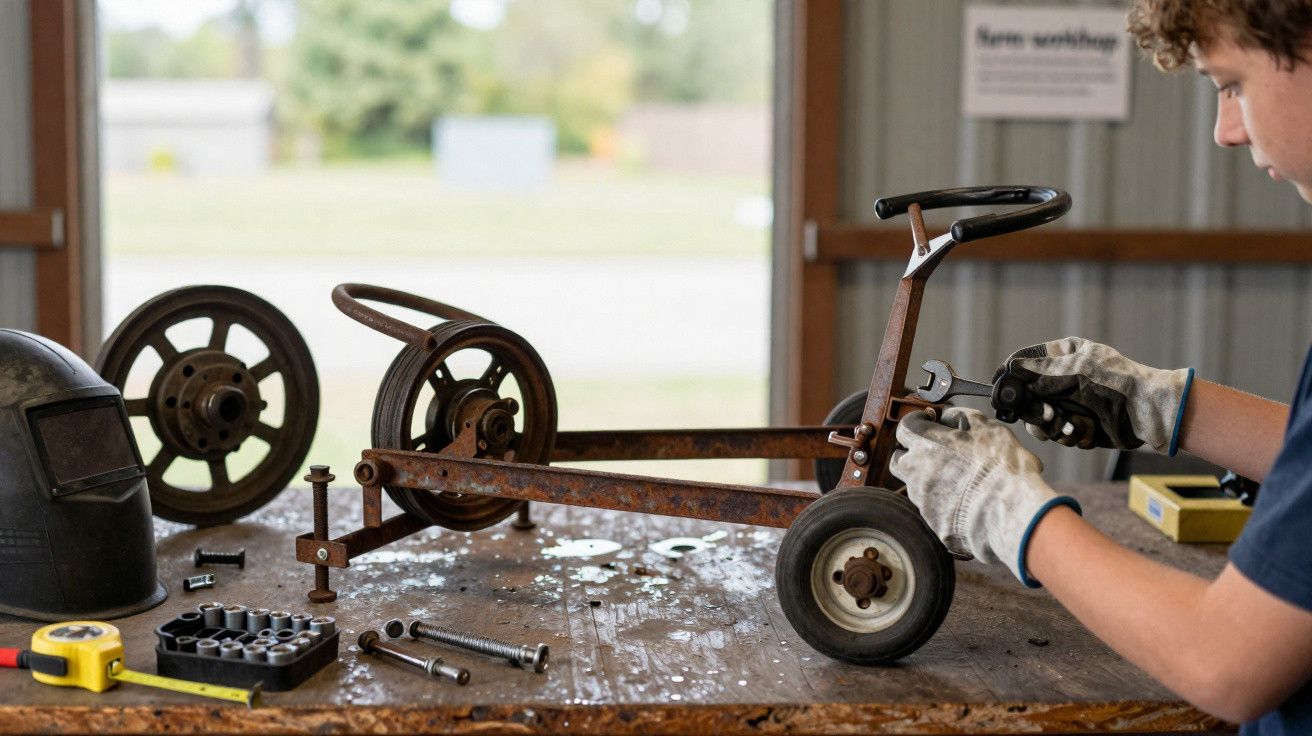
A broken mower, bent axle or old engine can look like nothing more than clutter. Yet, in the right hands, a discarded part can become the starting point for learning how machines work. The important trick is not simply saving scrap: it is sorting it carefully, checking what is safe to reuse and knowing when a job needs experienced help.
That is the useful lesson behind a tractor-like vehicle built by 14-year-old Thiago Príncipe in rural Argentina. His project drew attention from agricultural machinery professionals and led to a visit to a tractor manufacturing site. It is an impressive story of practical curiosity, but it is also a good reminder that homemade machinery must never be treated as a shortcut around proper engineering and safety checks.
A workshop project that attracted attention
Accounts of the project describe how Thiago built his machine from reclaimed materials, redundant machinery components and parts found around his family’s land near Río Cuarto, in Argentina’s Córdoba province.
The vehicle, known within the family as the Tractoneta, reportedly grew out of an earlier kart-style build. Parts came from machinery no longer in use and from damaged vehicles. The project was not about making every component from scratch; it was about identifying what could be repaired, adapted or safely discarded.
The machine was later shown at local agricultural and innovation events. That exposure led to an invitation to visit CNH Industrial facilities in Córdoba, where Thiago was able to see industrial agricultural-machinery production at close quarters.
A factory visit cannot turn a home project into a professionally engineered machine, but it can be hugely valuable for a young person. It shows why commercial equipment depends on drawings, tested materials, repeatable processes, inspections and safety systems.
A useful workshop is not one that keeps every old part. It is one that knows which parts are worth saving and which are not.
Why starting small matters
Thiago’s interest appears to have developed through smaller projects, including a kart and engine repairs, with support from family members. That gradual approach is the sensible one.
A driveable homemade tractor, buggy or kart is not an appropriate first project for most people, particularly children and teenagers. Steering, brakes, frames and fuel systems can fail with serious consequences, even at low speed.
A safer progression is to begin with low-risk tasks such as:
- learning the names and purposes of common hand tools;
- cleaning and sorting components with an experienced adult;
- repairing a non-safety-critical bracket, trolley or workbench;
- making a simple non-powered rolling frame;
- practising accurate measuring, marking-out and bolting;
- learning why guards, brakes and secure fixings are essential.
In the UK, school design and technology departments, Young Farmers’ Clubs, agricultural colleges, local machinery workshops and county shows can all offer useful routes into practical engineering. A patient mechanic, farmer or fabricator who explains why each stage matters is often more helpful than an online video alone.
Reclaimed does not mean ready to use
Reusing materials can reduce waste and make a project more affordable. It does not mean a part is safe simply because it looks solid.
Before fitting any salvaged component, it should be inspected for:
- cracks near welds, brackets, bolt holes and mounting points;
- heavy corrosion, especially on structural steel, wheels and brake components;
- bent shafts, damaged threads and distorted rims;
- worn bearings, loose steering joints and seized linkages;
- perished fuel hoses, hydraulic hoses and electrical insulation;
- unknown fluids, fuel residue, oil contamination or battery damage.
A dirty component may be perfectly serviceable once cleaned. A crack hidden beneath paint or rust can fail suddenly when the machine is under load. Anything involved in steering, braking, lifting, driving the wheels or containing fuel needs particularly cautious assessment.
In the UK, do not put waste oil, batteries, tyres, solvents or contaminated liquids in household bins, drains or bonfires. Check with your local authority recycling centre or a licensed waste contractor about suitable disposal arrangements.
The difficult parts are usually safety-critical
The front end of any small vehicle can be among the hardest areas to build well. It involves steering angles, wheel alignment, load paths and strong mounting points. A machine can look convincing while still being unsafe to move.
1. Frame and chassis
A frame must withstand vibration, twisting and uneven ground. Poor welds, thin steel or badly positioned joints can crack. Structural welding should be carried out or checked by someone competent in that type of work.
2. Steering and brakes
These are not areas for trial and error. Excessive steering play, weak linkages or unreliable brakes can quickly make a low-speed vehicle dangerous. Use proven components where possible and seek professional inspection before any testing.
3. Fuel and electrics
Fuel leaks, unprotected battery terminals, damaged wiring and hot exhaust components can cause fires. Electrical circuits need suitable fuses, secure routing and protection from heat, vibration and sharp edges.
4. Guards and moving parts
Chains, belts, fans, shafts and pulleys need effective guards. Loose sleeves, jewellery, long hair and even gloves can be caught in moving machinery. Never adjust, clean or inspect moving parts while an engine is running.
5. Stability
A homemade machine may be top-heavy or poorly balanced. Potholes, slopes, sudden turns, towing and carrying loads all increase the risk of overturning.
The most skilled decision in a workshop is recognising when a mechanic, fabricator or engineer needs to take over.
A safer way to develop an idea
For families supporting a young person’s interest in machinery, the aim should be a carefully supervised learning project, not a rush to create something driveable.
1. Define the purpose
Decide whether the project is a static display, a workshop trolley, a pedal-powered kart or a demonstration model. A clear purpose prevents unnecessary complexity.
2. Record the parts
Photograph and label recovered items. Note where each came from, its condition and whether an experienced person has approved it for reuse. Keep fasteners, bearings and electrical components organised separately.
3. Draw before cutting
Even a simple scale sketch can reveal problems early: a narrow wheel track, poor seating position, steering clashes or no room for guards. Measure twice before drilling, cutting or welding.
4. Build and inspect in stages
Inspect a static frame before fitting wheels. Check a rolling chassis before adding an engine. Any powered testing should be carried out only by a competent adult, in a suitable controlled area, with others kept clear.
5. Keep a build record
Photographs, sketches and notes make it easier to trace faults, explain decisions and present the project at a school or agricultural event.
Common mistakes with recycled machinery projects
Enthusiasm is useful, but it can lead to avoidable risks. Common mistakes include:
- using unknown or corroded steel for a load-bearing component;
- welding near fuel tanks, batteries, tyres or flammable residues;
- assuming that an engine is safe because it starts;
- adding guards only after the rest of the machine is built;
- working alone with heavy parts, jacks, grinders or cutting equipment;
- testing a homemade vehicle on a road, pavement or public track;
- letting social-media attention push a project beyond the maker’s skills;
- treating road-going components as simple bolt-on parts without understanding their correct installation.
Do not mix cleaning products. In particular, never mix bleach with acids, descalers or ammonia-based cleaners, as hazardous fumes can be produced. Use solvents and degreasers with ventilation, suitable gloves and eye protection, following the product label.
Young people should not weld, grind, cut metal or handle fuel systems without close adult supervision and appropriate protective equipment. Fire extinguishers, a clear work area and a plan for safely dealing with spills are basic workshop precautions.
Keep homemade vehicles away from public roads
A machine built for a workshop, field demonstration or school project is not automatically suitable for use on public roads. Road use can involve registration, construction standards, insurance, lighting and other legal requirements.
Do not assume that fitting lights or an alarm makes a homemade vehicle road-ready. If there is any possibility that a vehicle could be used beyond private land, seek advice from a qualified professional and check current requirements with the relevant UK authorities.
From curiosity to engineering skills
Thiago’s factory visit matters because it links hands-on making with the wider world of engineering. Agricultural machinery involves far more than joining metal together: designers and technicians consider materials, quality control, operator protection, electronics, emissions requirements, servicing and testing.
For young people in the UK, an interest in repairing machinery can lead towards fabrication, agricultural vehicle maintenance, precision farming, electronics, CAD design, parts supply or dealership support. A small repair or carefully documented school project may be the first indication of where someone’s practical strengths lie.
The Tractoneta is a striking example of youthful resourcefulness. Its real value is not the suggestion that scrap can replace professionally designed machinery. It is the reminder that curiosity deserves encouragement when it is paired with patient supervision, proper tools and respect for risk.
Start with a small job, ask an experienced person to inspect it and treat every safety system as essential. That is how old parts can become the beginning of genuine engineering skills.






Comments
No comments yet. Be the first to comment!
Leave a Comment