
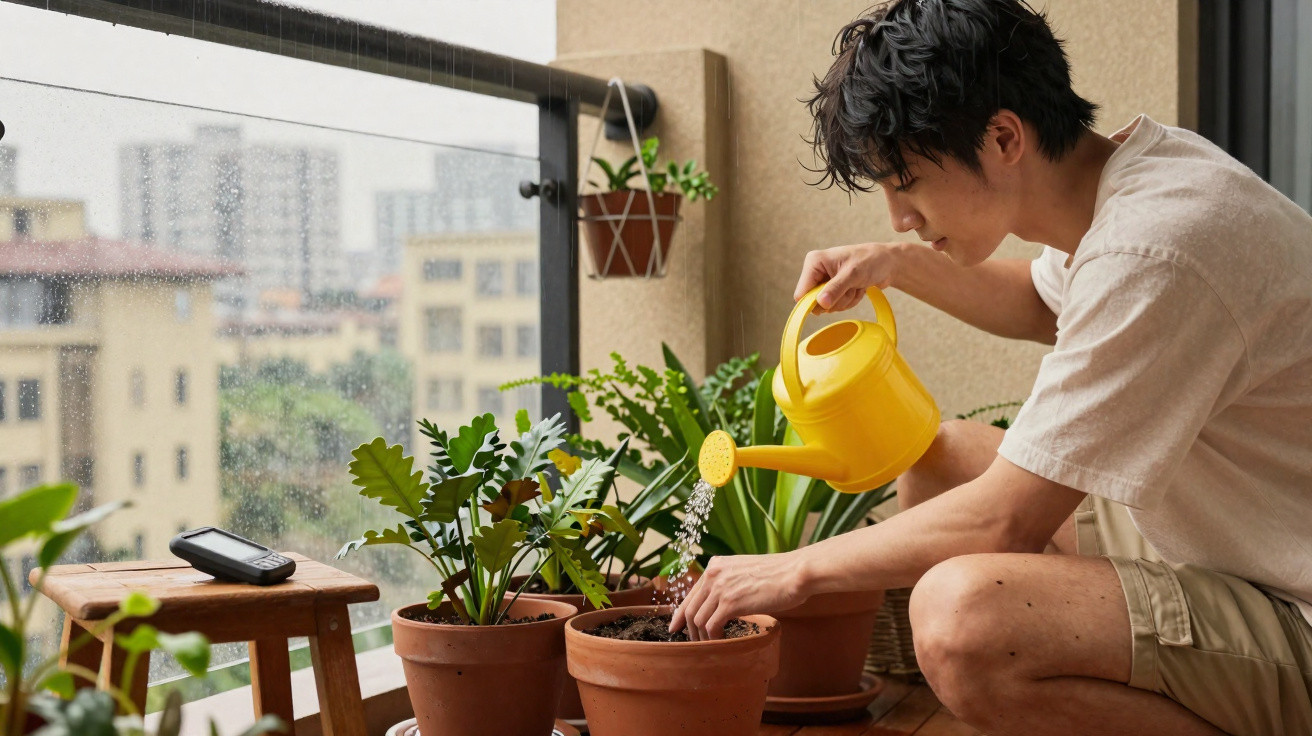
Many amateur gardeners relax the moment dark clouds roll in. The sky opens up, so there’s no need to water any more - or so the common assumption goes. But anyone who leaves beds and containers entirely to rainfall can end up with the opposite problem: hidden drought stress. The crucial question - and one that’s underestimated in countless gardens - is this: how much of that water actually reaches the roots?
Why a downpour doesn’t necessarily mean a full water reserve
The false sense of security after a thunderstorm
As soon as spring brings thunder and lightning, the gardening world breathes out. At last, rain - at last, a break from hauling the watering can around. Afterward, everything looks drenched: paths gleam, patio slabs shine, and the beds appear nicely soaked. That’s exactly where the misunderstanding begins.
A heavy, brief burst of rain can look dramatic, yet it often wets the soil only on the surface. The reason is simple: drops hit with force onto ground that’s frequently still cool, hard, or compacted. Instead of soaking in gradually, the water rushes across the top. It pools in low spots, runs towards drains, or disappears over the edge of the bed.
What matters isn’t how wet the surface looks, but how damp the soil is five to ten centimetres down.
A gentle, steady rainfall lasting several hours is far more useful than a spectacular shower. Even, consistent amounts give the soil time to absorb water instead of channelling it away.
Why soil often repels rain
In gardens with heavy, clay-rich soil or badly compacted ground, rainwater struggles to get where it’s needed. The surface can behave almost like it’s sealed:
- heavy drops “cap” and compact the top layer
- water forms puddles and runs off sideways
- deeper layers stay surprisingly dry
Even more troublesome is potting compost in containers or raised beds that has dried out completely. Over time it can become water-repellent. When you water - or when it rains - the water then runs down the inside wall of the pot and out through the drainage holes. The root ball in the middle remains dust-dry.
The “umbrella effect”: when leaves shield the soil from water
How dense foliage keeps the ground dry
In lush beds and borders, thick greenery quickly forms a kind of roof. Broad leaves on perennials, ornamental shrubs, or vegetable plants divert droplets outwards. It may look idyllic, but it has a deceptively risky consequence: almost nothing reaches the soil right at the base of the plant.
This umbrella effect creates unexpectedly dry patches beneath plants that otherwise look magnificent. If, after two rainy days, you scrape back a little soil beside a bushy shrub or a strong tomato plant, you’ll often find something surprising: the top is slightly damp, but just a few centimetres down it’s dusty.
Dense foliage doesn’t just block sun - it often blocks the rain too, precisely where the most important roots sit.
Hidden drought stress in the bed
These dry zones are easy to miss. At first the plant still looks fine; perhaps the leaves droop only a little. Many gardeners put that down to temperature swings or wind. In reality, the plant may already be fighting for every last drop.
Roots under long-term stress weaken the whole plant. Growth slows, susceptibility to fungal diseases and pests increases, and the plant becomes more sensitive during heatwaves. Particularly affected are:
- dense perennial clumps
- hedges and shrubs with lots of leaf mass
- vegetables with large leaves such as pumpkin, courgette, or rhubarb
Why balcony plants often miss out when it rains
Architecture as a hidden water blocker
On balconies and terraces there’s another factor: the way the building is constructed. Overhangs, floors above, railings, and awnings shield a large proportion of rainfall. Drops rarely fall straight down; wind swirls them around - and they end up everywhere except in the trough on the wall.
From indoors, everything looks wet: paving slabs shine and the railing drips. Yet right by the façade or under the eaves, the compost in the planter can still be dry. It’s especially critical with narrow balcony boxes positioned directly beneath an overhang.
Why potted plants dry out so quickly
Plants in pots or containers have only a limited volume of compost available. Their roots can’t retreat into deeper, cooler layers. At the same time, the containers are exposed to wind on all sides, which effectively pulls moisture out of the compost.
Rainy air alone isn’t enough for potted plants - without targeted watering, the root ball is often dry again before the sky has even cleared.
Even after days of drizzle, the centre of a larger tub can remain dry if only the rim gets any moisture. If you rely on the damp atmosphere, you can quickly lose sensitive balcony flowers or herbs.
How to check reliably whether rain really was enough
The finger test: simple and surprisingly effective
To avoid being misled by appearances, you don’t need an expensive meter. The classic finger test provides remarkably dependable results. The method is straightforward:
- push a finger two to five centimetres into the soil
- assess the feel: cool and moist, or warm and crumbly?
- look at your finger: do bits of soil cling, or does it all fall away dry?
If the soil feels cool and lightly sticks together, you can leave the watering can alone. If it feels warm, dusty, or falls apart when squeezed, it’s time to water - even if it’s pouring down.
Lift the pot instead of guessing
For container plants and balcony boxes, a second test is extremely practical: weight. If you regularly lift your pots, you quickly learn what “full” and “empty” feels like in terms of water stored.
- heavy = compost well moistened, no urgency to water
- unusually light = root ball dry, water now
This simple habit saves water because you won’t automatically water after every shower - and it also prevents plants from languishing in hidden dryness.
Why it can be worth watering right in the middle of rain
When humid air helps revive old compost
The idea of walking through the garden with a watering can while it’s raining can feel absurd. In some situations, though, it makes a surprising amount of sense. Humidity is high, evaporation is limited, and plants are already in “water uptake mode”.
Old potting compost that has dried out badly benefits in particular. It starts to accept water again more readily because the surrounding air isn’t pulling additional moisture away. If you water now with tempered, ideally collected rainwater, you help the root ball slowly rehydrate rather than letting water bead and run off.
Water precisely where rain never reaches
Wet weather is an ideal time to supply problem spots on purpose. These include:
- plants directly under roof overhangs
- perennials and shrubs with extremely dense foliage
- containers tight against walls or in house corners
In these areas, it’s worth taking the watering can straight to the root zone and watering slowly until the soil is visibly moistened through. Thanks to the already high humidity, more of the water you add actually stays in the soil.
How rain and the watering can work together at their best
If you know your garden and balcony well, you use rain not as a replacement, but as a partner to your own watering. Covered corners need targeted support, while open beds benefit from long, gentle spells of rain. Dense plantings should be checked after rainfall rather than judged only from the outside.
With a few simple actions - the finger test, lifting pots, and looking under the leaf canopy - you can quickly tell where the sky has done the job and where a helping hand is needed. That way, gardeners save water, protect vulnerable plants from drought stress, and make sure moisture ends up exactly where it’s required: at the roots.
Comments
No comments yet. Be the first to comment!
Leave a Comment