
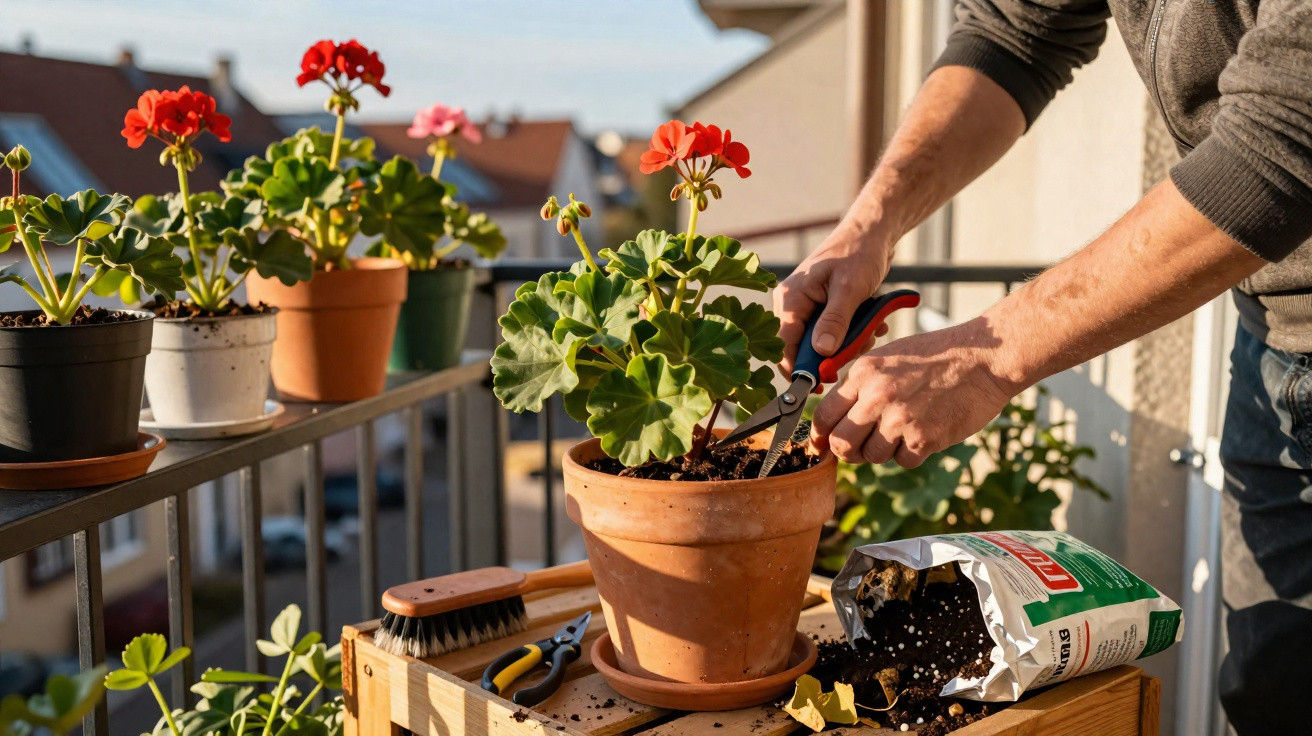
While most balconies appear dormant in January, certain neighbours somehow have geraniums spilling over by May.
Their advantage begins now.
The bright window boxes seen in early spring are rarely down to expensive fertiliser or a rushed trip to the garden centre. More often, they belong to gardeners who have quietly tended their pelargoniums – better known as geraniums – through winter, while everyone else has stopped thinking about them.
Why winter is not a complete rest for geraniums
Cold conditions slow a plant down, but they do not switch it off. Even in January, a frost-free geranium remains slightly active beneath the surface. Its roots continue taking up small amounts of moisture, while sap moves slowly enough to keep the plant’s tissues alive.
Think of a wintering geranium as a phone on low-power mode: screen dimmed, apps closed, but still using battery.
When that “battery” is spent supporting dead stems, damaged foliage or decaying blooms, valuable reserves are wasted. Instead of being held back for spring, energy is gradually used to sustain growth that serves no purpose.
This is why experienced gardeners take a firm approach. They regard every winter as a budgeting period for their plants, ensuring nothing is spent on growth that will not matter in April.
The January tidy-up that makes all the difference
Skilled balcony gardeners often choose one particular time: a dry day around the middle of January. This is when they carefully clean every pot of geraniums.
Removing all dead leaves and faded flowers in winter frees the plant to concentrate on future shoots, not past growth.
It is not simply a matter of appearance. Old material left on a plant over winter provides ideal conditions for fungal disease, particularly where the air is damp and stagnant. Brown, soft leaves hold moisture against both stems and compost, allowing grey mould to establish itself. By the time fluffy patches are visible, the problem has already progressed.
Removing this debris promptly delivers two benefits at the same time:
- Hygiene: it removes the places where fungi and rot can take hold.
- Signal: the plant stops attempting to support dying tissue and can send resources towards dormant buds.
Gardeners who keep up this winter practice often find their plants “wake up” more quickly as daylight increases. Rather than producing thin, sprawling stems, they develop sturdy, compact new shoots.
How to prune geraniums in winter safely
Any winter work on plants needs a careful hand. Rough pulling and tearing can be more harmful now than during summer, when the plant is growing strongly.
Tools and essential steps
Begin with suitable equipment and work steadily:
| Step | What to do | Why it matters |
|---|---|---|
| 1. Prepare tools | Choose sharp secateurs or scissors and wipe them with alcohol. | This avoids transferring viruses or fungal spores from one plant to another. |
| 2. Remove dead leaves | Snip off yellow or brown leaf stalks, leaving roughly 5 mm above the main stem. | It prevents damage to the main stem and limits possible disease entry points. |
| 3. Cut old flower stems | Remove every dried flower stalk missed during autumn deadheading. | This prevents decay and improves the plant’s overall shape. |
| 4. Check for rot | Examine the base; where a stem is black or soft, cut it back to sound green tissue. | It eliminates concealed rot that could spread through the crown. |
| 5. Clear the centre | Thin congested areas so light and air can reach the centre of the clump. | This helps the base stay leafy instead of becoming bare and woody. |
Make every cut neat rather than ragged. Avoid pulling leaves away with your fingers, however tempting it may be. Tugging can peel the outer layer from a stem, creating small unseen injuries that may later allow infection in.
Redirecting sap: the subtle benefit of winter pruning
The value of this midwinter routine lies in the way it alters the plant’s internal priorities. Each dying leaf remains a “consumer”, drawing on water and nutrients. Taking it away ends that demand.
By cutting out energy-draining tissues, you nudge the plant to store power in roots and dormant buds instead.
This redirection brings hormonal changes within the stems. Once geraniums are no longer burdened with needless maintenance, they begin accumulating resources in their nodes – the points where fresh shoots emerge. As daylight becomes stronger and temperatures climb, those stored supplies support rapid new growth.
Many experienced gardeners discreetly avoid elaborate “growth stimulators”, relying instead on good hygiene and well-chosen timing. It is inexpensive, uncomplicated and generally more dependable than another bottle bought from a garden centre shelf.
January also provides an early warning check
Winter cleaning offers another useful advantage: it makes you inspect every plant properly. This is often when early signs of pests become apparent.
Once a geranium has been tidied, it is far easier to notice:
- small groups of green or black aphids around soft new tips
- little white, woolly clusters indicating mealybugs
- sticky honeydew, which suggests sap-feeding insects are present
At this still point in the year, infestations are normally minor. Mild treatments, including a spray of diluted black soap or insecticidal soap, can often resolve them without the use of stronger chemicals. A pest-free plant entering spring can devote more of its energy to flowering instead of defending itself from attackers.
Preparing a balcony for early flowers
Using the “old hands’” approach changes the way you view gardening altogether. Winter stops being a blank period and becomes preparation for the season ahead.
The difference between a shy flush of flowers in June and a showy display in May often starts with 20 minutes of care in January.
For still better results, pair the winter tidy-up with several additional habits:
- Keep compost only just moist rather than wet, to prevent root rot.
- Protect plants from severe frost in a porch, unheated room or cold frame.
- Turn containers occasionally so that every side receives the limited available light.
With these modest measures, geraniums do not stagger into spring tired and leggy. Instead, they reach it rested, clean and prepared to react as soon as warmth and light return.
Why pelargoniums respond especially well to this method
Technically, the vivid balcony “geraniums” grown by most people are pelargoniums, which originate in South Africa. Their native climate includes cooler, drier spells followed by periods of vigorous growth when conditions improve.
That history explains their strong response to winter discipline. Trimming spent growth during their resting phase and keeping them relatively dry recreates the stress-and-release pattern to which they are adapted. When light levels rise, they quickly produce new leaves and flower stems, particularly if given a light feed in early spring.
Practical situations: if autumn maintenance was missed
Many gardeners arrive in January to find pots packed with brown sludge and tangled stems because autumn became too busy. However, the situation is not beyond recovery. A cautious midwinter session can still make a real improvement.
If plants are looking neglected:
- First remove only material that is clearly dead, mouldy or soft.
- Do not carry out major reshaping during severe cold; save substantial structural pruning for early spring.
- Inspect the roots by carefully easing one plant from its pot. White, firm roots suggest the plant still has good prospects.
Even this gentler treatment improves hygiene and helps the plant settle, despite missed opportunities earlier in the year. Flowering may start a little later, but the eventual display can still be abundant.
Balcony gardening as gradual planning, not a last-minute rush
A single quiet midwinter afternoon spent with secateurs can transform how you approach an outdoor space. Rather than hurrying to purchase ready-grown plants in May, you work with the seasonal cycle: allowing geraniums to rest, helping them remain healthy and then releasing their stored vigour at the right time.
For compact urban balconies and rented flats, where each pot needs to justify its space, this winter habit works much like financial planning for flowers. You remove avoidable costs – dead leaves, unhealthy stems and hidden pests – so that when spring arrives, the saved “budget” can be directed towards one result: a long-lasting, colourful display.


Comments
No comments yet. Be the first to comment!
Leave a Comment