
No plant jungle required.
Many city dwellers want exactly that: a compact outdoor space that is not crowded with pots yet still smells richly of summer. Rather than filling it with countless lavender, jasmine and rose plants, remarkably little is needed. With smart planning, one plant can create more fragrance than half a dozen containers.
The overlooked fragrance powerhouse for balconies and patios
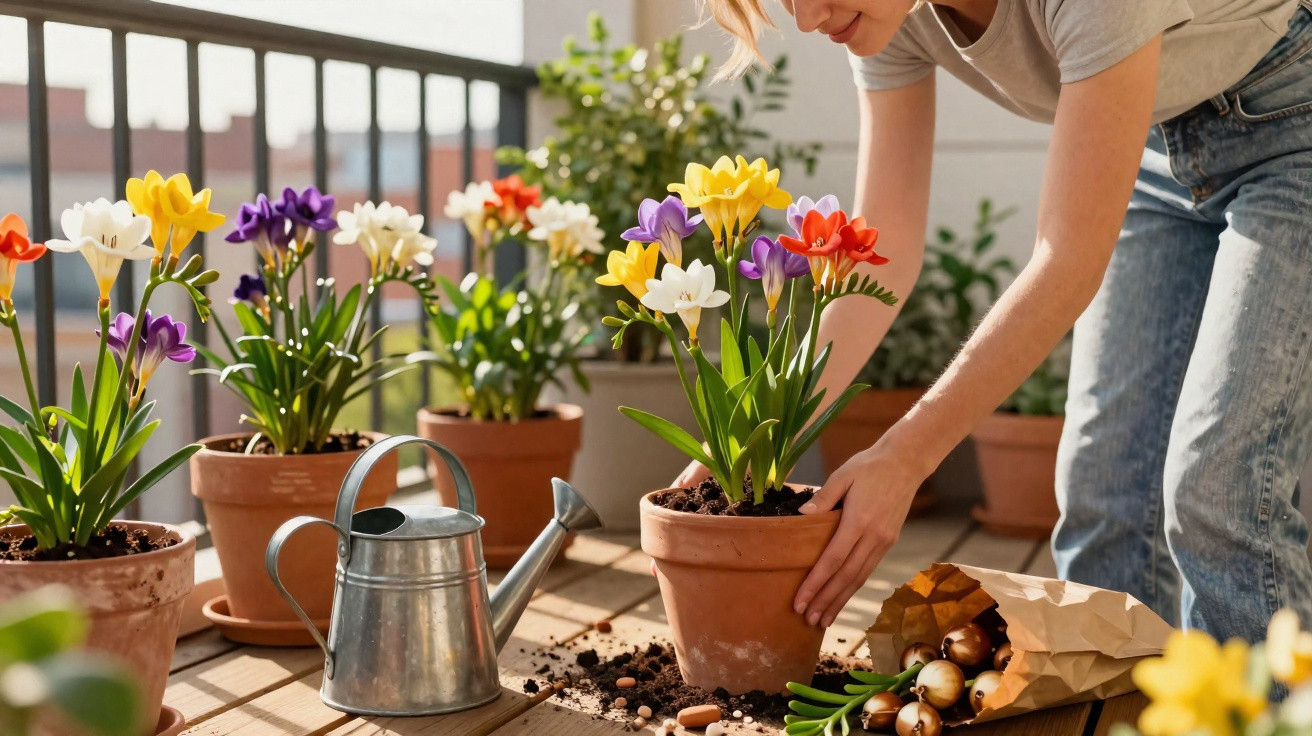
The quiet star here is the freesia. Botanically known as Freesia, it originates in southern Africa and is now a staple in countless perfumes. Its scent evokes a blend of honey and citrus: fresh and gently warm, without being heavy or overpowering.
“Just a few pots of freesias can perfume a small balcony so strongly that it feels like sitting in a flower shop.”
The plant produces long, gently curving stems, with its small trumpet-shaped flowers arranged along one side. Depending on the variety, flowers may be white, yellow, pink, red or violet, often with subtle colour gradations. Many balcony gardeners select flowers mainly for their appearance – but anyone who has smelled a flowering freesia tends to choose with their nose from then on.
Why freesias have such an intense scent
Freesias are among the most strongly scented bulb and corm plants. Their flowers contain essential oils which are warmed by the sun before being released into the air. In a confined setting, such as a city-centre balcony, this fragrant veil can seem to linger in place.
Their flowers also open one after another along each stem. Instead of delivering a brief burst of bloom, they often flower for several weeks. The scent therefore remains noticeable for a long period, without the need to keep buying replacement plants.
How to plant freesias in pots for maximum fragrance
Preparing the pot properly makes the difference between success and disappointment. Freesias grow from corms – technically, corms with a protective covering – and thrive in airy, freely draining conditions.
Choosing the right pot size and compost
- Pot size: At least 20 to 30 centimetres deep, with enough width to accommodate several corms.
- Compost: A loose, well-draining growing medium, for example:
- 50% multipurpose or planting compost
- 25% sand
- 25% light organic material, such as compost or bark humus
- Drainage: A layer of clay pebbles or gravel at the bottom of the pot helps prevent waterlogging.
A pot around 15 centimetres in diameter will hold five to seven corms. Plant them around three to five centimetres deep, with the pointed end facing upwards, and leave roughly five to six centimetres between each one. This will later create a dense, almost shrub-like cluster of flowers.
The best time to plant
The ideal planting date depends greatly on the climate:
| Region | Planting time | Note |
|---|---|---|
| Mild areas without severe frost | Spring or a sheltered autumn planting | Corms can often remain in their pots |
| Areas where frost falls below −3 to −4 °C | Spring, after the last frosts | Summer flowering; store corms afterwards |
When freesias are planted in spring, the first flowers can be expected around ten to twelve weeks later. For many balcony owners, this fits perfectly with the main season from June to August.
The ideal position on a balcony or patio
Freesias love light. For abundant flowering, they need around six hours of direct sunshine daily. Partly sunny positions can also work, provided they are not too shaded.
- Position: Sunny to lightly shaded, warm and sheltered from wind.
- Placement: Close to the balcony or patio door, beside seating, or beneath a window – anywhere you spend time regularly.
- Wind protection: Place them in corners, against walls or beside taller containers, so their delicate stems do not snap.
“Place the pots near a door and, each time it opens, you walk straight through an invisible cloud of fragrance.”
Watering, feeding and supporting healthy plants
After planting, moisten the compost thoroughly. From then on, keep it evenly damp but never saturated. Allow the top layer to dry slightly before watering again. Waterlogging quickly causes the corms to rot.
For strong flower stems, many gardeners recommend a potassium-rich fertiliser. Feeding once every two weeks during the bud-forming and flowering period is entirely sufficient. A controlled-release fertiliser is also suitable, as long as it is formulated for flowering plants.
The long, elegant stems may look delicate and can bend in strong wind or under the weight of full bloom. A few slim canes or a small circular plant support in the pot will keep plants upright without spoiling the overall look.
Saving freesias through winter and enjoying them every year
In colder areas, freesias are not reliably hardy. Anyone living where frosts are more severe should save the corms once the season ends.
- Do not cut the leaves back immediately after flowering; allow them to turn yellow naturally.
- Reduce watering gradually until the compost is almost dry.
- Lift the corms from the pot after the first light frosts.
- Gently shake off the compost and store them dry, for instance in cardboard boxes or mesh bags.
- Keep them somewhere cool and dry, ideally between 4 and 10 degrees.
The following spring, plant the corms into fresh compost and begin the fragrance season again. What starts as a one-off purchase can therefore become a lasting summer ritual.
How many pots you actually need
Most balconies are not roof gardens; they tend to measure more like five to ten square metres. This is precisely where freesias excel. Rather than filling every available centimetre with plants, three to five densely planted pots, positioned strategically, are often enough.
One possible arrangement:
- One larger pot directly beside the balcony door.
- Another next to the table or seating area.
- A smaller pot on the railing or on a stool at nose height.
This layout spreads fragrant pockets throughout the outdoor area without making the balcony look like a greenhouse. If you already have other flowering plants, simply place freesias among them – they occupy little room but provide plenty of aroma.
Common mistakes that reduce the fragrance
Many problems are easy to avoid once you know about them:
- A position that is too shady: This leads to few or no flowers, and therefore no scent.
- Compost that is too wet: Corms rot, while shoots stay weak or fail to appear altogether.
- No nutrients: Plants grow but produce only a small number of flower stems.
- Pots that are too small: Compost dries out too quickly, putting plants under stress.
Keeping these points in mind gives you a good chance of having a balcony that smells of summer, holidays and perfume after only a few weeks – without constant watering or pruning.
Other ways to enjoy freesias
There is an added benefit: freesias make excellent cut flowers. Individual stems can be cut easily and placed in a vase on the kitchen table, without noticeably reducing the fragrance outdoors. Depending on pot size, enough flowers will remain on the plant to keep scenting the balcony.
Those who enjoy experimenting with plants can also combine freesias with more subtly scented varieties, such as grasses, petunias or small citrus plants. This creates a cohesive display in which the freesia takes on the role of invisible perfume.
For people with little space, limited time and a strong love of fragrance, this plant is a highly practical insider tip: a few corms, a sunny spot and some care – and the balcony feels like a small summer lounge with its own built-in fragrance system.
Comments
No comments yet. Be the first to comment!
Leave a Comment